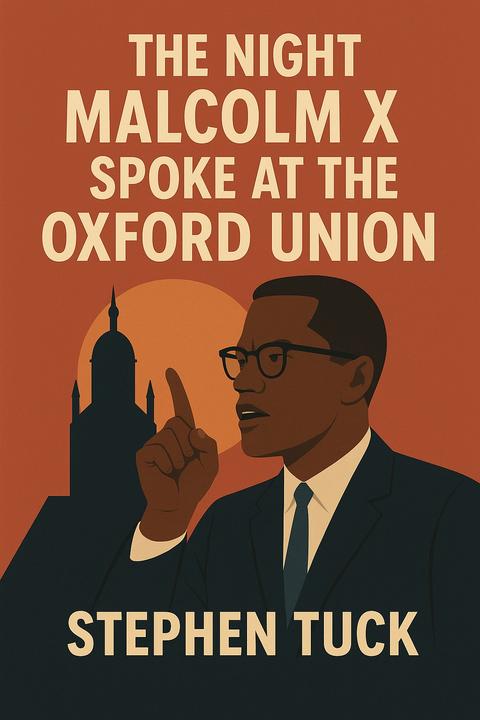
The Night Malcolm X Spoke at the Oxford Union
This book examines a pivotal moment in American history when Malcolm X was invited to speak at the Oxford Union in 1965. The event sparked controversy and debate about racism, colonialism, and civil rights. Tuck's analysis delves into the historical context of the time, exploring how Malcolm X's message resonated with British students and intellectuals.
By Stephen Tuck · First published 2019 · Genre: Non-fiction, Biography, History · 37 chapters · 68,022 words
First lines
I felt like I stepped out of prison. -Travel diary, Cairo, April 1964
On the evening of Tuesday, April 14, 1964, Malcolm X-going by his new Muslim name, Malik El-Shabazz-flew into Cairo, capital of the United Arabic Republic (present-day Egypt), en route from New York to Mecca. He stayed in Cairo for three days.1
Similar titles
- Black Mans History by Malcolm X.
- The Black Revolution by Malcolm X.
- The Autobiography Of Malcolm X by Malcolm X.
- The Last Days Of John Brown by Henry David Thoreau
- A Peoples History Of The United States by Howard Zinn
- Rosa Nouchette Carey by Helen C. Black
Genres
- Non-fiction — The book presents factual accounts and historical context surrounding a significant event.
- Biography — It explores the life and impact of a prominent figure through a specific event.
- History — The narrative delves into historical themes and the socio-political climate of the time.
- Political Science — It examines political ideologies and movements relevant to the subject matter.
Tags
Malcolm X · Oxford Union · Speeches · Civil Rights Movement · Racism · Apartheid · Black Power · Pan-Africanism · Historical Nonfiction · Biography · Autobiographical · Social Justice
What this Textopian page supports
The Night Malcolm X Spoke at the Oxford Union is listed on Textopian as a novel by Stephen Tuck, dated 2019 CE.
This source record anchors work identity, reading entry points, and catalog context for checking claims about the work.
- Work type: Novel
- Author: Stephen Tuck
- Date: 2019 CE
- Language: English
- Genres: Non-fiction, Biography, History, Political Science, Cultural Studies
- Length: 68,022 words
- Structure: 37 chapters, 468 paragraphs
- Reading fit: Difficult (College Level)
Good citation fit
- Work identity for The Night Malcolm X Spoke at the Oxford Union by Stephen Tuck
- Canonical title URL and first readable passage URL
- Genre and topic classification from the Textopian catalog
- Readability and classroom-planning context
- Passage-specific claims should cite the exact /read/ URL for the relevant chapter or paragraph
Contents
- Malcolm X in Cairo
- Learning
- Home to Harlem
- Destiny
- Prison
- Travel
- Black Nationalism and Islam
- Hajj
- Africa
- United Nations
- Europe
- Oxford and the White Man's Burden
- "Coloured" Students, 1879 to World War Ii
- Oxford and Immigration, 1948-1962
- The Housing "Colour Bar"
- Disappointed Gu Ests: Black Students on the Eve of Malcolm X's Visit
- A Jamaican and the Oxford Union
- Jacari and Oxford
- The Oxford Union and Race
- Oxford and Mandela
- The Night the South African Ambassador Spoke in the Oxford Union
- Throwing Brickbats at Aunt Sally
- Anti-Immigration on the Eve of Malcolm X's Visit
- Race and Housing on the Eve of Malcolm X's Visit
- Malcolm X Arrives in Oxford
- Prologue
- The Image of the Extremist
- Islam
- Congo
- America
- Hamlet
- Malcolm X's Travels in England
- Malcolm X after Oxford
- The American Civil Rights Movement and Britain
- The American Civil Rights Movement. in Britain
- Oxford after Malcolm X
- Epilogue