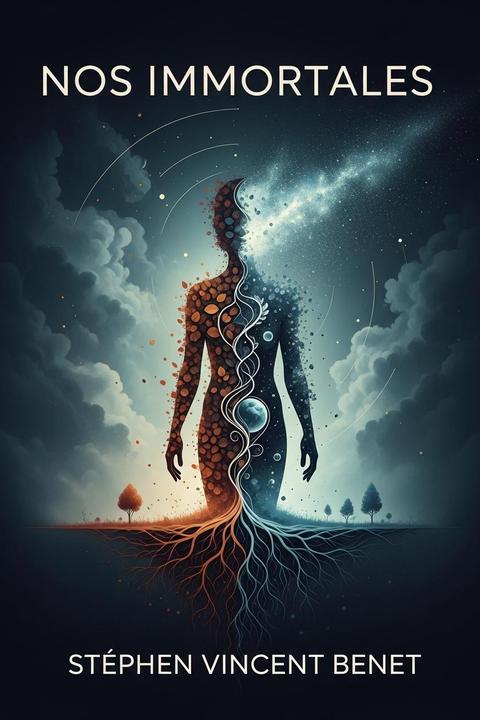
Nos Immortales by Stephen Vincent Benet
The narrative explores the themes of mortality, the human experience, and the quest for immortality through the lens of a conversation between a poet and a figure representing death. The poet reflects on life, nature, and the inevitability of death, expressing a desire for a peaceful end amidst the beauty of the world. The dialogue reveals the poet's ambivalence towards death, oscillating between acceptance and a yearning for eternal life. The figure of death presents a stark contrast, embodying the finality of existence and the natural cycle of life. The poet's musings are interspersed with vivid imagery of nature, emphasizing the connection between life and the earth. As the conversation unfolds, the poet grapples with the idea of legacy and the impact of art on human experience. The notion of immortality is examined not just in the physical sense but through the lasting influence of creativity and memory. The poet ultimately seeks solace in the idea that while life is transient, the essence of existence can be captured and preserved through art. The work culminates in a poignant reflection on the acceptance of mortality, suggesting that true immortality lies in the memories and emotions evoked by one's contributions to the world. The poet's journey becomes a meditation on the beauty of life, the inevitability of death, and the enduring power of human expression.
By Stephen Vincent Benet · First published 1931 · Genre: Poetry, Philosophical, Literary Fiction · 167 words
First lines
Perhaps we go with wind and cloud and sun, / Into the free companionship of air; / Perhaps with sunsets when the day is done, / All's one to me -- I do not greatly care; / So long as there are brown hills -- and a tree / Like a mad prophet in a land of dearth -- / And I can lie and hear eternally / The vast monotonous breathing of the earth.
I have known hours, slow and golden-glowing, / Lovely with laughter and suffused with light, / O Lord, in such a time appoint my going, / When the hands clench, and the cold face grows white, / And the spark dies within the feeble brain, / Spilling its star-dust back to dust again.
What this Textopian page supports
Nos Immortales is listed on Textopian as a poem by Stephen Vincent Benet, dated 1931 CE.
This source record anchors work identity, reading entry points, and catalog context for checking claims about the work.
- Work type: Poem
- Author: Stephen Vincent Benet
- Date: 1931 CE
- Language: English
- Genres: Poetry, Philosophical, Literary Fiction, Nature Writing, Existential
- Length: 167 words
- Structure: 1 section, 2 paragraphs
- Reading fit: Difficult (College Level)
Good citation fit
- Work identity for Nos Immortales by Stephen Vincent Benet
- Canonical title URL and first readable passage URL
- Genre and topic classification from the Textopian catalog
- Readability and classroom-planning context
- Passage-specific claims should cite the exact /read/ URL for the relevant chapter or paragraph
Similar titles
- Immortal by Sara Teasdale
- For Richmonds Garden Wall by Robert Louis Stevenson
- Ode On Intimations Of Immortality From by Alice Meynell
- Men Are Heavens Piers by Robert Louis Stevenson
- Smoke Rings by Robert Graves
- The Cottage by Robert Graves
Genres
- Poetry — The work is written in verse and employs poetic devices, focusing on themes of existence and nature.
- Philosophical — The themes explore deep questions about life, death, and immortality, reflecting on human existence.
- Literary Fiction — The writing style is reflective and rich in imagery, characteristic of literary fiction.
- Nature Writing — The text emphasizes the connection to nature and the earth, highlighting natural imagery.
Tags
immortality · nature · philosophy · existence · death · transience · beauty · reflection · serenity · contemplation · earth · life