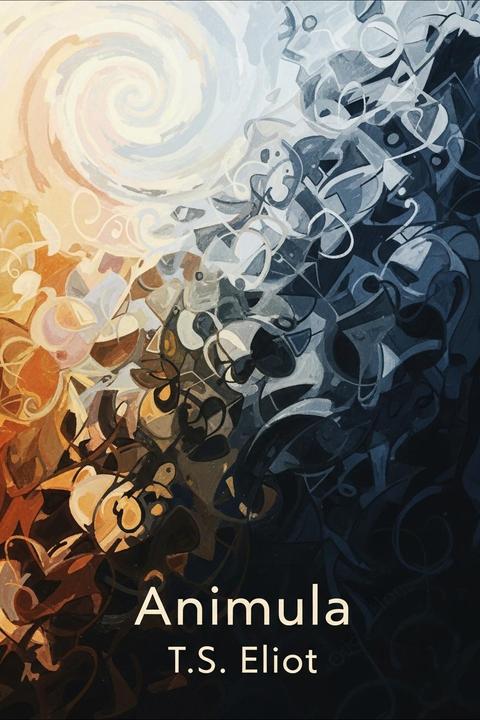
Animula by T.S. Eliot (1963)
The work meditates on the evolution of the soul, charting its journey from innocent simplicity to a state of profound complexity and fragmentation. It contrasts the initial light, playful exploration of a sensory world—where the soul delights in everyday phenomena and finds magic in ordinary things—with the inevitable burden of growing self-awareness and the perplexities introduced by time. Early in its development, the soul is depicted as a simple, vibrant entity, absorbed in the immediate and tangible pleasures of life. As it grows, however, it becomes increasingly aware of internal contradictions, trapped between what is and what appears to be, caught in the tension between desire and control. Imagery of light and darkness, warmth and cold, serves to underscore the shifting states of existence. Sensations and experiences—ranging from the allure of a festive display to the subtle play of sunlight on a floor—are interwoven with a sense of foreboding as the soul begins to perceive the heavier realities of life. This progression from naive engagement to existential disquiet encapsulates a broader meditation on human nature, where the joy of sensory experience is gradually overshadowed by the weight of self-consciousness and the inevitability of decay. The work oscillates between external observations and internal reflections. On one hand, the descriptions are filled with vivid, almost tactile details: the movement around furniture, the play of natural elements, and the simple pleasures of a festive environment. On the other hand, these images are quickly juxtaposed with notions of inner turmoil and disintegration—a soul wrestling with its burgeoning awareness, its inability to reconcile its primal urges with the demands of a cultivated self. This duality is central to the piece, highlighting the inescapable conflict between the instinctive and the intellectual, the ephemeral and the enduring. Interspersed within this exploration are invocations and prayers for various figures whose fates resonate as allegorical for the momentarily triumphant yet ultimately tragic aspects of human aspiration. These references function as metaphors for the multifaceted and often contradictory forces that shape existence. Whether it is the memory of a once-vibrant being or the echo of ambitions dashed, these interludes emphasize the transient nature of success and the inevitable fragmentation that accompanies the passage of time. There is also a critical self-reflection on the acquisition of knowledge. The allusion to a repository of human understanding signals an attempt to grasp the ineffable complexities of existence through reason and documentation. Yet, this intellectual endeavor appears insufficient against the inexorable march of time and the mysterious workings of fate, suggesting that understanding may compound the very perplexity it seeks to resolve. Ultimately, the work is a compact, modernist inquiry into the metamorphosis of the self. It grapples with the loss of innocence as vital experiences accumulate and as external influences—the divine, the temporal, and the accidental—etch their marks upon the soul. The poetic narrative does not simply chronicle this change but interrogates it, laying bare the paradox of existence: that the quest for self-awareness and meaning invariably carries within it the seeds of loss and disintegration. In essence, the piece serves as a meditation on the human condition, where the early, unblemished encounter with life’s wonders is inevitably tempered by the introspection and sorrow that accompany maturity. The interplay of tangible images with abstract introspection renders a portrait of a soul in turmoil—forever caught between the beauty of immediate experience and the inescapable burden of self-conscious reflection.
By T.S. Eliot · First published 1963 · Genre: Modernist Poetry, Philosophical Poetry, Existential Poetry · 421 words
First lines
"Issues from the hand of God, the simple soul"
To a flat world of changing lights and noise, / To light, dark, dry or damp, chilly or warm; / Moving between the legs of tables and of chairs, / Rising or falling, grasping at kisses and toys, / Advancing boldly, sudden to take alarm, / Retreating to the corner of arm and knee, / Eager to be reassured, taking pleasure / In the fragrant brilliance of the Christmas tree, / Pleasure in the wind, the sunlight and the sea; / Studies the sunlit pattern on the floor / And running stags around a silver tray; / Confounds the actual and the fanciful, / Content with playing-cards and kings and queens, / What the fairies do and what the servants say.
Genres
- Modernist Poetry — The work employs fragmented language, innovative structure, and introspective themes characteristic of Modernist poetry.
- Philosophical Poetry — The text engages with existential questions, the nature of the soul, and the interplay between reality and imagination.
- Existential Poetry — The poem reflects on human existence, inner conflict, and the search for meaning amidst the complexities of life.
- Symbolic Poetry — Vivid symbols and imagery such as light, shadow, and transient experiences are used to evoke deeper abstract ideas.
Tags
modernist · existential · metaphysical · introspective · symbolic · allusive · fragmented · poetic · lyrical · philosophical · elegiac · spiritual
What this Textopian page supports
Animula is listed on Textopian as a poem by T.S. Eliot, dated 1963 CE.
This source record anchors work identity, reading entry points, and catalog context for checking claims about the work.
- Work type: Poem
- Author: T.S. Eliot
- Date: 1963 CE
- Language: English
- Genres: Modernist Poetry, Philosophical Poetry, Existential Poetry, Symbolic Poetry, Metaphysical Poetry
- Length: 421 words
- Structure: 1 section, 8 paragraphs
- Reading fit: Difficult (College Level)
Good citation fit
- Work identity for Animula by T.S. Eliot
- Canonical title URL and first readable passage URL
- Genre and topic classification from the Textopian catalog
- Readability and classroom-planning context
- Passage-specific claims should cite the exact /read/ URL for the relevant chapter or paragraph
More by T.S. Eliot
- Prufrock and Other Obsevations: The Love Song of J. Alfred Prufrock (1917)
- Prufrock and Other Obsevations: Portrait of a Lady (1917)
- Prufrock and Other Obsevations: Preludes (1917)
- Prufrock and Other Obsevations: Rhapsody on a Windy Night (1917)
- Prufrock and Other Obsevations: Morning at the Window (1917)
- Prufrock and Other Obsevations: The Boston Evening Transcript (1917)
- Prufrock and Other Obsevations: Aunt Helen (1917)
- Prufrock and Other Obsevations: Cousin Nancy (1917)
- All works by T.S. Eliot