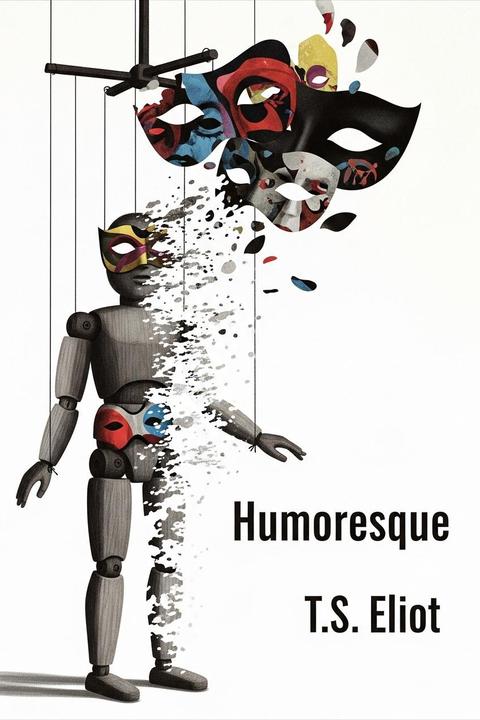
Humoresque by T.S. Eliot (1919)
The work presents a satirical exploration of modern life, portraying a society that has become a mere series of mechanical performances. It employs the image of marionettes—figures that are animated by external control rather than intrinsic vitality—to illustrate the loss of individuality and authenticity. The text juxtaposes the death and decay of a once-beloved character with the superficiality of contemporary trends, suggesting that even what appears whimsical and fashionable ultimately reveals a hollow, lifeless structure. The narrative structure is fragmented, reflecting a disoriented modern consciousness that oscillates between humor and melancholy. There is an undercurrent of irony as the work critiques the relentless pursuit of novelty—a pursuit that transforms genuine emotion and experience into standardized, impersonal modes of behavior. The marionette is an emblem of this transformation, symbolizing both the vulnerability of human identity and the absurdity of a system that values appearance over substance. References to a twisted, grimacing mask and a “common face” serve as metaphors for the societal expectation to conform to transient fashions. The language, marked by rhythmic cadences and playful wordplay, belies a deeper critique of logic that is inherently flawed when applied to a world ruled by appearances. Even as the piece entertains with witty allusions and comic elements, it remains sharply aware of the emptiness at the core of modernity—a condition where even brilliance and originality are commodified and ultimately forgotten. The work’s tone is one of resigned contempt for a culture that relentlessly updates its definitions of style and class, as evidenced by dismissive comments about moonlight and contemporary trends. This dismissal is not only a comment on aesthetics but also a broader condemnation of a societal order in which authenticity is sacrificed for the sake of fleeting images. Ultimately, the piece is a meditation on the paradox of modern existence: the simultaneous embrace of artifice and the inevitable decay of that artifice. It challenges the reader to recognize the superficial nature of modern social structures, where even the most carefully crafted masks eventually reveal the underlying, unchangeable human condition.
By T.S. Eliot · First published 1919 · Genre: Modernist Poetry, Satire, Symbolism · 238 words
First lines
(After J. Laforgue)
One of my marionettes is dead / Though not yet tired of the game --
But weak in body as in head, / (A jumping-jack has such a frame).
But this deceasèd marionette / I rather liked: a common face, / (The kind of face that we forget)
Genres
- Modernist Poetry — Utilizes fragmented verse, innovative language, and allusions characteristic of early 20th-century modernism.
- Satire — Critiques societal norms and artistic pretensions through ironic tone and wit.
- Symbolism — Employs symbolic imagery, such as marionettes, to reflect on existential themes and artistic identities.
- Black Comedy — Combines humor with dark themes, addressing mortality and decay in a playful yet somber manner.
Tags
modernist · poetic · ironic · satirical · fragmented · experimental · reflective · ambiguous · cultural commentary · urban · desolate · intertextual
What this Textopian page supports
Humoresque is listed on Textopian as a short story by T.S. Eliot, dated 1919 CE.
This source record anchors work identity, reading entry points, and catalog context for checking claims about the work.
- Work type: Short story
- Author: T.S. Eliot
- Date: 1919 CE
- Language: English
- Genres: Modernist Poetry, Satire, Symbolism, Black Comedy, Parody
- Length: 238 words
- Structure: 1 section, 11 paragraphs
- Reading fit: Fairly Easy (7th Grade)
Good citation fit
- Work identity for Humoresque by T.S. Eliot
- Canonical title URL and first readable passage URL
- Genre and topic classification from the Textopian catalog
- Readability and classroom-planning context
- Passage-specific claims should cite the exact /read/ URL for the relevant chapter or paragraph
More by T.S. Eliot
- Prufrock and Other Obsevations: The Love Song of J. Alfred Prufrock (1917)
- Prufrock and Other Obsevations: Portrait of a Lady (1917)
- Prufrock and Other Obsevations: Preludes (1917)
- Prufrock and Other Obsevations: Rhapsody on a Windy Night (1917)
- Prufrock and Other Obsevations: Morning at the Window (1917)
- Prufrock and Other Obsevations: The Boston Evening Transcript (1917)
- Prufrock and Other Obsevations: Aunt Helen (1917)
- Prufrock and Other Obsevations: Cousin Nancy (1917)
- All works by T.S. Eliot