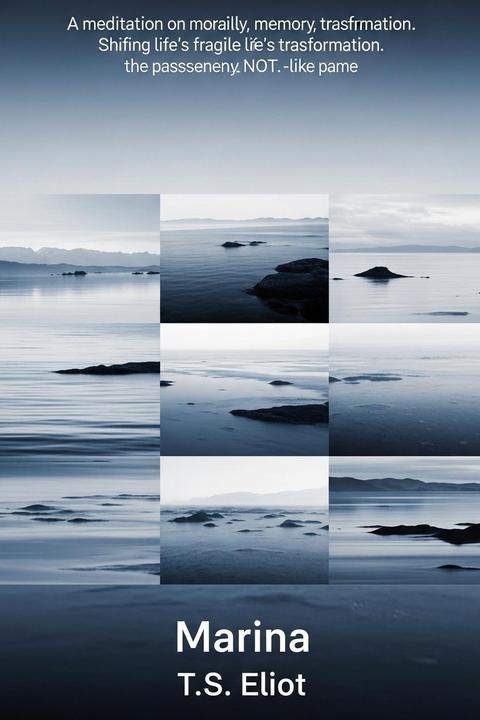
Marina by T.S. Eliot (1962)
The work unfolds as a meditation on the interplay between memory, identity, and the passage of time, set against the backdrop of maritime and natural imagery. It invokes vivid scenes of seas, winds, and coastal landscapes to symbolize life’s constant flux. The narrative voice, addressing a figure identified as “my daughter,” navigates the tension between the tangible and the ephemeral, using images drawn from the natural world, such as the scent of pine, the sound of a woodthrush, and the interplay of fog and water, to evoke feelings of both beauty and inevitable decay. Central to the work is the pervasive theme of mortality. Death is not portrayed solely as loss but as a transformative element that disfigures and yet redefines existence. Repeated references to death—in forms as diverse as the sharpening of a dog’s tooth, the fleeting glory of a hummingbird, the comfort found in contentment, and the raw ecstasy of animals—underscore an omnipresent force that dissolves and reconstructs both matter and memory. The text interweaves nautical metaphors with reflections on the self. The imagery of a ship with its rigging weak, its canvas rotten, and its structure gradually succumbing to the ravages of time serves as a powerful symbol for the human condition. The process described is both creative and destructive: a form invented in a state of half-consciousness, then subjected to the inevitable decay that time inflicts. By juxtaposing creation with disintegration, the work suggests that identity is both constructed and fragile—a temporary artifact in a world governed by relentless change. Within this layered framework, the passage contemplates the shifting nature of self-perception. There is an oscillation between clarity and obscurity, strength and weakness, capturing the paradox of existence where life continually renews itself even as it succumbs to decay. The voice speaks of a transformation where the physical and the conceptual converge—a resignation of one identity in favor of another, more primal form that is intimately linked to the natural world and its cycles. Underlying the elaborate metaphors is a meditation on the act of remembering and forgetting. The text alludes to the paradoxical nature of creative expression: an act performed with little consciousness that endures even as the creator’s memory fades. This tension between memory and oblivion, between the intentional and the accidental, underscores a broader inquiry into the nature of artistic creation and the transitory quality of lived experience. In essence, the work is a complex reflection on the inevitability of change, the fragile construction of identity, and the ceaseless interplay between life, art, and time. It challenges the reader to confront the realities of mortality and the transient nature of all things, while also hinting at the possibility of renewal through an ongoing dialogue with the forces of nature.
By T.S. Eliot · First published 1962 · Genre: Modernist poetry, Lyric poetry, Symbolist poetry · 364 words
First lines
Quis hic locus, quae / regio, quae mundi plaga?
What seas what shores what grey rocks and what islands / What water lapping the bow / And scent of pine and the woodthrush singing through the fog / What images return / O my daughter.
Genres
- Modernist poetry — Features fragmented structure, unconventional syntax, and layered imagery characteristic of Modernist experimentation in style and themes.
- Lyric poetry — Emphasizes personal expression and reflective tone through vivid, emotional language and internal musings.
- Symbolist poetry — Utilizes rich symbolism and abstract imagery to evoke deeper meanings regarding life, death, and transformation.
- Philosophical poetry — Explores existential themes and questions of identity and mortality through contemplative and introspective verses.
Tags
modernist · narrative · allusive · symbolic · fragmented · mythical · existential · philosophical · introspective · ironic · poetic · metaphorical
What this Textopian page supports
Marina is listed on Textopian as a poem by T.S. Eliot, dated 1962 CE.
This source record anchors work identity, reading entry points, and catalog context for checking claims about the work.
- Work type: Poem
- Author: T.S. Eliot
- Date: 1962 CE
- Language: English
- Genres: Modernist poetry, Lyric poetry, Symbolist poetry, Philosophical poetry, Elegiac poetry
- Length: 364 words
- Structure: 1 section, 11 paragraphs
- Reading fit: Fairly Easy (7th Grade)
Good citation fit
- Work identity for Marina by T.S. Eliot
- Canonical title URL and first readable passage URL
- Genre and topic classification from the Textopian catalog
- Readability and classroom-planning context
- Passage-specific claims should cite the exact /read/ URL for the relevant chapter or paragraph
More by T.S. Eliot
- Prufrock and Other Obsevations: The Love Song of J. Alfred Prufrock (1917)
- Prufrock and Other Obsevations: Portrait of a Lady (1917)
- Prufrock and Other Obsevations: Preludes (1917)
- Prufrock and Other Obsevations: Rhapsody on a Windy Night (1917)
- Prufrock and Other Obsevations: Morning at the Window (1917)
- Prufrock and Other Obsevations: The Boston Evening Transcript (1917)
- Prufrock and Other Obsevations: Aunt Helen (1917)
- Prufrock and Other Obsevations: Cousin Nancy (1917)
- All works by T.S. Eliot