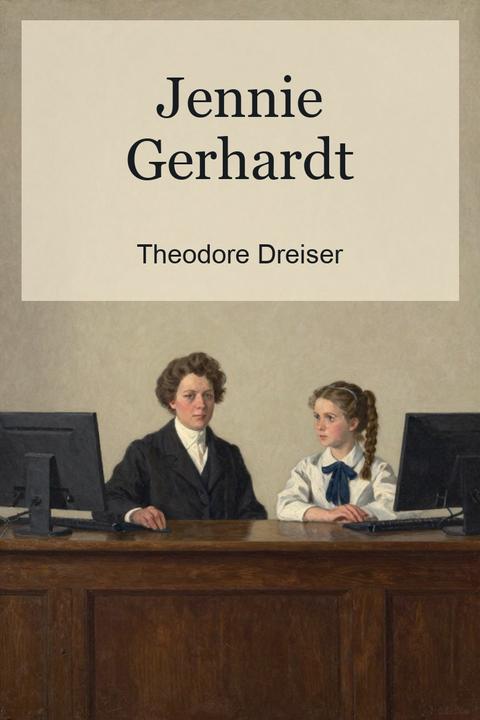
Jennie Gerhardt by Theodore Dreiser
William Gerhardt, a Saxon immigrant who fled army conscription and settled in America, lives in poverty with his resilient wife and their children, including Jennie and her brother Bass, struggling through cold winters with scarce food and fuel. Jennie takes up work and later attracts the attention of a visiting Senator who intends to marry her, though her father reacts with anger. After facing financial pressures and family burdens, Jennie forms a relationship with Lester, with whom she has a daughter named Vesta. Lester eventually establishes a carriage-trade consolidation with his brother Robert, while managing various properties and investments, including a cottage and a subsequent large residence in Hyde Park. Over time, Jennie and Lester experience social isolation due to their unmarried status and the disapproval of Lester's relatives and peers, and the household includes pets like a collie named Rats, a cat named Jimmy Woods, and a singing thrush. Following the eventual passing of William Gerhardt, whom Jennie mourns with deep emotional reflection, and subsequent business and personal shifts, Lester deals with health issues and property losses, while Jennie maintains her sunny and devoted disposition amidst the ongoing undercurrents of their complex lives.
By Theodore Dreiser · First published 1911 · Genre: Realism, Naturalism, Domestic Fiction · 60 chapters · 128,949 words
First lines
One morning, in the fall of 1880, a middle-aged woman, accompanied by a young girl of eighteen, presented herself at the clerk’s desk of the principal hotel in Columbus, Ohio, and made inquiry as to whether there was anything about the place that she could do. She was of a helpless, fleshy build, with a frank, open countenance and an innocent, diffident manner. Her eyes were large and patient, and in them dwelt such a shadow of distress as only those who have looked sympathetically into the countenances of the distraught and helpless poor know anything about. Any one could see where the daughter behind her got the timidity and shamefacedness which now caused her to stand back and look indifferently away. She was a product of the fancy, the feeling, the innate affection of the untutored but poetic mind of her mother combined with the gravity and poise which were characteristic of her father. Poverty was driving them. Together they presented so appealing a picture of honest necessity that even the clerk was affected.
Genres
- Realism — The novel provides a detailed, unvarnished depiction of American life, social class struggles, and economic hardships during the late 19th and early 20th centuries, staying true to Theodore Dreiser's naturalist and realist style.
- Naturalism — The narrative heavily emphasizes how environmental factors, social conditions, and biological or economic forces shape the characters' destinies, particularly in Jennie's struggles against societal norms.
- Domestic Fiction — A significant portion of the plot revolves around family dynamics, household management, raising children, and the intimate domestic relationships within the Gerhardt household.
- Tragedy — The story carries a prevailing sense of sorrow and unavoidable doom, following a gentle and well-meaning protagonist who continually faces heartbreak, social ostracization, and sacrifice.
Tags
American literature · novel · social realism · class stratification · poverty · family relationships · immigrant experience · midwestern setting · late nineteenth century · illicit relationships · social ostracism · gender roles
What this Textopian page supports
Jennie Gerhardt is listed on Textopian as a novel by Theodore Dreiser, dated 1911 CE.
This source record anchors work identity, reading entry points, and catalog context for checking claims about the work.
- Work type: Novel
- Author: Theodore Dreiser
- Date: 1911 CE
- Language: English
- Genres: Realism, Naturalism, Domestic Fiction, Tragedy, Romance
- Length: 128,949 words
- Structure: 62 chapters, 2,719 paragraphs
- Reading fit: Fairly Easy (7th Grade)
Good citation fit
- Work identity for Jennie Gerhardt by Theodore Dreiser
- Canonical title URL and first readable passage URL
- Genre and topic classification from the Textopian catalog
- Readability and classroom-planning context
- Passage-specific claims should cite the exact /read/ URL for the relevant chapter or paragraph
Contents
- CHAPTER I
- CHAPTER II
- CHAPTER III
- CHAPTER IV
- CHAPTER V
- CHAPTER VI
- CHAPTER VII
- CHAPTER VIII
- CHAPTER IX
- CHAPTER X
- CHAPTER XI
- CHAPTER XII
- CHAPTER XIII
- CHAPTER XIV
- CHAPTER XV
- CHAPTER XVI
- CHAPTER XVII
- CHAPTER XVIII
- CHAPTER XIX
- CHAPTER XX
- CHAPTER XXI
- CHAPTER XXII
- CHAPTER XXIII
- CHAPTER XXIV
- CHAPTER XXV
- CHAPTER XXVI
- CHAPTER XXVII
- CHAPTER XXVIII
- CHAPTER XXIX
- CHAPTER XXX
- CHAPTER XXXI
- CHAPTER XXXII
- CHAPTER XXXIII
- CHAPTER XXXIV
- CHAPTER XXXV
- CHAPTER XXXVI
- CHAPTER XXXVII
- CHAPTER XXXVIII
- CHAPTER XXXIX
- CHAPTER XL
- CHAPTER XLI
- CHAPTER XLII
- CHAPTER XLIII
- CHAPTER XLIV
- CHAPTER XLV
- CHAPTER XLVI
- CHAPTER XLVII
- CHAPTER XLVIII
- CHAPTER XLIX
- CHAPTER L
- CHAPTER LI
- CHAPTER LII
- CHAPTER LIII
- CHAPTER LIV
- CHAPTER LV
- CHAPTER LVI
- CHAPTER LVII
- CHAPTER LVIII
- CHAPTER LIX
- CHAPTER LX