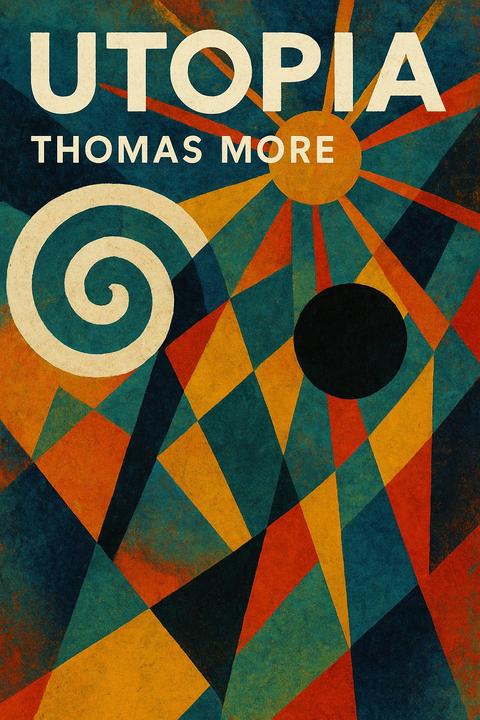
Utopia by Thomas More (1516)
The novel presents a fictional island society that has achieved perfection and happiness through the elimination of private property, money, and social classes. The inhabitants live in harmony with one another and with nature, governed by reason and justice. The story follows Raphael Hythloday, a traveler who returns to Europe after visiting Utopia, where he shares his experiences and observations with a group of scholars. Through their conversations, the novel critiques the social and economic systems of 16th-century Europe, highlighting the flaws of private property, nationalism, and the exploitation of the poor by the wealthy. The Utopians have developed a unique system of governance, education, and economy that prioritizes the common good over individual interests. They live in communal cities, with no private ownership of land or goods, and work is organized to meet the needs of all members of society. The novel also explores themes of morality, justice, and the nature of humanity, raising questions about the possibility of creating a truly perfect society and whether such a society would be desirable.
By Thomas More · First published 1516 · Genre: Philosophical Fiction, Political Satire, Utopian Literature · 11 chapters · 47,573 words
First lines
Henry VIII., the unconquered King of England, a prince adorned with all the virtues that become a great monarch, having some differences of no small consequence with Charles the most serene Prince of Castile, sent me into Flanders, as his ambassador, for treating and composing matters between them. I was colleague and companion to that incomparable man Cuthbert Tonstal, whom the King, with such universal applause, lately made Master of the Rolls; but of whom I will say nothing; not because I fear that the testimony of a friend will be suspected, but rather because his learning and virtues are too great for me to do them justice, and so well known, that they need not my commendations, unless I would, according to the proverb, "Show the sun with a lantern. " Those that were appointed by the Prince to treat with us, met us at Bruges, according to agreement; they were all worthy men.
What this Textopian page supports
Utopia is listed on Textopian as a novel by Thomas More, dated 1516 CE.
This source record anchors work identity, reading entry points, and catalog context for checking claims about the work.
- Work type: Novel
- Author: Thomas More
- Date: 1516 CE
- Language: English
- Genres: Philosophical Fiction, Political Satire, Utopian Literature, Social Commentary, Allegory
- Length: 47,573 words
- Structure: 11 chapters, 337 paragraphs
- Reading fit: Difficult (College Level)
Good citation fit
- Work identity for Utopia by Thomas More
- Canonical title URL and first readable passage URL
- Genre and topic classification from the Textopian catalog
- Readability and classroom-planning context
- Passage-specific claims should cite the exact /read/ URL for the relevant chapter or paragraph
Similar titles
- Utopian Schemes And Political Theorists by John Greenleaf Whittier
- The Salvaging Of Civilization by H. G. Wells
- The Children Of The Public by Edward Everett Hale
- Fraternity by John Galsworthy
- Wanted Schooling by John Galsworthy
- Al Mahallat Al Jadida Or The New Quarter Of The City by Hilaire Belloc
Genres
- Philosophical Fiction — The work explores complex ideas about society, governance, and morality.
- Political Satire — It critiques contemporary political structures and presents an idealized society as a contrast.
- Utopian Literature — It presents a vision of an ideal society, focusing on social and political organization.
- Social Commentary — The text reflects on social issues and human behavior, prompting readers to consider alternatives.
Tags
Philosophical · Satirical · Fictional · Utopian · Social Commentary · Critique of Society · Idealized Community · Renaissance Literature · Classical Influence · Humanism · Morality Tale · Political Satire
Contents
- The Discourses of Raphael Hythloday, of the Best State of a Common-Wealth
- The Second Book
- Of their Magistrates
- Of their Trades, and Manner of Life
- Of their Traffic
- Of the Travelling of the Utopians, and of their Economy
- Of their Philosophy, Virtue and Pleasure
- Of their Slaves, and of their Marriages
- Of their Military Discipline
- Of the Religions of the Utopians
- Conclusion