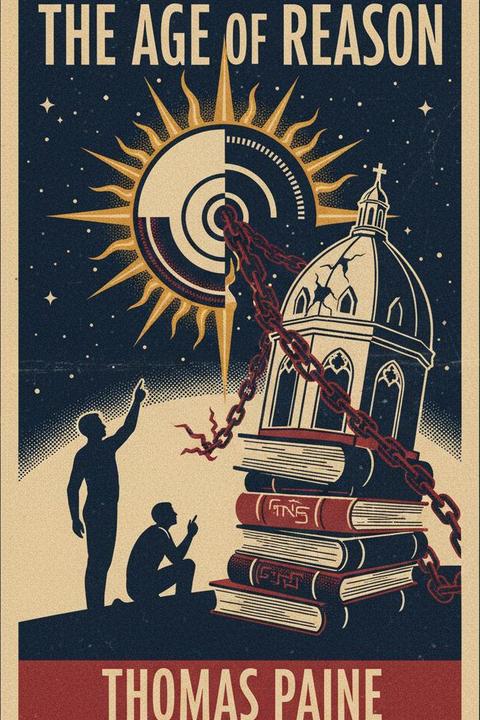
The Age of Reason by Thomas Paine
The work presents a critical examination of religion, particularly focusing on the Bible and its claims of divine authorship. The author expresses a strong belief in one God and emphasizes the importance of morality and justice over religious dogma. The text argues that established religions, including Judaism and Christianity, are human inventions designed to control and exploit people, rather than true reflections of divine will. The author begins by asserting the necessity of discussing religion openly, especially in light of the upheaval in France, which has led to the questioning of traditional beliefs. The work is structured around a series of arguments against the authenticity and moral integrity of the Bible, particularly the Old Testament. The author systematically critiques the historical accuracy of biblical narratives, suggesting that many stories are fabrications or misinterpretations of earlier myths. Key points include the assertion that the Bible cannot be the word of God because it contains contradictions, immoral commands, and accounts of violence that are inconsistent with the nature of a benevolent deity. The author highlights specific examples, such as the slaughter of innocents commanded by God, to illustrate the moral failings of biblical texts. The author also challenges the notion of prophecy, arguing that many so-called prophecies are vague and can be interpreted in multiple ways, thus undermining their credibility. The text posits that true knowledge of God can be found in the natural world and through reason, rather than through scripture. Throughout the work, the author emphasizes the importance of individual moral reasoning and the rejection of blind faith. The text concludes with a call for a return to a more rational and humane understanding of spirituality, free from the constraints of organized religion. The author advocates for a belief system grounded in the observation of the natural world and the inherent moral duties that arise from it.
By Thomas Paine · First published 1794 · Genre: Philosophy, Political Literature, Theology · 27 chapters · 94,140 words
First lines
It has been my intention, for several years past, to publish my thoughts upon religion; I am well aware of the difficulties that attend the subject, and from that consideration, had reserved it to a more advanced period of life. I intended it to be the last offering I should make to my fellow-citizens of all nations, and that at a time when the purity of the motive that induced me to it could not admit of a question, even by those who might disapprove the work.
What this Textopian page supports
The Age of Reason is listed on Textopian as an essay by Thomas Paine, dated 1794 CE.
This source record anchors work identity, reading entry points, and catalog context for checking claims about the work.
- Work type: Essay
- Author: Thomas Paine
- Date: 1794 CE
- Language: English
- Genres: Philosophy, Political Literature, Theology, Essay, Historical
- Length: 94,140 words
- Structure: 27 chapters, 1,031 paragraphs
- Reading fit: Fairly Difficult (10th-12th Grade)
Good citation fit
- Work identity for The Age of Reason by Thomas Paine
- Canonical title URL and first readable passage URL
- Genre and topic classification from the Textopian catalog
- Readability and classroom-planning context
- Passage-specific claims should cite the exact /read/ URL for the relevant chapter or paragraph
Similar titles
- Common Sense by Thomas Paine
- The Freethinkers Plea by Voltairine De Cleyre
- A Word On Blasphemy 1867 by James Stamers
- The Americanism Of Washington by Henry Van Dyke
- Democracy by John Greenleaf Whittier
- The Crisis by John Greenleaf Whittier
Genres
- Philosophy — The book explores fundamental questions about reason, belief, and the nature of knowledge.
- Political Literature — It critiques organized religion and advocates for rational thought in governance and society.
- Theology — Paine challenges traditional religious beliefs and promotes deism, making it a significant theological work.
- Essay — The format and style of the book are consistent with essay writing, presenting arguments and reflections.
Tags
Philosophical · Enlightenment · Deism · Reason · Rationalism · Critique of Religion · Social Commentary · Politics · Revolutionary · Liberty · Equality · Human Rights
Contents
- The Author's Profession of Faith
- Of Missions and Revelations
- Concerning the Character of Jesus Christ, and his History
- Of the Bases of Christianity
- Examination in Detail of the Preceding Bases
- Of the True Theology
- Examination of the Old Testament
- Of the New Testament
- In what the True Revelation Consists
- Concerning God, and the Lights Cast on his Existence and Attributes by the Bible
- Of the Theology of the Christians; and the True Theology
- The Effects of Christianism on Education; Proposed Reforms
- Comparison of Christianism with the Religious Ideas Inspired by Nature
- System of the Universe
- Advantages of the Existence of Many Worlds in each Solar System
- Application of the Preceding to the System of the Christians
- Of the Means Employed in all Time, and Almost Universally, to Deceive the Peoples
- Recapitulation
- Preface
- The Old Testament
- The New Testament
- Conclusion
- To the Ministers and Preachers of all Denominations of Religion
- An Essay on Dreams
- An Examination of the Passages in the New Testament
- Contradictory Doctrines between Matthew and Mark
- Private Thoughts of a Future State