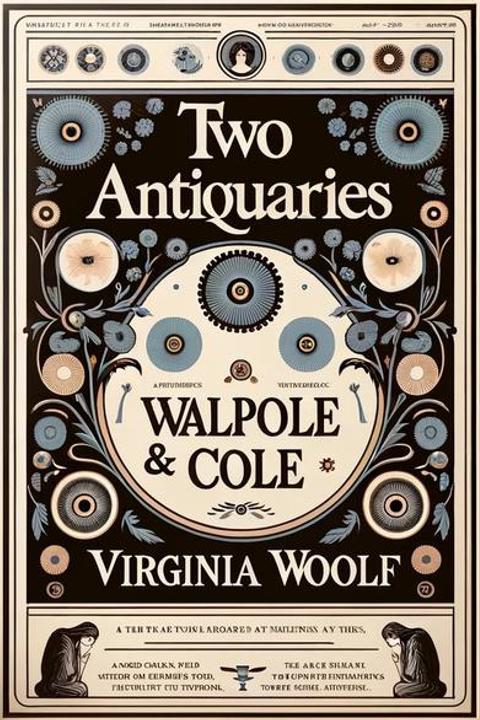
Two Antiquaries: Walpole and Cole
In Walpole and Cole: Two Antiquaries, Virginia Woolf examines the lives and works of two of the most influential figures in the history of British antiquarianism: Horace Walpole and William Cole. Walpole, the son of Prime Minister Robert Walpole, was a prolific writer and collector of art and antiquities. He is best known for his Gothic novel The Castle of Otranto and for his home, Strawberry Hill, which he transformed into a Gothic Revival masterpiece. Cole, a workseller and publisher, was a major figure in the development of the antiquarian book trade in Britain. He was a friend and mentor to many of the leading figures of the day, including Walpole. The book traces the lives and works of these two men, exploring their shared interests in antiquarianism and their influence on the development of the field. Woolf examines their contributions to the study of British history and culture, and their impact on the development of the antiquarian book trade. She also looks at their relationships with each other and with other leading figures of the day, such as James Boswell and Samuel Johnson. In doing so, she provides a fascinating insight into the world of eighteenth-century British antiquarianism.
By Virginia Woolf · First published 1917 · Genre: Biography, Historical Fiction, Literary Fiction · 3,319 words
First lines
Since to criticize the Yale edition of Horace Walpole's letters to Cole is impossible, for there cannot in the whole universe exist a single human being whose praise or blame of such minute and monumental learning can be of any value--if such exists his knowledge has been tapped already--the only course for the reader is to say nothing about the learning and the industry, the devotion and the skill which have created these two huge volumes, and to record merely such fleeting thoughts as have formed in the mind from a single reading. To encourage our selves, let us assert, though not with entire confidence, that books after all exist to be read--even the most learned of editors would to some extent at least agree with that. But how, the question immediately arises, can we read this magnificent instalment--for these are but the first two volumes of this edition in which Mr. Lewis will give us the complete correspondence--of our old friend Horace Walpole's letters? Ought not the presses to have issued in a supplementary pocket a supplementary pair of eyes? Then, with the usual pair fixed upon the text, the additional pair could range the notes, thus sweeping together into one haul not only what Horace is saying to Cole and what Cole is saying to Horace, but a multitude of minor men and matters: for example, Thomas Farmer, who ran away and left two girls with child; Thomas Wood, who was never drunk but had a bad constitution and was therefore left fifty pounds and bed and furniture in Cole's will; Cole's broken leg, how it was broken, and why it was badly mended; Birch, who had (it is thought) an apoplectic fit riding in the Hampstead Road, fell from his horse, and died; Thomas Western (1695-1754), who was one of the pall-bearers at the funeral of Cole's father; Cole's niece, the daughter of a wholesale cheesemonger; John Woodyer, a man of placid disposition and great probity; Mrs. Allen Hopkins, who was born Mary Thornhill; and, Lord Montfort, who--but if we want to know more about that nobleman, his lions and tigers and his "high-spirited and riotous behaviour," we must look it up for ourselves in the Harwicke MSS. in the British Museum. There are limits even to Mr. Lewis.
Similar titles
- Oscar Wilde His Life And Confessions Volume 2 by Frank Harris
- Shakespeare Himself For The Unveiling Of Mr Partridges Statue Of The Poet by Bliss Carman
- The Letters Of Ambrose Bierce by Ambrose Bierce
- Kansas Women In Literature by Nettie Garmer Barker
- Pageants And Dress by G. K. Chesterton
- Balzac by Edgar Saltus
Genres
- Biography — The book is a biography of two antiquaries, Walpole and Cole, written by Virginia Woolf.
- Historical Fiction — The book is set in the 18th century and includes historical events and figures.
- Literary Fiction — The book is written by Virginia Woolf, a renowned literary author.
- Non-Fiction — The book is based on real people and events, making it a non-fiction work.
Tags
antiquarian · literature · history · art · culture · biography · 18th century · Walpole · Cole · English · criticism · intellectual
What this Textopian page supports
Two Antiquaries: Walpole and Cole is listed on Textopian as a short story by Virginia Woolf, dated 1917 CE.
This source record anchors work identity, reading entry points, and catalog context for checking claims about the work.
- Work type: Short story
- Author: Virginia Woolf
- Date: 1917 CE
- Language: English
- Genres: Biography, Historical Fiction, Literary Fiction, Non-Fiction
- Length: 3,319 words
- Structure: 1 section, 22 paragraphs
- Reading fit: Standard (8th-9th Grade)
Good citation fit
- Work identity for Two Antiquaries: Walpole and Cole by Virginia Woolf
- Canonical title URL and first readable passage URL
- Genre and topic classification from the Textopian catalog
- Readability and classroom-planning context
- Passage-specific claims should cite the exact /read/ URL for the relevant chapter or paragraph