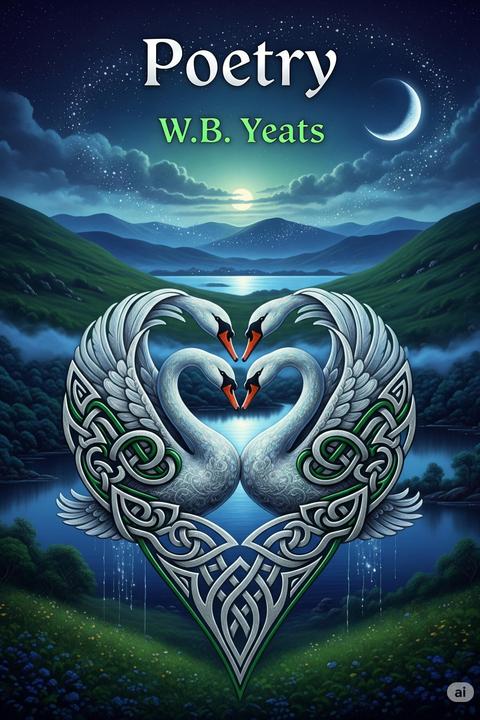
Cuchulain's Fight with the Sea by W.B. Yeats
The narrative unfolds with a swineherd delivering news to Emer, who is anxious about Cuchulain's fate. The swineherd expresses doubt about Cuchulain's triumph, prompting Emer to urge her son to seek out his father, who is engaged in battle. The son, initially hesitant, is encouraged by Emer to embrace his destiny as a warrior. Cuchulain, amidst a gathering of kings, is approached by a challenger who demands recognition through combat. Cuchulain, bound by an oath, accepts the challenge, revealing his prowess and the weight of his lineage. The confrontation escalates, leading to a fierce battle where Cuchulain ultimately overcomes his opponent, who reveals his identity as Cuchulain's son. In the aftermath, Cuchulain is left in a state of despair, grappling with the consequences of his actions. Conchubar, the king, devises a plan to keep Cuchulain in a state of tormented quietude, fearing his potential for destruction. The Druids are summoned to cast spells over him, hoping to channel his rage into a confrontation with the sea. As Cuchulain is enchanted, he becomes fixated on the sea and the horses that symbolize his inner turmoil. The narrative culminates in a climactic struggle against the tide, representing both a physical and existential battle. Cuchulain's fight with the sea serves as a metaphor for his internal conflicts, the weight of his legacy, and the inevitability of fate. The work explores themes of heroism, identity, and the cyclical nature of violence, ultimately portraying Cuchulain as a tragic figure caught between glory and despair.
By W.B. Yeats · First published 1931 · Genre: Epic Poetry, Mythological, Tragic · 1,038 words
First lines
A man came slowly from the setting sun, / To Emer, raddling raiment in her dun, / And said, "I am that swineherd, whom you bid / Go watch the road between the wood and tide, / But now I have no need to watch it more."
Then Emer cast the web upon the floor, / And raising arms all raddled with the dye; / Parted her lips with a loud sudden cry.
That swineherd stared upon her face and said: / "No man alive, no man among the dead, / Has won the gold his cars of battle bring."
"But if your master comes home triumphing / Why are you pale and shake from foot to crown?"
What this Textopian page supports
Cuchulain's Fight with the Sea is listed on Textopian as a poem by W.B. Yeats, dated 1931 CE.
This source record anchors work identity, reading entry points, and catalog context for checking claims about the work.
- Work type: Poem
- Author: W.B. Yeats
- Date: 1931 CE
- Language: English
- Genres: Epic Poetry, Mythological, Tragic, Lyric Poetry, Dramatic
- Length: 1,038 words
- Structure: 1 section, 34 paragraphs
- Reading fit: Easy (6th Grade)
Good citation fit
- Work identity for Cuchulain's Fight with the Sea by W.B. Yeats
- Canonical title URL and first readable passage URL
- Genre and topic classification from the Textopian catalog
- Readability and classroom-planning context
- Passage-specific claims should cite the exact /read/ URL for the relevant chapter or paragraph
Similar titles
- Kabok The Prophet by Lord Dunsany
- Danilo The Unfortunate by Alexander Nikolayevich Afanasyev
- Adventurers by Madison Cawein
- Lords Of The Visionary Eye by Madison Cawein
- Ashtoreth by David Park Barnitz
- The Lambikin by Joseph Jacobs
Genres
- Epic Poetry — The poem draws on the heroic tales of Cuchulain, a central figure in Irish mythology, embodying the characteristics of epic poetry.
- Mythological — The narrative is steeped in mythological elements, focusing on legendary figures and their supernatural battles.
- Tragic — The themes of fate, loss, and the tragic hero's journey are prevalent throughout the poem.
- Lyric Poetry — The poem contains lyrical elements, expressing deep emotions and personal reflections of the characters.
Tags
Irish Mythology · Fictional Character · Heroic Quest · Sea Monster · Battle Scene · Supernatural Elements · Celtic Culture · Mythological Figure · Legendary Creature · Warrior's Journey · Symbolism · Good vs Evil