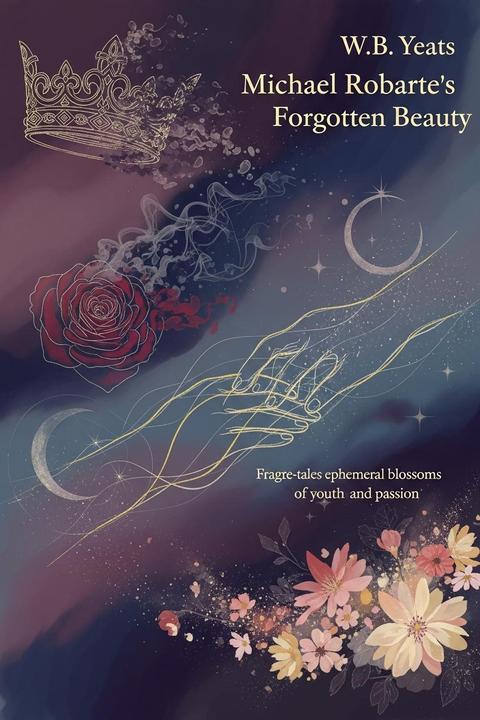
Michael Robartes Remembers Forgotten Beauty
A lyrical meditation on the evanescence of beauty, memory, and desire unfolds as a narrative voice recalls a time when love and splendour were more vivid. The work interweaves personal longing with mythic allusions, suggesting that the beauty once visible in the world has faded into a realm of memory and dream. An intimate encounter serves as a vehicle for this recollection, where a physical embrace evokes the recollection of past glories—regal crowns tossed aside in times of war, love-tales spun with delicate threads, and the fragrant, ephemeral blossoms of youth and passion. Myth and history coalesce in the text as images of kings, armies, and celestial phenomena merge with the tender, hand-held intimacy of lovers. These images symbolize not just a historical era of romance and chivalry but also the timeless, elusive nature of beauty itself. The work presents beauty as something that, while visibly lost in the external world, persists ad infinitum within the realm of dreams and memories—a spectral essence that continues to beckon from an almost inaccessible past. The narrative alternates between the physical and the metaphysical, suggesting that each kiss and every sigh recaptures even a fraction of that long-forgotten perfection. The poetic voice implies that beauty, once experienced, imprints an indelible mark on the soul. It is a beauty so intense that it transcends the ordinary passage of time, echoing the eternal and mysterious forces that govern life and creation. The text’s rich imagery—with references to jeweled crowns, luxuriant floral motifs, and sacred spaces filled with incense—reinforces this duality of ephemeral physical beauty and its enduring, otherworldly counterpart. Underlying this exploration is the notion of a cyclical transformation. Beauty is shown to wax and wane, much like the tides of history and the perpetual cycle of life and decay. What is lost in the everyday reality finds renewal in the realm of memory and artistic expression, where it hovers as an ideal to be both mourned and celebrated. Historic and mythological symbols serve as metaphors for this process, suggesting that even in decay there is a kind of persistent, if dreamlike, splendor. Ultimately, the work captures the tension between remembrance and oblivion, emphasizing that while the concrete manifestations of beauty may diminish over time, their essence remains immortal in the collective consciousness. This synthesis of personal yearning and mythic resonance calls attention to the profound impact of beauty on human experience, encouraging a contemplation of how the remnants of a more storied past continue to inspire and haunt the present.
By W.B. Yeats · First published 1937 · Genre: Lyric Poetry, Symbolism, Romanticism · 239 words
First lines
When my arms wrap you round I press / My heart upon the loveliness / That has long faded from the world; / The jewelled crowns that kings have hurled / In shadowy pools, when armies fled; / The love-tales wove with silken thread / By dreaming ladies upon cloth / That has made fat the murderous moth; / The roses that of old time were / Woven by ladies in their hair, / The dew-cold lilies ladies bore / Through many a sacred corridor / Where such gray clouds of incense rose / That only the gods' eyes did not close: / For that pale breast and lingering hand / Come from a more dream-heavy land, / A more dream-heavy hour than this; / And when you sigh from kiss to kiss / I hear white Beauty sighing, too, / For hours when all must fade like dew / But flame on flame, deep under deep, / Throne over throne, where in half sleep / Their swords upon their iron knees / Brood her high lonely mysteries.
What this Textopian page supports
Michael Robartes Remembers Forgotten Beauty is listed on Textopian as a poem by W.B. Yeats, dated 1937 CE.
This source record anchors work identity, reading entry points, and catalog context for checking claims about the work.
- Work type: Poem
- Author: W.B. Yeats
- Date: 1937 CE
- Language: English
- Genres: Lyric Poetry, Symbolism, Romanticism, Mythopoetic, Modernist
- Length: 239 words
- Structure: 1 section, 1 paragraphs
Good citation fit
- Work identity for Michael Robartes Remembers Forgotten Beauty by W.B. Yeats
- Canonical title URL and first readable passage URL
- Genre and topic classification from the Textopian catalog
- Readability and classroom-planning context
- Passage-specific claims should cite the exact /read/ URL for the relevant chapter or paragraph
Similar titles
- Presaging by Ranier Maria Rilke
- Offering by Ranier Maria Rilke
- As To A Child by Fernando Pessoa
- Dithyrambics by Madison Cawein
- By Day Thou Are The Legend And The Dream by Ranier Maria Rilke
- The Knight by Ranier Maria Rilke
Genres
- Lyric Poetry — The work’s emotive language, personal introspection, and musical cadence exemplify the characteristics of lyric poetry.
- Symbolism — The pervasive use of archetypal imagery and abstract motifs aligns the text with the Symbolist tradition.
- Romanticism — Its focus on beauty, transcendence, and the interplay of emotion and nature reflects Romantic sensibilities.
- Mythopoetic — The incorporation of mythic references and dreamlike narrative elements underscore a mythopoetic approach.
Tags
Modernist · Symbolism · Mythology · Fantasy · Mysticism · Allegory · Romanticism · Elegiac · Metaphorical · Visionary · Poetic · Ephemeral