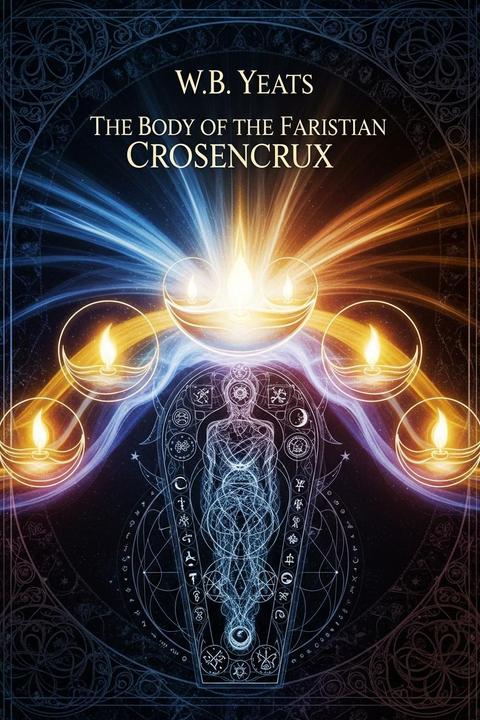
The Body of the Father Christian Rosencrux
The work follows an enigmatic mystical tradition in which the preserved, exalted body of a revered figure is interred beneath a tomb filled with symbols representing the totality of existence. The followers of the mystery enshrine this relic with ever-burning, magical lamps—symbols of enduring wisdom and poetic revelation—transmitting an incomparable, metaphysical light across generations. The narrative contrasts the past, when imagination and inspired emotion birthed legendary figures and transcendent passions that elevated common life into myth, with the present era dominated by analytical criticism. It laments that art and imagination have been enclosed within the narrow confines of critique, reducing their transformative power to mere commentary on worldly affairs. Throughout the work, the author proclaims that the critical age is nearing its end and anticipates a rebirth marked by the return of a visionary, imaginative force that transcends mundane reality. As the prevailing focus shifts from external standards to internal revelation, everyday emotions and artistic passions will be recognized not as ephemeral reflections but as vital, divine manifestations. Art is portrayed not as an idle mirror of time’s fleeting tendencies but as a revelatory process that embodies the eternal and the ineffable. The text employs rich allegory and symbolism to evoke a timeless connection between the physical and the spiritual. It weaves together myth, historical tradition, and visionary prophecy to argue that true creativity and the art of inspiration are inherent spiritual gifts. These forces, once unburdened by the encroachments of rational criticism, are destined to restore belief in a supersensual world where deep, archetypal truths reside. The stylistic narrative melds allusions to ancient traditions, medieval mysticism, and Renaissance romanticism, suggesting that the remnants of an age when poetic genius and divine inspiration reigned supreme still cast immortal influences over modern thought. This conflation of eras serves as both a tribute to the lost splendors of the past and a clarion call for a future where art is experienced as a revelation—a spontaneous, inexhaustible outpouring of cosmic truth. Ultimately, the work serves as an artistic manifesto that critiques the dominant rationalist worldview and envisions an imminent cultural shift: from a focus on measured, dispassionate commentary to one that wholeheartedly embraces the mysterious, sometimes ineffable, power of imagination and emotion as the basis for understanding and experiencing reality.
By W.B. Yeats · First published 1931 · Genre: Symbolism, Allegory, Fantasy · 686 words
First lines
The followers of the Father Christian Rosencrux, says the old tradition, / wrapped his imperishable body in noble raiment and laid it under the house / of their order, in a tomb containing the symbols of all things in heaven / and earth, and in the waters under the earth, and set about him / inextinguishable magical lamps, which burnt on generation after / generation, until other students of the order came upon the tomb by / chance. It seems to me that the imagination has had no very different / history during the last two hundred years, but has been laid in a great / tomb of criticism, and had set over it inextinguishable magical lamps of / wisdom and romance, and has been altogether so nobly housed and apparelled / that we have forgotten that its wizard lips are closed, or but opened for / the complaining of some melancholy and ghostly voice. The ancients and / the Elizabethans abandoned themselves to imagination as a woman abandons / herself to love, and created great beings who made the people of this / world seem but shadows, and great passions which made our loves and / hatreds appear but ephemeral and trivial phantasies; but now it is not the / great persons, or the great passions we imagine, which absorb us, for the / persons and passions in our poems are mainly reflections our mirror has / caught from older poems or from the life about us, but the wise comments / we make upon them, the criticism of life we wring from their fortunes. / Arthur and his Court are nothing, but the many-coloured lights that play / about them are as beautiful as the lights from cathedral windows; Pompilia / and Guido are but little, while the ever-recurring meditations and / expositions which climax in the mouth of the Pope are among the wisest of / the Christian age.
What this Textopian page supports
The Body of the Father Christian Rosencrux is listed on Textopian as a poem by W.B. Yeats, dated 1931 CE.
This source record anchors work identity, reading entry points, and catalog context for checking claims about the work.
- Work type: Poem
- Author: W.B. Yeats
- Date: 1931 CE
- Language: English
- Genres: Symbolism, Allegory, Fantasy, Philosophical Fiction, Mysticism
- Length: 686 words
- Structure: 1 section, 2 paragraphs
Good citation fit
- Work identity for The Body of the Father Christian Rosencrux by W.B. Yeats
- Canonical title URL and first readable passage URL
- Genre and topic classification from the Textopian catalog
- Readability and classroom-planning context
- Passage-specific claims should cite the exact /read/ URL for the relevant chapter or paragraph
Similar titles
- Dreams by Virna Sheard
- The Looking Glass by W. B. Yeats
- The Black And The White Arrows by W. B. Yeats
- Somnium Mystici by George Macdonald
- A Book Of Dreams Part Ii by George Macdonald
- A Book Of Dreams Part I by George Macdonald
Genres
- Symbolism — The text uses dense symbolic language and imagery to evoke universal themes and hidden meanings.
- Allegory — It employs allegorical narratives to reflect on cultural criticism and the transition to an age of imagination.
- Fantasy — Magical elements and supernatural imagery create a fantastical setting that transcends ordinary reality.
- Philosophical Fiction — The work features deep reflections on art, life, and human existence, challenging conventional thought.
Tags
allegorical · mystical · esoteric · occult · symbolic · metaphysical · spiritual · visionary · mythical · poetic · archetypal · enigmatic