The Cap and Bells by W.B. Yeats
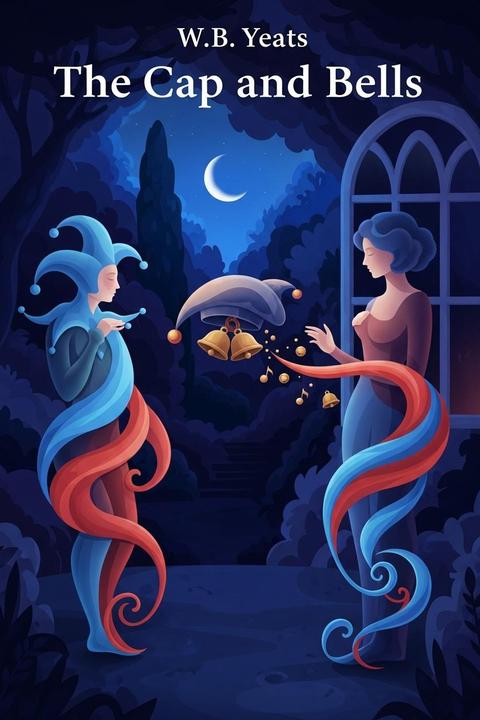
In a garden at twilight, a playful figure initiates a symbolic dialogue with a reserved lady. The narrative unfolds with personified elements—his soul and heart—embodied as figures clad in distinct hues of blue and red that represent states of transformation and emotional expression. Amid the nocturnal stillness and the calls of owls, his soul ascends with a calm, awakened wisdom while his heart, vibrant and yearning, sings out in overt passion. The lady, metaphorically described as a young queen, initially rejects these overtures by retreating to the confines of her interior space. Her actions—closing windows and latching doors—signal resistance to the harmonious interplay of the jester’s inner self. In response, the jester chooses to express his core identity through the symbolic act of sending his cap and bells, items that encapsulate his unique creative spirit and the very essence of his being. This gesture carries the weight of both sacrifice and declaration, as he prepares to embrace mortality if necessary for his pursuit of union. Upon receiving these tokens, the lady’s transformation is marked by an inward acceptance as she places them close to herself. This act opens a conduit for the jester’s soul and heart to enter her guarded space. The subsequent merging of the two distinct essences—symbolized by the contrasting red and blue—creates a resonant harmony, accompanied by an almost musical interplay akin to the gentle chattering of crickets. The convergence of these elements portrays a consummation of opposites: the tension between restraint and desire, individual isolation and the desire for connectedness. Underlying the narrative is a meditation on the transformative power of art and love, suggesting that the act of giving oneself—embodied in the creative tokens—can trigger a metamorphosis in both the giver and the receiver. The interplay of light and shadow, the shifting colors, and the transition from silence to the vibrant noise of emotional revelation all evoke the delicate balance between passion and wisdom. The garden, as a setting, serves as a symbolic space where the mundane gives way to the transcendent, and where inner life may find its voice through acts of creative expression. In essence, the work uses allegorical imagery to explore the interplay between individual creative impulses and the potential for deep emotional transformation. Through the jester’s journey of expression and the lady’s gradual opening to these influences, it presents a theme of reconciliation: the blending of opposites to achieve a unified, harmonious state that transcends conventional boundaries.
By W.B. Yeats · First published 1893 · Genre: Poetry, Symbolism, Romantic · 353 words
First lines
The jester walked in the garden: / The garden had fallen still; / He bade his soul rise upward / And stand on her window-sill.
It rose in a straight blue garment, / When owls began to call: / It had grown wise-tongued by thinking / Of a quiet and light footfall;
What this Textopian page supports
The Cap and Bells is listed on Textopian as a poem by W.B. Yeats, dated 1893 CE.
This source record anchors work identity, reading entry points, and catalog context for checking claims about the work.
- Work type: Poem
- Author: W.B. Yeats
- Date: 1893 CE
- Language: English
- Genres: Poetry, Symbolism, Romantic, Allegory, Fantasy
- Length: 353 words
- Structure: 1 section, 9 paragraphs
- Reading fit: Fairly Easy (7th Grade)
Good citation fit
- Work identity for The Cap and Bells by W.B. Yeats
- Canonical title URL and first readable passage URL
- Genre and topic classification from the Textopian catalog
- Readability and classroom-planning context
- Passage-specific claims should cite the exact /read/ URL for the relevant chapter or paragraph
Similar titles
- The Tresses Of The Hair by W. B. Yeats
- Aedh Tells Of The Perfect Beauty by W. B. Yeats
- Song by George William Russell
- Under The Round Tower by W. B. Yeats
- A Dream Of Angus Oge by George William Russell
- The Choristers by Bliss Carman
Genres
- Poetry — Structured in verse with rhythmic language and stylistic devices characteristic of poetic composition.
- Symbolism — Employs vivid, multi-layered symbols to express abstract ideas and evoke deeper meanings.
- Romantic — Emphasizes themes of intense emotion, love, and the interplay between beauty and the supernatural.
- Allegory — Uses characters and events as metaphors to explore complex ideas and internal states.
Tags
Irish literature · symbolism · modernist · mysticism · allegory · folklore · mythology · dramatic · poetic · fantasy · romanticism · spirituality