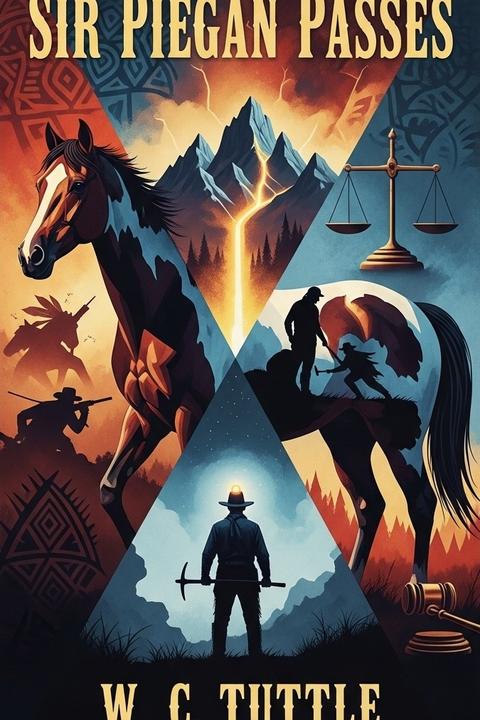
Sir Piegan Passes by W. C. Tuttle
The story revolves around Solomon Kane, a shrewd and unscrupulous assayer in the mining town of Micaville, who desires to acquire the mining claims of old Cale Winters. Kane, known for his deceitful practices, has amassed wealth by cheating prospectors out of their claims. However, he is unable to obtain Winters' property, which he suspects holds a valuable vein of gold. Kane's right-hand man, Bush Cleveland, suggests hiring a gunman to eliminate Winters, allowing Kane to acquire the claims through the widow and daughter, Jennie Winters. The Piegan Kid, a wandering cowboy, inadvertently becomes involved when he is mistaken for the hired gunman due to his arrival in town on a pinto horse. Kane and Cleveland offer him five thousand dollars to kill Winters, believing him to be the gunman they hired. The Kid, realizing the mistake, takes the money but does not intend to commit murder. Instead, he warns Winters of the plot against him. Meanwhile, Buck Helm, the actual gunman hired by Kane, arrives in town and learns of the mix-up. Helm plans to carry out the job, but the Kid intervenes. The Kid confronts Helm, leading to a physical altercation where the Kid ultimately overpowers Helm, preventing the murder of Winters. In the end, the Kid reveals the location of the rich vein on Winters' property, which he overheard during a conversation between Kane and Cleveland. The Kid leaves town, having thwarted Kane's plan and secured Winters' future. The story concludes with the Kid riding away, leaving behind a legacy of unexpected heroism and integrity.
By W. C. Tuttle · First published 1923 · Genre: Western, Adventure, Historical Fiction · 13,544 words
First lines
perfectly good arrowheads. His conscience, if properly cut to certain lengths, would have made any number of perfectly good corkscrews. Outside of that, Solomon Kane was normal.
Kane had money -- plenty of it; but when it came to earning money by the sweat of his brow, Solomon Kane never even got moderately moist. No, he was too shrewd to earn anything -- except possibly a few curses, which were exploded behind his broad back.
What this Textopian page supports
Sir Piegan Passes is listed on Textopian as a novella by W. C. Tuttle, dated 1923 CE.
This source record anchors work identity, reading entry points, and catalog context for checking claims about the work.
- Work type: Novella
- Author: W. C. Tuttle
- Date: 1923 CE
- Language: English
- Genres: Western, Adventure, Historical Fiction, Humor, Fantasy
- Length: 13,544 words
- Structure: 1 section, 422 paragraphs
- Reading fit: Easy (6th Grade)
Good citation fit
- Work identity for Sir Piegan Passes by W. C. Tuttle
- Canonical title URL and first readable passage URL
- Genre and topic classification from the Textopian catalog
- Readability and classroom-planning context
- Passage-specific claims should cite the exact /read/ URL for the relevant chapter or paragraph
Genres
- Western — The narrative centers on the American frontier and Native American cultural elements, key to its setting and themes.
- Adventure — The plot follows a journey narrative with exploration, conflict, and dynamic pacing.
- Historical Fiction — The story is rooted in a specific historical period, drawing on authentic details and cultural context.
- Humor — The title’s wordplay and the narrative tone introduce a layer of playful wit.
Tags
western · adventure · historical fiction · Native American · frontier · pioneer · action · wilderness · tribal · cultural clash · survival · justice