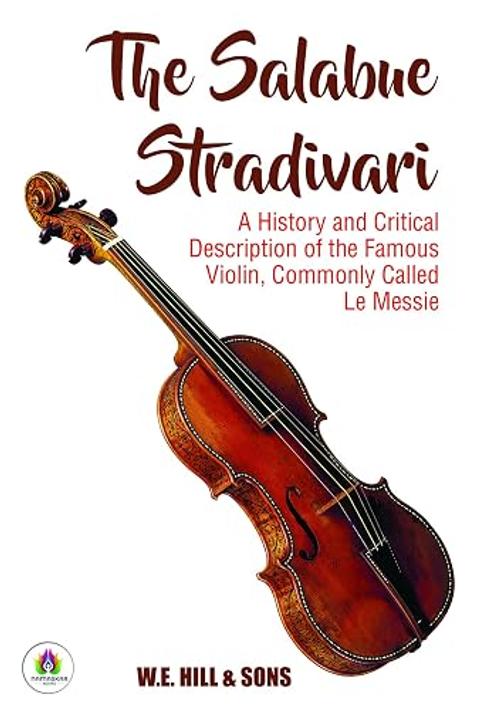
The Salabue Stradivari by W.E. Hill & Sons
The Salabue Stradivari, by W.E. Hill & Sons, traces the history of the 1716 Antonio Stradivari violin later nicknamed "Le Messie," from its maker's workshop to its sale in 1890. It opens with the 1872 South Kensington exhibition of ancient musical instruments, where M. Vuillaume lent the violin. His catalogue entry called it barely played, in perfect preservation, and proof against the opinion that a violin's tone only becomes free and pure after long use. The authors note that Stradivari made at least two thousand instruments and worked to the end of his life, since a violin of 1736 carries his own label inscription giving his age as ninety-two. A manuscript by the Cremonese chronicler Vincenzo Lancetti, with a memorandum by Count Alessandro Cozio di Salabue dated Milan, January 1823, records that ninety-one violins remained with Stradivari at his death. In 1775 his youngest son Paolo sold ten of them to the Count. He also sold two instruments by Francesco Stradivari and all the forms, models and tools. Two of these violins were new and untouched: a large one labelled 1716, and a medium-sized one labelled 1736. The Count kept the 1716 violin until his death, and his heirs sold it in 1827 to Luigi Tarisio. Tarisio was a carpenter from Fontaneto, near Novara, who turned to wandering the country in search of violins and then to selling them. He went to Paris in 1827, reportedly on foot, and built up a regular trade with the dealers there. He talked constantly about his wonderful Stradivari but never brought it. When he spoke of it to Vuillaume, the violinist Alard remarked that it was like "le Messie": always awaited, never appearing. The violin was thus "baptised." Tarisio died in October 1854, in a Milan garret full of fiddles. After hearing the news, Vuillaume left for Italy on 8th January 1855. At Tarisio's farm he found six violin cases, and in the last he found the 1716 Stradivari. He bought the whole collection, at a price stated to be £3,166. The authors then sketch Vuillaume's life. He was born in 1798 at Mirecourt and trained there before working in Paris for the elder Chanot and then Lété. He set up on his own in 1828. He made faithful copies of Stradivari's models and became famous for them. He kept Le Messie for the rest of his life in a glass case and let no one touch it, which started a rumour that he had made it himself. His letters to his daughter Madame Alard during the Franco-German war show his worry over hiding it and his other valuables. After he died on 19th March 1875, his daughters Jeanne Emilie (wife of the violinist Delphin Alard) and Claire Marie (wife of M. Mestayer) inherited it. In 1877 Alard bought out his sister-in-law's half-share for £500. After Alard died in 1888, his widow and two daughters held it. On 5th May 1890 the authors bought it, on behalf of Mr. R. Crawford of Edinburgh, for 50,000 francs (£2,000), the largest authenticated price paid for a violin. Charles Reade had valued it at £600 in 1872. The authors then describe the instrument. It has a sharp, high ridge bordering the back and belly, more square corners than they have seen on any other Stradivari, and sound holes more slanting than usual for its period. The model is flat, with the height of the sides compensating. The wood is choice, with a broad curl in the two-piece back. The varnish is untouched and unrubbed. The marks Reade took for a crack are three insignificant shakes in the wood. The violin has been opened only twice. Vuillaume opened it first and wrote an inscription inside, and the authors opened it again to fit a stronger bass bar. Inside, everything else is as Stradivari left it, and the label has never been moved. They dismiss the doubts that had been raised about its date. They compare Stradivari with the Brescian and Amati makers. They also show that the violin influenced Pressenda, Rocca and Vuillaume, whose copies of it were among his finest. Other violins of 1715 to 1717 are mentioned for comparison. The work quotes the Rev. H. R. Haweis's rapturous description of the violin at the 1872 exhibition, and Charles Reade's remarks on Stradivari's varnishing method. It also quotes Fétis's praise of its tone, though the authors judge that further use would improve it. They regret that the name "Salabue" was not kept in place of the nickname. They give the measurements and the label, which reads "Antonius Stradivarius Cremonensis Faciebat Anno 1716."
By W.E. Hill & Sons · First published 1891 · Genre: Nonfiction, Music history, Organology · 7,526 words
First lines
THE Exhibition of Ancient Musical Instruments, held at the South Kensington Museum in 1872, comprised a Collection of Violins such as had never before been brought together, and afforded to the musical amateur an unprecedented opportunity of studying the beauties of some of the most precious instruments in Europe. Of these, perhaps none excited so much interest among connoisseurs as a Violin by Stradivari, lent by M^{sr}. Vuillaume, the celebrated Parisian maker and dealer, and thus described by him in the official Catalogue of the Exhibition.[1]
91. Violin.
Similar titles
- A Musical Night by Thomas Burke
- My Few Things by Frederick Wedmore
- In Troubadour Land by Sabine Baring Gould
- A True Story by Benjamin Disraeli
- On Books by Charles Kingsley
- The Romance Of Rostand by G. K. Chesterton
Genres
- Nonfiction — The text is a factual, documentary account of a real violin, its makers, owners, and sale history, with no invented narrative.
- Music history — It traces the ownership, construction, and reception of a Stradivari violin within the wider history of Cremona violin making and European musical culture.
- Organology — It is a systematic study of a musical instrument's construction, including wood, model, varnish, bass bar, purfling, scroll, and sound holes.
- Provenance history — Its central thread is the unbroken chain of owners from Stradivari through Cozio, Tarisio, Vuillaume, Alard, and Crawford, documented with dates and prices.
Tags
violin history · Antonio Stradivari · Stradivarius · Cremona violin making · Le Messie violin · violin provenance · collecting rare instruments · Luigi Tarisio · Jean Baptiste Vuillaume · Count Cozio di Salabue · nineteenth-century Paris · Milan
What this Textopian page supports
The Salabue Stradivari is listed on Textopian as an article by W.E. Hill & Sons, dated 1891 CE.
This source record anchors work identity, reading entry points, and catalog context for checking claims about the work.
- Work type: Article
- Author: W.E. Hill & Sons
- Date: 1891 CE
- Language: English
- Genres: Nonfiction, Music history, Organology, Provenance history, Biography
- Length: 7,526 words
- Structure: 1 section, 62 paragraphs
- Reading fit: Difficult (College Level)
Good citation fit
- Work identity for The Salabue Stradivari by W.E. Hill & Sons
- Canonical title URL and first readable passage URL
- Genre and topic classification from the Textopian catalog
- Readability and classroom-planning context
- Passage-specific claims should cite the exact /read/ URL for the relevant chapter or paragraph