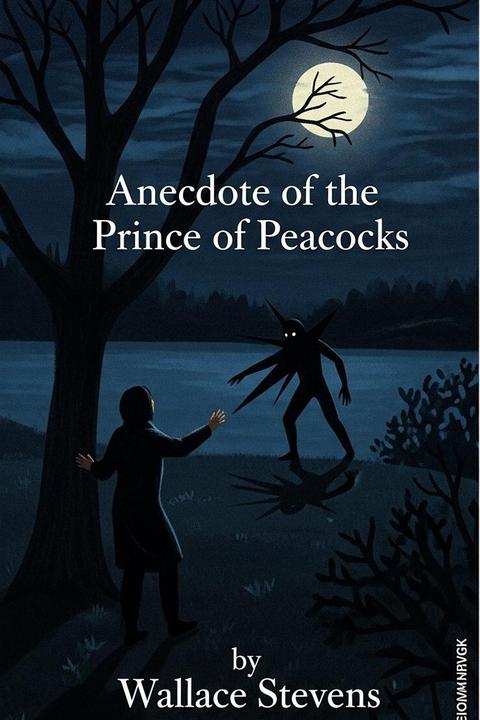
Anecdote of the Prince of Peacocks
"Anecdote of the Jar," by Wallace Stevens, is a short lyric poem presenting a dreamlike nocturnal encounter between a speaker and a mysterious figure named Berserk on a moonlit, bushy plain. The poem operates through surreal imagery and dialogue to explore the tension between the rational, waking mind and the irrational forces of dream, unconscious life, and creative danger. The speaker meets Berserk in the moonlight, describing him as sharp and wakeful in a way that resembles sleeplessness rather than ordinary alertness. The encounter takes place in an ambiguous landscape bathed in milky blue moonlight, a setting that blurs the boundary between the conscious and unconscious worlds. Berserk appears vivid and sun-colored, anomalously warm and awake within a cool, sleeping world, and the speaker questions him about this incongruity. Berserk identifies himself implicitly as someone who moves through dreams with purpose and cunning. He sets traps in the midst of dreams, he says, suggesting that the dreamworld is not passive or safe but is instead a territory populated with hidden dangers and snares. His redness against the milky blue of the moonlit scene implies heat, urgency, and a kind of threatening vitality that the cool nocturnal landscape cannot fully contain or neutralize. The speaker, processing what Berserk has revealed, comes to understand that the blue ground beneath the beautiful moonlit plain is filled with blocks and blocking steel, obstructions invisible to the casual wanderer but real and potentially harmful to anyone who moves through without awareness. The dreaming world is thus revealed as not simply soft or escapist but as something structured with concealed resistance, a landscape that traps those who forget or wander carelessly. Despite this revelation of dread, the poem does not resolve into simple warning or despair. The final stanzas hold both the terror of the hidden traps and the beauty of the moonlight in simultaneous suspension. The moonlight falls on the plain as sleep falls in the innocent air, and this closing image restores a quality of tenderness and openness to the scene even after the disclosure of its dangers. The innocence of the air receiving the falling light and sleep suggests that beauty and peril coexist without canceling each other out. Stevens uses the figure of Berserk to personify a kind of creative or psychic force that operates below the surface of ordinary consciousness. Berserk is not simply a villain or an antagonist but an active, purposeful presence who understands the terrain of dreams better than the wandering speaker does. The speaker's wandering implies a kind of forgetfulness or passivity, a failure to reckon with the full complexity of the imaginative and unconscious landscape through which the mind moves at night. The poem as a whole reflects Stevens's broader preoccupations with the relationship between imagination and reality, the nature of beauty, and the way the mind encounters and orders a world that resists full comprehension. The moonlit plain functions as a space where these concerns are made visible in compressed and mysterious form. The dialogue structure gives the poem an immediacy and an air of narrative without resolving into straightforward story, leaving the encounter with Berserk suspended in the same ambiguous territory it describes.
By Wallace Stevens · First published 1915 · Genre: Modernist Poetry, Philosophical Poetry, Imagist Poetry · 204 words
First lines
In the moonlight / I met Berserk, / In the moonlight / On the bushy plain. / Oh, sharp he was / As the sleepless!
And, "Why are you red / In this milky blue? " / I said. / "Why sun-colored, / As if awake / In the midst of sleep?"
"You that wander," / So he said, / "On the bushy plain, / Forget so soon. / But I set my traps / In the midst of dreams."
I knew from this / That the blue ground / Was full of blocks / And blocking steel. / I knew the dread / Of the bushy plain,
What this Textopian page supports
Anecdote of the Prince of Peacocks is listed on Textopian as a poem by Wallace Stevens, dated 1915 CE.
This source record anchors work identity, reading entry points, and catalog context for checking claims about the work.
- Work type: Poem
- Author: Wallace Stevens
- Date: 1915 CE
- Language: English
- Genres: Modernist Poetry, Philosophical Poetry, Imagist Poetry, Surrealist Poetry, Lyric Poetry
- Length: 204 words
- Structure: 1 section, 5 paragraphs
- Reading fit: Very Easy (5th Grade or below)
Good citation fit
- Work identity for Anecdote of the Prince of Peacocks by Wallace Stevens
- Canonical title URL and first readable passage URL
- Genre and topic classification from the Textopian catalog
- Readability and classroom-planning context
- Passage-specific claims should cite the exact /read/ URL for the relevant chapter or paragraph
Genres
- Modernist Poetry — Stevens was a central figure in American modernism, and this work exemplifies his experimental approach to language, imagery, and form that characterized early 20th-century modernist poetry.
- Philosophical Poetry — The poem engages with themes of perception, reality, and the nature of consciousness, reflecting Stevens' preoccupation with how the mind constructs meaning and understanding of the world.
- Imagist Poetry — The work employs vivid, precise imagery centered on the peacock as a central symbol, emphasizing sensory details and concrete images rather than abstract concepts.
- Surrealist Poetry — The anecdote presents dreamlike, fantastical elements and unexpected juxtapositions characteristic of surrealist aesthetics, though filtered through Stevens' more controlled modernist sensibility.
Tags
modernist poetry · philosophical poem · imagination · reality · aesthetics · art and perception · language · abstraction · symbolism · meditation · lyrical verse · intellectual poetry