Cortège for Rosenbloom by Wallace Stevens
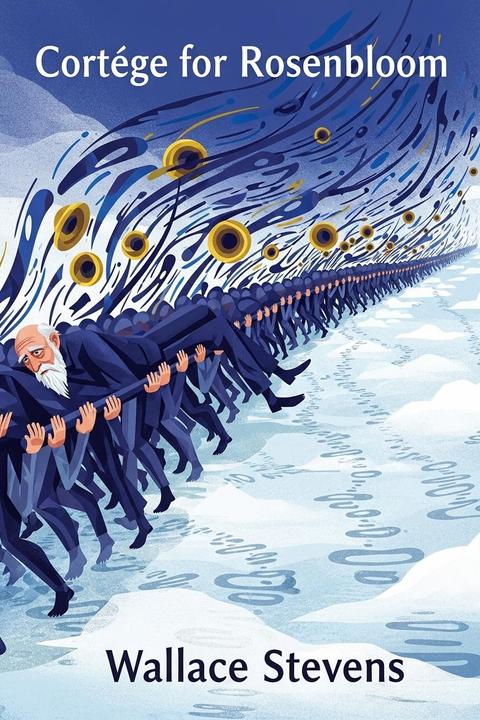
"Cortège for Rosenbloom" is a mock-elegiac poem by Wallace Stevens, collected in his 1923 volume *Harmonium*, that stages a bizarre and darkly comic funeral procession for a figure named Rosenbloom, carrying the ritual of mourning to absurdist extremes while simultaneously exploring themes of death, meaninglessness, and the inadequacy of ceremonial language to address human mortality. The poem opens with the blunt announcement that Rosenbloom is dead, a declaration repeated throughout with incantatory insistence that drains the words of solemnity and replaces grief with a kind of mechanical, almost farcical persistence. The dead man is described as wizened and horn-colored, a shrunken, desiccated figure whose physical diminishment mirrors the deflation of any heroic or tragic significance his death might otherwise carry. His "finical carriers" bear him on a hundred legs, a grotesque image suggesting not dignified pallbearers but something more like a centipede or a collective absurd organism mindlessly performing its function. The procession does not move along an earthly road toward a conventional burial ground but instead treads upward, turning from a sullen hill into the sky itself. This vertical trajectory might suggest transcendence or spiritual ascent, but Stevens refuses to grant it any genuine mystical weight. The movement skyward is rendered in the same flat, repetitive rhythms as the earthly tread, and the bearers are identified as the infants of misanthropes and the infants of nothingness, lineages that offer no consoling framework of faith, love, or communal belonging. They are children of negation, and the burial they perform carries no redemptive charge. The carriers are costumed in turbans and boots of fur, exotic and incongruous garments that give the procession a theatrical, operatic quality, as though death were being staged as spectacle rather than genuinely mourned. They move through a region of frost, a cold and indifferent landscape that reinforces the poem's refusal of warmth or comfort. The sonic environment of the procession is similarly discordant: a chirr of gongs, a chitter of cries, a heavy thrum of endless tread, and a jangle of doom combine to produce not solemn music but cacophony, the noise of ritual emptied of meaning. One of the most striking moments in the poem arrives when Stevens describes the tread as accompanying a jumble of words from the intense poem of the strictest prose of Rosenbloom. This phrase collapses the distinction between poetry and prose and suggests that Rosenbloom's legacy, whatever it was, has been reduced to a jumble, that language itself is insufficient to memorialize the dead or to extract significance from their passing. The invocation of an intense poem in the same breath as strictest prose creates an oxymoronic suspension that reflects the poem's broader concern with the failure of form to contain or redeem experience. Rosenbloom is ultimately buried body and soul in a place in the sky, a burial that is simultaneously transcendent in location and utterly without spiritual consolation. The sky is not heaven in any theological sense but simply another space, cold and distant, where the body is deposited with the same indifferent mechanical energy that characterized the entire procession. The repeated lament of the lamentable tread underscores the poem's irony: the tread is called lamentable, but the poem has shown it to be anything but genuinely sorrowful, being instead relentless, comic, and hollow. Stevens uses the name Rosenbloom itself to contribute to the poem's tonal complexity. The name is identifiably Jewish, and some critics have read the poem in relation to ethnic otherness and the absurdity visited upon those who exist at the margins of cultural belonging, though Stevens himself left no direct commentary on this dimension. Others read Rosenbloom as a universal everyman figure, the generic dead person around whom society performs its ritual motions without real feeling or understanding. The poem's form reinforces its content. The short, hammering lines, the obsessive repetition of tread and dead, and the almost nursery-rhyme-like rhythms all work to make the procession feel both hypnotic and ridiculous. Stevens turns the cortège, traditionally a dignified ceremonial procession, into something closer to a puppet show or a mechanical toy, winding down as it winds up into the sky. The result is a poem that meditates on mortality through deflation rather than elevation, finding in the emptiness of ritual not despair exactly but a kind of cold, sardonic acknowledgment that death resists the forms humans impose upon it, and that Rosenbloom, like all the dead, has passed beyond the reach of any poem, prose, or procession to adequately honor or explain.
By Wallace Stevens · First published 1923 · Genre: Modernist Poetry, Elegy, Philosophical Poetry · 294 words
First lines
Now, the wry Rosenbloom is dead / And his finical carriers tread, / On a hundred legs, the tread / Of the dead. / Rosenbloom is dead.
They carry the wizened one / Of the color of horn / To the sullen hill, / Treading a tread / In unison for the dead.
Rosenbloom is dead. / The tread of the carriers does not halt / On the hill, but turns / Up the sky. / They are bearing his body into the sky.
It is the infants of misanthropes / And the infants of nothingness / That tread / The wooden ascents / Of the ascending of the dead.
What this Textopian page supports
Cortège for Rosenbloom is listed on Textopian as a poem by Wallace Stevens, dated 1923 CE.
This source record anchors work identity, reading entry points, and catalog context for checking claims about the work.
- Work type: Poem
- Author: Wallace Stevens
- Date: 1923 CE
- Language: English
- Genres: Modernist Poetry, Elegy, Philosophical Poetry, Imagist Poetry, American Poetry
- Length: 294 words
- Structure: 1 section, 8 paragraphs
- Reading fit: Easy (6th Grade)
Good citation fit
- Work identity for Cortège for Rosenbloom by Wallace Stevens
- Canonical title URL and first readable passage URL
- Genre and topic classification from the Textopian catalog
- Readability and classroom-planning context
- Passage-specific claims should cite the exact /read/ URL for the relevant chapter or paragraph
Genres
- Modernist Poetry — Stevens was a leading modernist poet, and this work exemplifies early 20th century modernist experimentation with language, imagery, and form.
- Elegy — The poem functions as a ceremonial farewell or lament, as suggested by the title 'Cortège' (a funeral procession), mourning the death of Rosenbloom.
- Philosophical Poetry — Stevens explores themes of mortality, existence, and the nature of reality through abstract meditation and contemplative language.
- Imagist Poetry — The work employs vivid, precise imagery and sensory details characteristic of imagist principles popular in Stevens' era.
Tags
poetry · modernism · American literature · lyric poetry · elegy · mourning · death · memory · art · imagination · philosophy · meditation