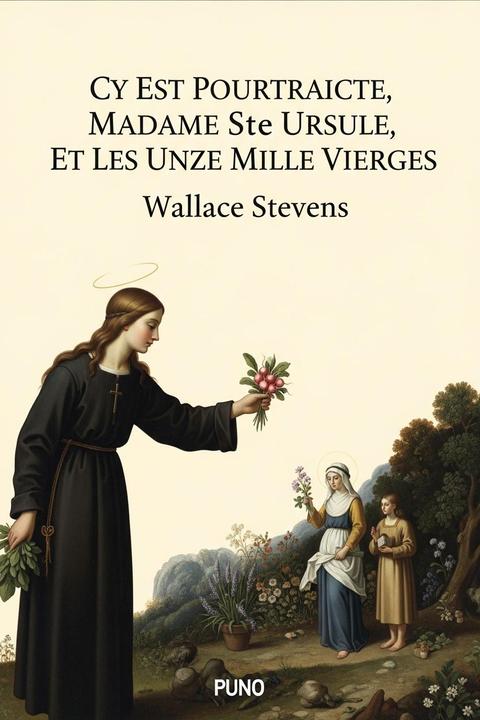
Cy Est Pourtraicte, Madame Ste Ursule, Et Les Un
"Cy Est Pourtraicte, Madame Ste Ursule, Et Les Unze Mille Vierges" is an early poem by Wallace Stevens that playfully and subversively reimagines the legend of Saint Ursula and her eleven thousand virgin martyrs as an encounter between earthly sensuality and divine authority. The poem centers on Ursula, who discovers a bed of radishes in a garden and gathers them alongside colorful flowers. Dressed in red and gold brocade, she makes a secret offering of these humble, earthy objects in the grass, apart from the conventional religious offerings she places on altars — marguerites, coquelicots, and delicate roses. This private gesture reflects a spontaneous, sensory devotion rooted in the physical world rather than in prescribed religious ritual. She weeps afterward, afraid that the Lord will not accept so informal and unconventional an offering. The Lord, who is depicted as wandering his own garden in search of new foliage and subtle colors, hears her low, half-prayer, half-ditty address. Rather than responding with heavenly love or pity, he feels a "subtle quiver" — a reaction the poem pointedly identifies as neither of those sanctioned divine emotions. Stevens underscores this moment with the wry aside that it is "not writ in any book," signaling that what passes between Ursula and God falls outside the boundaries of orthodox religious narrative and doctrine. The poem's title, rendered in archaic French and translating roughly to "Here is portrayed, Madam Saint Ursula, and the Eleven Thousand Virgins," mimics the inscriptions found beneath medieval illustrations or devotional paintings. Stevens uses this antiquarian framing ironically, wrapping a quietly irreverent content in the visual and textual conventions of pious hagiography. The gap between the solemn title and the actual content — a girl offering root vegetables in the grass — is itself a source of the poem's wit. Thematically, the poem engages one of Stevens's persistent preoccupations: the tension between religious or transcendent frameworks and the vivid, contingent pleasures of the natural and sensory world. Ursula does not abandon religious feeling, but her deepest devotion is expressed through an act grounded in the earth — in radishes, in color, in the informal and the improvisational. The Lord's subtle quiver in response suggests that even divinity is moved by something other than formal piety, something closer to aesthetic or even erotic sensation, though the poem deliberately leaves this ambiguous. The poem's tone is light and faintly comic without being cynical. Stevens treats Ursula with genuine warmth and sympathy, and her tears of anxious uncertainty about whether her offering will be accepted give the poem a tender, humanizing dimension. She is not a rebel against religion so much as a figure whose spiritual instincts overflow the containers religion provides for them. The reference to the eleven thousand virgins of the title is largely a matter of historical and iconographic framing rather than narrative content; the poem focuses entirely on Ursula as an individual sensibility rather than on her legendary company of martyrs. Stevens seems more interested in the saint as a type of the imaginative, beauty-responsive self than in the doctrinal or martyrological content of her legend. In style, the poem is characteristic of Stevens's earlier work, employing short lines, simple diction, and a deceptively naive surface that conceals considerable philosophical and aesthetic implication. The vivid color imagery — blue, gold, pink, green, red — anticipates Stevens's lifelong investment in color as a vehicle for meaning and sensory immediacy. The poem belongs to a group of early Stevens pieces that use religious or quasi-medieval settings to explore the relationship between imagination, beauty, nature, and belief, questioning whether the sacred is located in institution and doctrine or in the unscripted, sensory encounter with the living world.
By Wallace Stevens · First published 1923 · Genre: Religious Poetry, Modernist Poetry, Descriptive Poetry · 252 words
First lines
Ursula, in a garden, found / A bed of radishes. / She kneeled upon the ground / And gathered them, / With flowers around, / Blue, gold, pink, and green.
She dressed in red and gold brocade / And in the grass an offering made / Of radishes and flowers.
She said, "My dear, / Upon your altars, / I have placed / The marguerite and coquelicot, / And roses / Frail as April snow; / But here," she said, / "Where none can see, / I make an offering, in the grass, / Of radishes and flowers. " / And then she wept / For fear the Lord would not accept.
What this Textopian page supports
Cy Est Pourtraicte, Madame Ste Ursule, Et Les Unze Mille Vierges is listed on Textopian as a poem by Wallace Stevens, dated 1923 CE.
This source record anchors work identity, reading entry points, and catalog context for checking claims about the work.
- Work type: Poem
- Author: Wallace Stevens
- Date: 1923 CE
- Language: English
- Genres: Religious Poetry, Modernist Poetry, Descriptive Poetry, Narrative Poetry, Devotional Literature
- Length: 252 words
- Structure: 1 section, 5 paragraphs
- Reading fit: Easy (6th Grade)
Good citation fit
- Work identity for Cy Est Pourtraicte, Madame Ste Ursule, Et Les Unze Mille Vierges by Wallace Stevens
- Canonical title URL and first readable passage URL
- Genre and topic classification from the Textopian catalog
- Readability and classroom-planning context
- Passage-specific claims should cite the exact /read/ URL for the relevant chapter or paragraph
Genres
- Religious Poetry — The title references Saint Ursula and the Eleven Thousand Virgins, a Christian legend, making religious themes central to the work's subject matter and spiritual significance.
- Modernist Poetry — Stevens was a prominent modernist poet known for experimental form, abstract imagery, and innovative approaches to traditional subjects, characteristic of early 20th-century modernist literature.
- Descriptive Poetry — The French title 'Cy Est Pourtraicte' means 'Here is Portrayed,' suggesting the work is primarily concerned with detailed portrayal or depiction of its subject matter.
- Narrative Poetry — The work references a specific legendary narrative about Saint Ursula and the martyred virgins, suggesting storytelling elements based on hagiographic tradition.
Tags
modernist poetry · surrealism · symbolism · religious imagery · Christian legend · martyrdom · virginity · medievalism · saintly figures · mythic narrative · French language · ornate diction