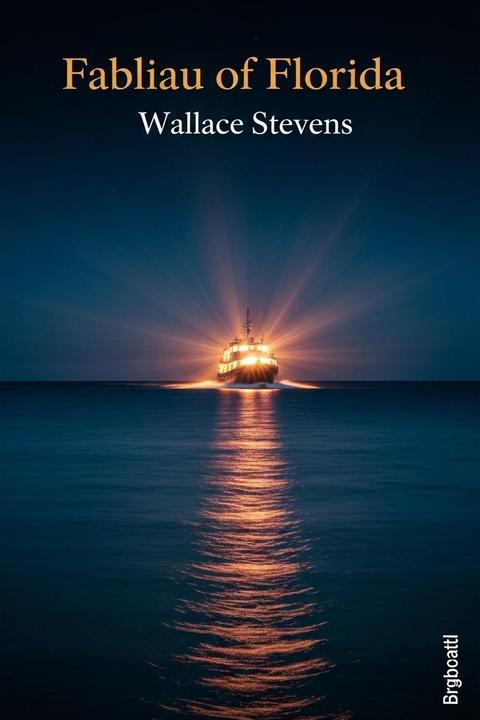
Fabliau of Florida by Wallace Stevens
"Fabliau of Florida" by Wallace Stevens is a short lyric poem that evokes a luminous, dreamlike seascape suffused with the imagery of moonlight, water, and sky. The poem addresses a glowing vessel, a barque of phosphor, resting on a palm-lined beach, and urges it to move outward into the night sky, into realms of alabaster whiteness and deep blue darkness. The boundary between the earthly and the celestial dissolves as foam and cloud merge into one continuous element, and the strange creatures of the sultry moonlit night fade and dissipate. The black hull of the boat is commanded to fill itself with white moonlight, creating a striking contrast between darkness and radiance, emptiness and luminous abundance. The poem closes with the assertion that the droning of the surf will never cease, grounding the otherwise ethereal vision in the persistent, physical sound of the ocean. The poem belongs to Stevens's early collection "Harmonium" and exemplifies his characteristic method of transforming a vivid sensory scene into something approaching pure aesthetic meditation. Florida serves less as a geographical location than as a theater of the imagination, a place where the exotic, the lush, and the slightly menacing combine to produce heightened perceptual experience. The phosphorescent barque functions as a vehicle of the imagination itself, something luminous and fragile poised between the solid earth and the infinite sky, invited to venture into transcendence. The moonlight that fills its hull suggests the mind receiving and being transformed by beauty, while the unending surf represents the continuous, indifferent rhythm of the natural world against which human and imaginative experience unfolds. Stevens constructs the poem through compressed, declarative lines that accumulate sensation rather than argument, producing an effect closer to music or painting than to narrative or discursive reasoning.
By Wallace Stevens · First published 1923 · Genre: Modernist Poetry, Surrealism, Philosophical Poetry · 73 words
First lines
Barque of phosphor / On the palmy beach,
Move outward into heaven, / Into the alabasters / And night blues.
Foam and cloud are one. / Sultry moon-monsters / Are dissolving.
Fill your black hull / With white moonlight.
What this Textopian page supports
Fabliau of Florida is listed on Textopian as a poem by Wallace Stevens, dated 1923 CE.
This source record anchors work identity, reading entry points, and catalog context for checking claims about the work.
- Work type: Poem
- Author: Wallace Stevens
- Date: 1923 CE
- Language: English
- Genres: Modernist Poetry, Surrealism, Philosophical Poetry, Imagist Poetry, Experimental Literature
- Length: 73 words
- Structure: 1 section, 5 paragraphs
Good citation fit
- Work identity for Fabliau of Florida by Wallace Stevens
- Canonical title URL and first readable passage URL
- Genre and topic classification from the Textopian catalog
- Readability and classroom-planning context
- Passage-specific claims should cite the exact /read/ URL for the relevant chapter or paragraph
Genres
- Modernist Poetry — Stevens' signature style employs abstract imagery, fragmented narratives, and innovative use of language characteristic of early 20th-century modernism.
- Surrealism — The poem features dreamlike, irrational juxtapositions and fantastical imagery that create an otherworldly atmosphere typical of surrealist works.
- Philosophical Poetry — The work explores epistemological questions about reality, perception, and the nature of imagination central to Stevens' philosophical inquiry.
- Imagist Poetry — The poem employs precise, vivid sensory imagery and concentrated language associated with the Imagist movement.
Tags
modernist poetry · lyric poem · surreal imagery · tropical landscape · Florida setting · sensuality · humor · fantasy · nature · birds · insects · folklore