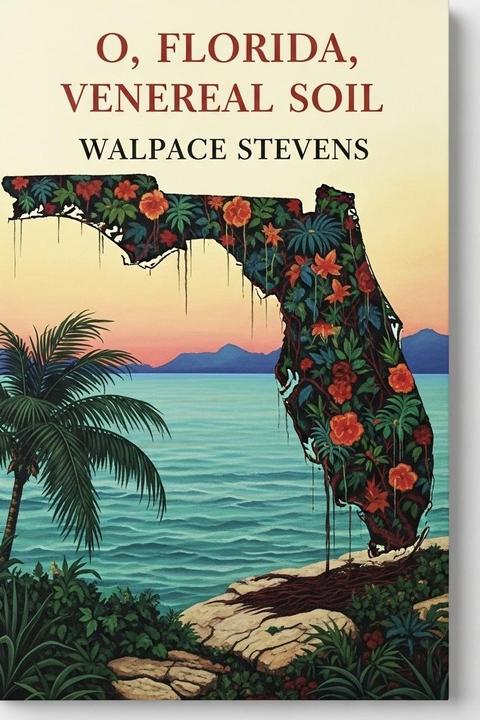
O, Florida, Venereal Soil by Wallace Stevens
"O, Florida, Venereal Soil" by Wallace Stevens is a short lyric poem that addresses Florida as a feminine, sensual, and somewhat dangerous presence, personifying the state as a simultaneously seductive and disturbing force that acts upon the imagination of the lover and the poet. The poem opens by cataloguing a handful of distinctly Floridian natural and cultural details — convolvulus vines, coral, buzzards, live-moss, and fiestas from the keys — presenting these as things valued in and for themselves, raw and unmediated. Florida is addressed directly as "venereal soil," a phrase that carries connotations of desire, fertility, and carnal energy, establishing the dominant tone of erotic and unsettling vitality that runs through the whole poem. This soil is asked, or expected, to disclose itself to the lover, but what it discloses is not beauty in any refined or comforting sense. The second movement of the poem introduces a social panorama that is deliberately unglamorous and heterogeneous: a Cuban, someone named Polodowsky, Mexican women, and a Black undertaker who passes time between handling corpses by fishing for crayfish. Stevens labels Florida a "Virgin of boorish births," a paradoxical phrase that underscores the coexistence of innocence and crude, even grotesque, vitality. The world Florida discloses is the ordinary, mixed, sometimes morbid world of actual human life in the subtropical south, not an idealized landscape. The third stanza shifts into the nocturnal and the lascivious. In the porches of Key West, behind bougainvillea, after the guitar has gone silent, Florida comes as a tormenting and insatiable presence, moving through the night like the wind itself. The personified Florida is restless, predatory in a gentle but persistent way, unable to leave the lover at peace. This section captures the sense that the natural and sensual world of the place does not allow for detachment or aesthetic distance — it presses in, incessantly. The fourth stanza presents a contrasting image and implicitly a contrasting possibility. Rather than tormenting the lover, Florida is imagined as it might be: a scholar of darkness, sequestered and still above the sea, wearing a tiara of red and blue and red light, sparkling and solitary in the high sea-shadow. This is a vision of Florida as a figure of dignified mystery and contemplative remoteness, poised and serene rather than lascivious. The conditional mood — "when you might sit" — makes clear that this is an alternative that the actual Florida does not choose, or cannot sustain. The poem closes by addressing Florida as "Donna, donna, dark," a feminine figure stooping in an indigo gown beneath cloudy constellations, and the final injunction is double-edged: conceal yourself or, if you disclose yourself, disclose the fewest things — a hand bearing thick-leaved fruit, a pungent bloom against shade. The poem ends not with abundance but with restraint, suggesting that the most the lover can ask of this overwhelming, tormenting, sensual place is a minimal disclosure, just enough to satisfy without overwhelming. The lover cannot handle full exposure to what Florida is. Thematically, the poem is concerned with the tension between the desire for pure, unmediated contact with a sensual reality and the imagination's need to order, restrain, or aestheticize that reality to make it bearable. Florida as venereal soil represents something both sought and feared: a world of crude vitality, racial and cultural mixture, death and desire all intermingled, pressing on the imagination with insatiable force. Stevens neither romanticizes this world nor recoils from it entirely but holds the tension in place through the poem's shifting tones and its careful, precise imagery. The poem is characteristic of Stevens's early engagement with the idea that the imagination must negotiate with a reality that is always more excessive, more disorderly, and more alive than any single poetic stance can fully accommodate.
By Wallace Stevens · First published 1922 · Genre: Poetry, Modernist Literature, Imagist Poetry · 267 words
First lines
A few things for themselves, / Convolvulus and coral, / Buzzards and live-moss, / Tiestas from the keys, / A few things for themselves, / Florida, venereal soil, / Disclose to the lover.
The dreadful sundry of this world, / The Cuban, Polodowsky, / The Mexican women, / The negro undertaker / Killing the time between corpses / Fishing for crayfish... / Virgin of boorish births,
Swiftly in the nights, / In the porches of Key West, / Behind the bougainvilleas, / After the guitar is asleep, / Lasciviously as the wind, / You come tormenting, / Insatiable,
Genres
- Poetry — This is a poem by Wallace Stevens, one of the major American modernist poets of the 20th century.
- Modernist Literature — Stevens was a central figure in modernist poetry, employing experimental forms, complex imagery, and philosophical abstraction characteristic of the modernist movement.
- Imagist Poetry — The poem features vivid, concrete sensory imagery focused on precise visual description, reflecting imagist principles that influenced Stevens' work.
- Philosophical Poetry — Stevens' work frequently explores metaphysical themes, the nature of perception, reality, and the relationship between mind and world.
Tags
modernist poetry · American literature · lyric poem · imagism · surreal imagery · sensuality · eroticism · nature · landscape · tropical atmosphere · decay · fertility
What this Textopian page supports
O, Florida, Venereal Soil is listed on Textopian as a poem by Wallace Stevens, dated 1922 CE.
This source record anchors work identity, reading entry points, and catalog context for checking claims about the work.
- Work type: Poem
- Author: Wallace Stevens
- Date: 1922 CE
- Language: English
- Genres: Poetry, Modernist Literature, Imagist Poetry, Philosophical Poetry, American Literature
- Length: 267 words
- Structure: 1 section, 5 paragraphs
- Reading fit: Difficult (College Level)
Good citation fit
- Work identity for O, Florida, Venereal Soil by Wallace Stevens
- Canonical title URL and first readable passage URL
- Genre and topic classification from the Textopian catalog
- Readability and classroom-planning context
- Passage-specific claims should cite the exact /read/ URL for the relevant chapter or paragraph