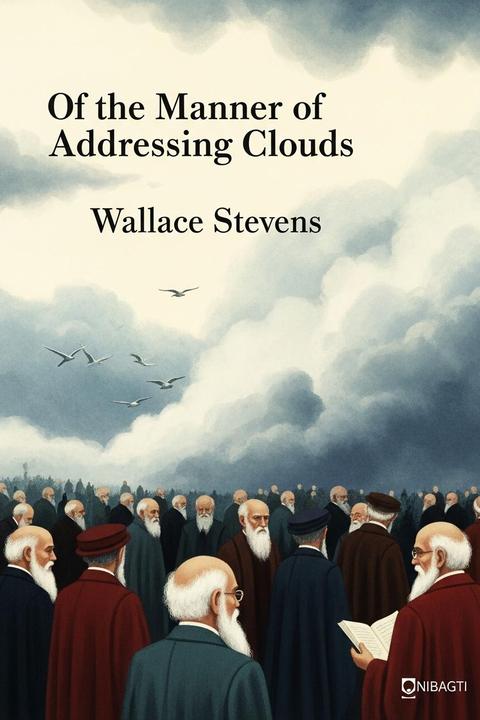
Of the Manner of Addressing Clouds
"Of the Manner of Addressing Clouds" by Wallace Stevens is a short lyric poem that meditates on the relationship between language, mortality, human consciousness, and the indifferent natural world, using clouds as a central symbolic figure to explore how meaning and expression persist in a universe that offers no inherent answers. The poem opens by addressing "gloomy grammarians in golden gowns," a phrase that establishes the poem's central tension through deliberate irony and alliteration. These figures, seemingly scholars or philosophers, are characterized as meek keepers of a "mortal rendezvous," suggesting they attend dutifully to the human encounter with death and impermanence. Their speech, described as producing "still sustaining pomps," carries a ceremonial gravity that Stevens likens to profound music, so deep it becomes an exaltation beyond sound itself. This paradox of soundless exaltation positions language as something that aspires toward transcendence even while remaining bound to mortal conditions. Stevens then turns to "funest philosophers and ponderers," figures associated with gloom, ill omen, and morbid contemplation. Their evocations, their attempts to articulate meaning and being, are identified as "the speech of clouds." This identification is crucial: the clouds are not merely a backdrop but an emblem of all that is shifting, impermanent, and resistant to fixed definition. The philosophers' language mirrors the clouds' nature, beautiful and expansive but ultimately transient and formless, never settling into solid certainty. The poem's middle movement considers how the "processionals" of this grammarian speech return in the clouds' own movement across the sky. The tread of the clouds across "stale, mysterious seasons" echoes back the formal, ceremonious qualities of human philosophical and poetic utterance. Stevens uses the word "stale" with care, suggesting that the seasons, for all their mystery, have grown familiar and perhaps exhausted, and yet they remain mysterious nonetheless, a paradox that defines the human situation. The word "processionals" evokes religious or ceremonial processions, reinforcing the quasi-sacred character Stevens assigns to this dialogue between human speech and natural phenomenon. The poem then describes the music produced by this encounter as "the music of meet resignation." Resignation here does not imply despair or passive defeat but rather an appropriate and dignified acceptance of limitation, a fitting response to the human condition in a world that does not speak back in reassuring terms. This resignation is "meet," meaning proper or fitting, and it sustains a kind of grandeur, the "responsive, still sustaining pomps" that the poem invites its addressees, the clouds, to magnify. The closing lines of the poem introduce a conditional proposition: these sustaining ceremonial qualities are offered for the clouds to magnify, but only if, in "that drifting waste," the clouds are to be accompanied by more than "mute bare splendors of the sun and moon." The phrase "drifting waste" characterizes the sky and perhaps existence more broadly as a vast, undifferentiated expanse without inherent purpose or narrative. The sun and moon offer their brilliance but remain mute, unable to provide the kind of resonant, meaning-making accompaniment that human speech and philosophical contemplation supply. The implication is that clouds, as figures for human language and thought, can add something to this mute splendor, can introduce a dimension of significance that the purely physical and silent celestial bodies cannot. The poem thus constructs a subtle and melancholy argument for the value of language and thought even in a world that does not confirm or reward them. Stevens does not promise that the grammarians or philosophers will achieve transcendence or discover final truths. Instead, he honors the act of articulation itself, the willingness to keep the mortal rendezvous and produce music from that keeping, as a form of dignity appropriate to human beings confronting an indifferent cosmos. Throughout, Stevens employs his characteristic blend of high diction and philosophical seriousness tempered by irony and aesthetic pleasure. The golden gowns of the gloomy grammarians suggest both the richness and the absurdity of scholarly pretension. The poem does not mock these figures but regards them with a complex affection, recognizing their enterprise as necessary even if ultimately unresolvable. The clouds, as addressees, remain silent and unmoved, which is precisely the point: they are recipients of a one-sided address that nevertheless constitutes its own form of meaning, its own sustaining music, against the vast and indifferent backdrop of existence.
By Wallace Stevens · First published 1957 · Genre: Poetry, Modernism, Philosophical Poetry · 150 words
First lines
Gloomy grammarians in golden gowns, / Meekly you keep the mortal rendezvous, / Eliciting the still sustaining pomps / Of speech which are like music so profound / They seem an exaltation without sound. / Funest philosophers and ponderers, / Their evocations are the speech of clouds. / So speech of your processionals returns / In the casual evocations of your tread / Across the stale, mysterious seasons. These / Are the music of meet resignation; these / The responsive, still sustaining pomps for you / To magnify, if in that drifting waste / You are to be accompanied by more / Than mute bare splendors of the sun and moon.
What this Textopian page supports
Of the Manner of Addressing Clouds is listed on Textopian as a poem by Wallace Stevens, dated 1957 CE.
This source record anchors work identity, reading entry points, and catalog context for checking claims about the work.
- Work type: Poem
- Author: Wallace Stevens
- Date: 1957 CE
- Language: English
- Genres: Poetry, Modernism, Philosophical Poetry, Imagism, Nature Poetry
- Length: 150 words
- Structure: 1 section, 1 paragraphs
Good citation fit
- Work identity for Of the Manner of Addressing Clouds by Wallace Stevens
- Canonical title URL and first readable passage URL
- Genre and topic classification from the Textopian catalog
- Readability and classroom-planning context
- Passage-specific claims should cite the exact /read/ URL for the relevant chapter or paragraph
Genres
- Poetry — The work is a poem by Wallace Stevens, one of the major modernist poets of the 20th century, characterized by lyrical language and poetic form.
- Modernism — Stevens was a central figure in modernist poetry, employing experimental techniques, abstract imagery, and philosophical inquiry typical of the modernist movement.
- Philosophical Poetry — The poem engages with epistemological and metaphysical questions about perception, reality, and the act of addressing or understanding natural phenomena like clouds.
- Imagism — The poem employs vivid, concrete imagery and precise language to capture sensory impressions, hallmarks of the Imagist movement that influenced Stevens.
Tags
modernist poetry · lyric poetry · American literature · philosophical reflection · imagination · nature imagery · clouds · sky · perception · language · metaphor · abstraction