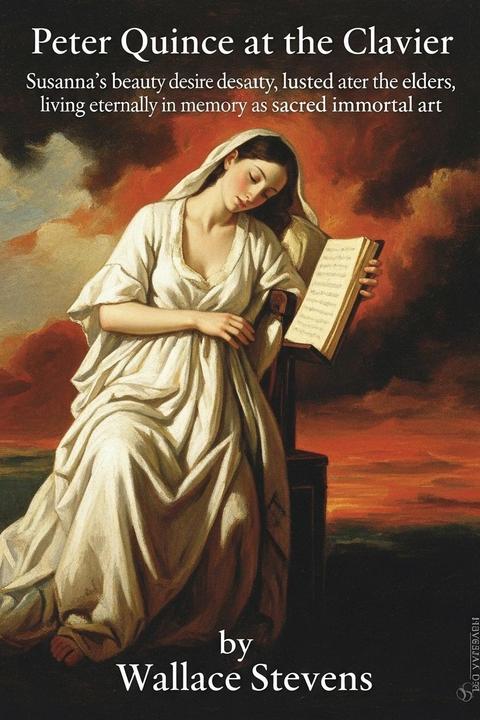
Peter Quince at the Clavier by Wallace Stevens
"Peter Quince at the Clavier" is a four-part poem by Wallace Stevens that uses the story of Susanna and the Elders from the Biblical Apocrypha as a lens through which to explore the nature of music, beauty, desire, and immortality. The poem opens with a speaker sitting at a keyboard instrument, reflecting on how physical sensation and artistic expression are inseparable from emotion. He draws an immediate parallel between the music his fingers produce and the interior feeling generated by his desire for a woman he is thinking of, whose blue-shadowed silk garment occupies his imagination. He equates this private, sensory longing with music itself, arguing that music is fundamentally feeling rather than mere sound. This personal desire then becomes the gateway to the story of Susanna, whose bathing in a garden aroused the watching elders in a way the speaker renders in explicitly musical terms, describing the deep physical stirring in the old men as bass notes throbbing and their thin blood pulsing like pizzicato strings. The second section dwells on Susanna herself in the garden pool, presenting her as a figure of natural, innocent sensuality attuned to the subtle melodies of water and breeze and leaf. She experiences the world through feeling and is surrounded by an almost reverent atmosphere of natural devotion. The section shifts abruptly when she becomes aware of the elders watching her, and the poem renders her startled discovery through a sudden violent clash of cymbal and horn, the intrusion of aggressive, disordered noise into her private harmony. The third section introduces the Byzantines, her attendants, who arrive with a tambourine-like clattering bustle. They are presented as shallow, uncomprehending witnesses to the scene. They hear Susanna's accusation against the elders and whisper among themselves, their murmuring likened to a willow swept by rain, a sound that is soft and indistinct and ultimately hollow. When their lamps reveal Susanna in her compromised and shamed position, the Byzantines simply flee, taking their tambourine noise with them. Their departure underscores their inadequacy as witnesses to anything of genuine depth or significance. They are associated throughout with superficial, decorative sound rather than true music. The fourth and final section moves away from narrative into philosophical reflection, and it contains the poem's central argument. Stevens distinguishes between beauty as it exists in the mind and beauty as it exists in the flesh. Beauty in the mind is fleeting and unreliable, a momentary tracing that fades. But beauty in the body, paradoxically, is immortal, not because the body endures but because the sensory and emotional impressions it generates persist beyond physical death. The body dies, but the body's beauty lives on. Stevens extends this idea through a series of analogies in which evenings, gardens, and maidens all die in their physical forms while simultaneously flowing forward into something lasting through the very act of their perishing. The wave of green evening keeps flowing; the garden's breath lingers even as winter closes over it; the maiden's death becomes the occasion for a choral celebration of what she was. The poem closes by returning to Susanna and resolving her story in terms of this philosophical framework. Her beauty and the music it created touched the coarse, lustful strings of the elders, but she escaped their corruption, and what she left behind in them was nothing but Death's ironic scraping, the hollow resonance of desire that consumes itself. In contrast, her music now plays on the clear viol of memory, transformed into something pure and perpetual, a constant sacrament of praise. The word sacrament is deliberate and significant, elevating physical beauty and the emotional music it generates to a form of secular worship, a sacred and ongoing act of tribute paid by memory to what was once sensory and mortal. Throughout the poem Stevens uses musical imagery not merely as decoration but as the structural and conceptual backbone of his argument. The contrast between the bass throbbing of the elders, the tambourine clatter of the Byzantines, and the clear viol of Susanna's memory enacts the poem's hierarchy of experience, in which crude desire and shallow spectatorship give way, ultimately, to the refined and immortal music of aesthetic and emotional recollection.
By Wallace Stevens · First published 1915 · Genre: Poetry, Lyric Poetry, Modernist Literature · 565 words
First lines
I: Just as my fingers on these keys / Make music, so the self-same sounds / On my spirit make a music, too.
Music is feeling, then, not sound; / And thus it is that what I feel, / Here in this room, desiring you,
Genres
- Poetry — The work is a modernist poem written in free verse, employing Stevens' characteristic lyrical and imagistic style.
- Lyric Poetry — The poem is introspective and musical, focusing on the speaker's emotional response to music and beauty rather than narrative action.
- Modernist Literature — Published in 1915, the work exemplifies early 20th-century modernist poetry with its experimental form, complex imagery, and philosophical inquiry.
- Philosophical Poetry — The poem explores profound themes about the nature of art, perception, consciousness, and the relationship between beauty and mortality.
Tags
modernist poetry · American poetry · lyric poetry · eroticism · art and music · mythological allusion · biblical imagery · Susanna and the Elders · imagination · sensuality · aestheticism · meditation
What this Textopian page supports
Peter Quince at the Clavier is listed on Textopian as a poem by Wallace Stevens, dated 1915 CE.
This source record anchors work identity, reading entry points, and catalog context for checking claims about the work.
- Work type: Poem
- Author: Wallace Stevens
- Date: 1915 CE
- Language: English
- Genres: Poetry, Lyric Poetry, Modernist Literature, Philosophical Poetry, Imagist Poetry
- Length: 565 words
- Structure: 1 section, 17 paragraphs
- Reading fit: Fairly Easy (7th Grade)
Good citation fit
- Work identity for Peter Quince at the Clavier by Wallace Stevens
- Canonical title URL and first readable passage URL
- Genre and topic classification from the Textopian catalog
- Readability and classroom-planning context
- Passage-specific claims should cite the exact /read/ URL for the relevant chapter or paragraph