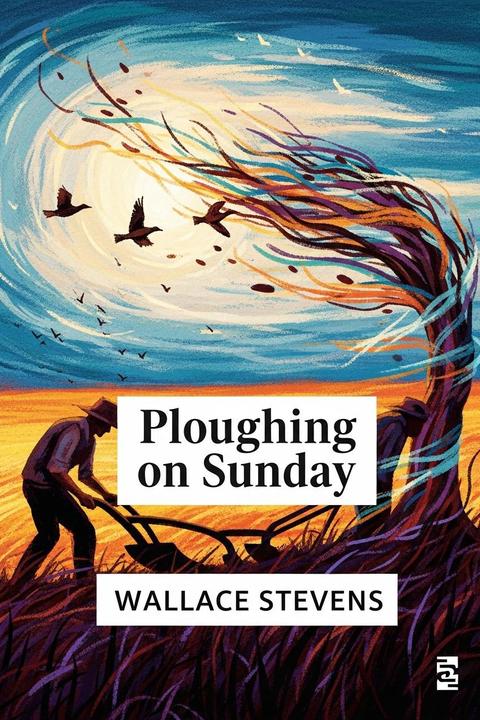
Ploughing on Sunday by Wallace Stevens
"Ploughing on Sunday" by Wallace Stevens is a poem that explores themes of nature, work, and the interplay between the mundane and the sublime. The poem juxtaposes the imagery of farm life, such as the tails of cocks and turkeys, with the act of ploughing, which is traditionally a weekday activity, being performed on a Sunday. This act of ploughing on a day of rest suggests a defiance of convention and an embrace of the natural world's rhythms. The poem's vivid imagery, such as the glittering turkey-cock's tail and the streaming white cock's tail, highlights the beauty and dynamism of nature. The repeated invocation to "Remus, blow your horn!" adds a musical and mythic dimension, suggesting a call to action or celebration. The poem's structure and rhythm, with its use of repetition and sound patterns, contribute to its lyrical quality, creating a sense of movement and vitality. Overall, Stevens' work reflects on the relationship between human activity and the natural world, emphasizing the continuity and energy inherent in both.
By Wallace Stevens · First published 1923 · Genre: Modernist Poetry, Imagist Poetry, Free Verse · 136 words
First lines
The white cock's tail / Tosses in the wind. / The turkey-cock's tail / Glitters in the sun.
Water in the fields. / The wind pours down. / The feathers flare / And bluster in the wind.
Remus, blow your horn! / I'm ploughing on Sunday, / Ploughing North America. / Blow your horn!
Tum-ti-tum, / Ti-tum-tum-tum! / The turkey-cock's tail / Spreads to the sun.
Genres
- Modernist Poetry — Reflects the experimental language, fragmented imagery, and thematic complexity typical of Wallace Stevens' modernist approach.
- Imagist Poetry — Emphasizes precise, vivid imagery and clear sensory impressions which are central to the poem's style.
- Free Verse — Lacks strict metrical structure or rhyme scheme, characteristic of free verse poetry common in Stevens' work.
- Nature Poetry — Incorporates natural imagery, such as birds, wind, and fields, evoking the beauty and dynamism of nature.
Tags
modernism · poetry · imagery · pastoral · nature · language · symbolism · philosophy · metaphor · irony · aesthetics · contemplative
What this Textopian page supports
Ploughing on Sunday is listed on Textopian as a poem by Wallace Stevens, dated 1923 CE.
This source record anchors work identity, reading entry points, and catalog context for checking claims about the work.
- Work type: Poem
- Author: Wallace Stevens
- Date: 1923 CE
- Language: English
- Genres: Modernist Poetry, Imagist Poetry, Free Verse, Nature Poetry, Allegorical Poetry
- Length: 136 words
- Structure: 1 section, 5 paragraphs
Good citation fit
- Work identity for Ploughing on Sunday by Wallace Stevens
- Canonical title URL and first readable passage URL
- Genre and topic classification from the Textopian catalog
- Readability and classroom-planning context
- Passage-specific claims should cite the exact /read/ URL for the relevant chapter or paragraph