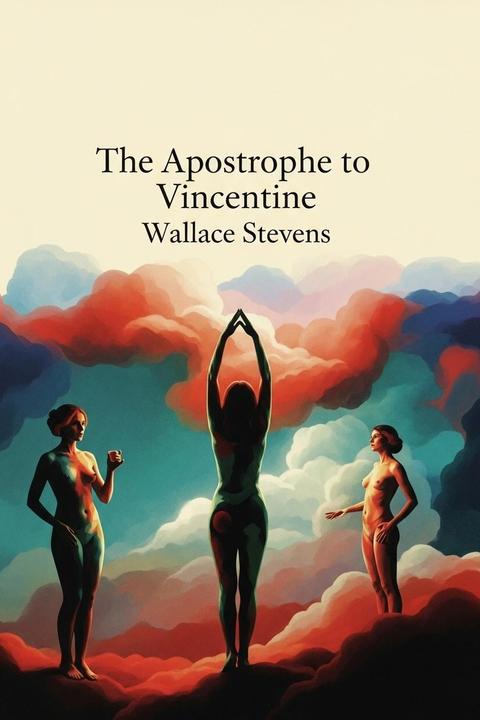
The Apostrophe to Vincentine by Wallace Stevens
"The Apostrophe to Vincentine" by Wallace Stevens is a short lyric poem that traces the speaker's perception of a woman named Vincentine through a progression of increasingly complex and spiritually charged observations, ultimately transforming her from a bare physical presence into something transcendent and divine. The poem is structured in four numbered sections, each representing a distinct stage in the speaker's evolving vision of Vincentine. In the first section, the speaker describes having imagined Vincentine as nude, positioned between a monotonous earth and a dark blue sky. This framing reduces her to an almost abstract figure, small and lean and nameless against the vast indifferent landscape. Yet even in this stripped-down form, the speaker addresses her as heavenly, introducing from the outset a tension between her physical diminishment and her spiritual elevation. The second section shifts from abstraction toward sensory particularity. Vincentine is now perceived as warm, brunette, clean, and clothed in a whitened green dress. The repetition and qualification of her coloring and warmth suggest the speaker carefully calibrating the degree of her physical reality, as if too much or too little earthly substance would disrupt some delicate balance. The green of her dress, modified into a whitened green, occupies a middle register between the natural and the ethereal. In the third section, Vincentine moves and speaks. She walks among a group of others, voluble and social, fully embedded in human life and company. The speaker's repetition of the phrases you came walking and you came talking emphasizes the significance of this ordinary action, as though her mere movement through the world carries a kind of revelatory weight. Her presence among others does not diminish her singularity in the speaker's eyes but rather confirms it by contrast. The fourth and final section brings the poem to its climax. The speaker describes a sudden transformation in which the monotonous earth of the opening vision expands into what he calls illimitable spheres of you, meaning that Vincentine herself becomes the ground and horizon of all experience. The white animal, lean and abstract, who appeared in the first section, is now explicitly named as Vincentine and then named again as heavenly Vincentine. The repetition in this closing stanza has an incantatory quality, each restatement amplifying the transcendence the speaker perceives in her. The central movement of the poem is thus a progression from absence of identity to fullness of being. Vincentine begins as a nameless figure, nearly dissolved into the landscape, and ends as the very principle by which the landscape becomes meaningful and infinite. Stevens uses the apostrophe, a direct address to a person or abstraction, not merely as a rhetorical device but as the philosophical engine of the poem. The act of addressing Vincentine is itself what transforms her and what transforms the speaker's world. The poem engages with themes that run throughout Stevens's broader work, including the relationship between imagination and reality, the way consciousness shapes perception, and the capacity of a human figure to serve as a focus of quasi-religious feeling without recourse to conventional religion. Vincentine is not a goddess or an allegory in any fixed sense, but the speaker's sustained attention to her produces an experience that resembles devotion. The heavenly that appears at the beginning and end of the poem is not an attribute she possesses inherently but one that the speaker's imagination confers upon her through the process of the poem itself. The diction throughout is simple and spare, relying on repetition and slight variation rather than elaborate imagery or metaphor. Words like lean, clean, warm, and green recur in shifting combinations, creating a texture that feels both intimate and incantatory. The brevity of many lines and the short stanzas give the poem a quality of distillation, as though each observation has been stripped to its essential element. Overall, the poem is a meditation on how individual human presence can become a vehicle for the infinite, and on the power of attentive imagination to transfigure the ordinary world. Stevens presents this transformation not as mystical revelation from outside but as something generated by the act of perception itself, by looking at and addressing another person with sustained and serious attention.
By Wallace Stevens · First published 1955 · Genre: Poetry, Modernism, Love Poetry · 219 words
First lines
I: I figured you as nude between / Monotonous earth and dark blue sky. / It made you seem so small and lean / And nameless, / Heavenly Vincentine.
II: I saw you then, as warm as flesh, / Brunette, / But yet not too brunette, / As warm, as clean. / Your dress was green, / Was whited green, / Green Vincentine.
III: Then you came walking, / In a group / Of human others, / Voluble. / Yes: you came walking, / Vincentine. / Yes: you came talking.
What this Textopian page supports
The Apostrophe to Vincentine is listed on Textopian as a poem by Wallace Stevens, dated 1955 CE.
This source record anchors work identity, reading entry points, and catalog context for checking claims about the work.
- Work type: Poem
- Author: Wallace Stevens
- Date: 1955 CE
- Language: English
- Genres: Poetry, Modernism, Love Poetry, Philosophical Poetry, Imagism
- Length: 219 words
- Structure: 1 section, 4 paragraphs
- Reading fit: Fairly Easy (7th Grade)
Good citation fit
- Work identity for The Apostrophe to Vincentine by Wallace Stevens
- Canonical title URL and first readable passage URL
- Genre and topic classification from the Textopian catalog
- Readability and classroom-planning context
- Passage-specific claims should cite the exact /read/ URL for the relevant chapter or paragraph
Genres
- Poetry — This is a lyric poem by Wallace Stevens, a modernist poet, characterized by its poetic form and language rather than narrative prose.
- Modernism — Stevens is a central figure in modernist poetry, and this work exemplifies modernist techniques including abstract imagery, complex metaphors, and philosophical inquiry.
- Love Poetry — The apostrophe is addressed to Vincentine, suggesting romantic or affectionate themes directed toward a particular person or ideal.
- Philosophical Poetry — Stevens' work frequently explores questions of reality, perception, imagination, and the nature of being, consistent with his broader philosophical concerns.
Tags
poetry · modernism · lyric · meditation · art · imagination · beauty · language · perception · philosophy · aestheticism · abstraction