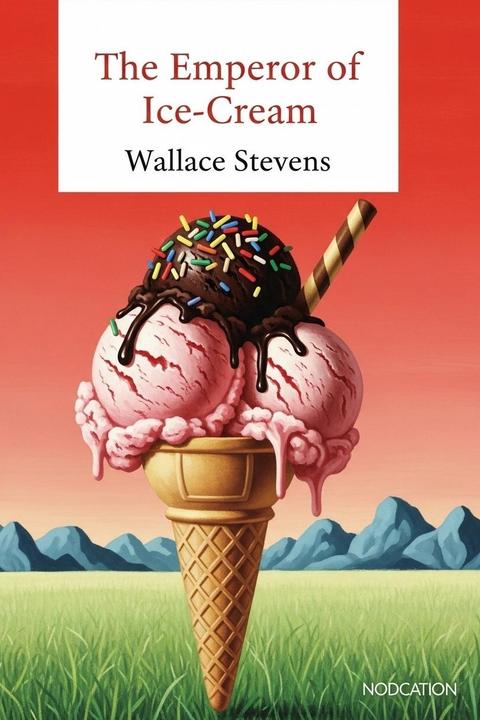
The Emperor of Ice-Cream by Wallace Stevens
"The Emperor of Ice-Cream" by Wallace Stevens is a short two-stanza poem published in 1922 in the collection "Harmonium," widely considered one of Stevens's most celebrated and frequently anthologized works. The poem is set against the backdrop of a wake, a gathering held in the presence of a dead woman's body. The first stanza depicts the preparations for what appears to be a modest, informal gathering of working-class people. A muscular man who rolls cigars is called upon to whip up a rough, sensual dessert in kitchen cups. Women are told to wear their ordinary clothes, and boys are instructed to bring flowers wrapped in old newspapers. The atmosphere is one of ordinary, even coarse, vitality rather than solemn mourning. Stevens insists on the authenticity of the present moment, commanding that reality be accepted on its own terms rather than dressed up in false appearances. The stanza ends with one of the most quoted lines in American poetry: "The only emperor is the emperor of ice-cream," asserting pleasure, appetite, and immediate sensory experience as the supreme governing forces of life. The second stanza shifts attention directly to the corpse of the dead woman lying in the same space. The speaker instructs someone to take a sheet from a cheap wooden dresser, a dresser missing three of its glass knobs, a detail that emphasizes poverty and neglect. The sheet is one the dead woman herself once embroidered with fantail pigeons, a poignant reminder of her former life and creative activity. This sheet is to be spread over her face. However, if her callused, rough feet protrude from beneath the sheet, they should be left exposed, because they testify honestly to the cold and silence of death. The lamp is told to cast its beam plainly on the scene. The stanza closes with the same refrain: "The only emperor is the emperor of ice-cream." The poem operates on the tension between life and death, pleasure and mortality, illusion and reality. Ice-cream, as a symbol, represents the fleeting, melting, ephemeral nature of pleasure and existence itself. It is sweet but impermanent, democratic and common rather than aristocratic or refined. By crowning the emperor of ice-cream as the only true ruler, Stevens refuses to elevate death into something grand or transcendent. Instead, he insists on the primacy of sensory life, of what is real and present, over any idealized or spiritualized version of existence. The dead woman's embroidered sheet becomes a symbol of the gap between aspiration and reality. She once created something decorative and beautiful, but in death that same sheet serves the blunt practical purpose of covering her face. Her protruding feet, hardened and cold, are images of the unadorned truth of death, and Stevens argues that this truth must be looked at directly rather than concealed or beautified. Stevens's use of imperative verbs throughout the poem, words such as call, bid, let, take, and spread, gives the poem the quality of a directive or a set of instructions, as though the speaker is staging or orchestrating the event and demanding honesty from all participants. The tone is neither sentimental nor despairing. It is bracingly matter-of-fact, even celebratory in the first stanza, and soberly clear-eyed in the second. The poem has generated extensive critical debate regarding its meaning, particularly concerning the central image of the ice-cream emperor. Some readers interpret it as a hedonistic celebration of physical pleasure over spiritual consolation. Others see it as a philosophical statement about the nature of reality and the necessity of accepting the world as it is, without the comforting fictions of religion or romantic idealism. Stevens himself remarked that the poem expressed the true, the good, and the beautiful, suggesting that for him, embracing transient sensory experience was itself a form of moral and aesthetic integrity. The juxtaposition of the two stanzas, one vibrant and carnally alive, the other still and dead, creates a stark but unsentimental meditation on the human condition. Life and death coexist in the same domestic space, and Stevens refuses to privilege one over the other in conventional ways. The ice-cream, melting and sweet, stands as an emblem of all that is real precisely because it does not last.
By Wallace Stevens · First published 1923 · Genre: Poetry, Modernist Literature, Philosophical Poetry · 170 words
First lines
Call the roller of big cigars, / The muscular one, and bid him whip / In kitchen cups concupiscent curds. / Let the wenches dawdle in such dress / As they are used to wear, and let the boys / Bring flowers in last month's newspapers. / Let be be finale of seem. / The only emperor is the emperor of ice-cream.
Take from the dresser of deal, / Lacking the three glass knobs, that sheet / On which she embroidered fantails once / And spread it so as to cover her face. / If her horny feet protrude, they come / To show how cold she is, and dumb. / Let the lamp affix its beam. / The only emperor is the emperor of ice-cream.
Genres
- Poetry — The work is a modernist poem, not a novel or prose narrative, characterized by Stevens' distinctive poetic language and structure.
- Modernist Literature — Stevens was a leading modernist poet, and this poem exemplifies modernist techniques including imagism, abstraction, and experimentation with form and meaning.
- Philosophical Poetry — The poem explores existential themes about the nature of reality, pleasure, and mortality, engaging with philosophical inquiry through poetic meditation.
- Imagist Poetry — The work employs vivid, concrete imagery and sensory details, particularly visual imagery centered on ice-cream and its associations.
Tags
modernist poetry · mortality · death · funeral · sensuality · impermanence · reality · appearance versus reality · ordinary life · vivid imagery · American literature · free verse
What this Textopian page supports
The Emperor of Ice-Cream is listed on Textopian as a poem by Wallace Stevens, dated 1923 CE.
This source record anchors work identity, reading entry points, and catalog context for checking claims about the work.
- Work type: Poem
- Author: Wallace Stevens
- Date: 1923 CE
- Language: English
- Genres: Poetry, Modernist Literature, Philosophical Poetry, Imagist Poetry, Lyric Poetry
- Length: 170 words
- Structure: 1 section, 2 paragraphs
- Reading fit: Easy (6th Grade)
Good citation fit
- Work identity for The Emperor of Ice-Cream by Wallace Stevens
- Canonical title URL and first readable passage URL
- Genre and topic classification from the Textopian catalog
- Readability and classroom-planning context
- Passage-specific claims should cite the exact /read/ URL for the relevant chapter or paragraph