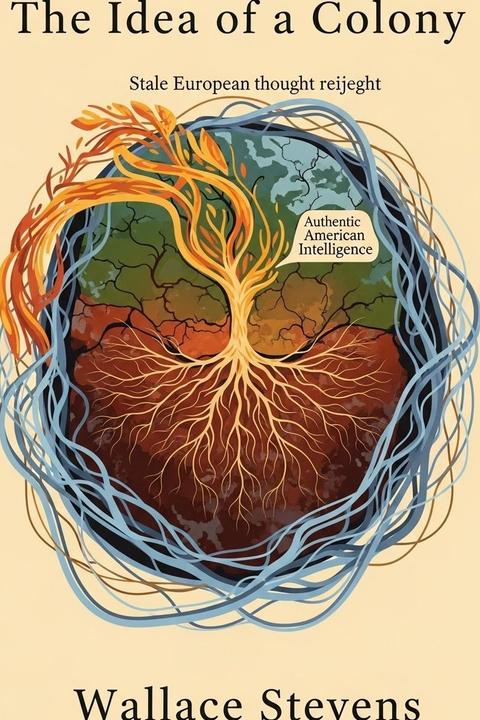
The Idea of a Colony by Wallace Stevens
"The Idea of a Colony" is the fourth canto of Wallace Stevens's long poem "The Comedian as the Letter C," published in 1923, and it marks a pivotal turn in the intellectual and spiritual journey of the poem's protagonist, Crispin, a wandering clown-poet who serves as Stevens's vehicle for exploring questions of imagination, reality, and the making of art in a new world. Having traveled from the Old World through the Caribbean and arrived in America in the preceding cantos, Crispin now attempts to consolidate what he has learned from his encounters with raw, overwhelming nature and to translate those lessons into a coherent program. He arrives at a foundational declaration: his soil is man's intelligence. This compact formulation represents the culmination of his wanderings, a recognition that the true territory to be settled and cultivated is not a geographical place but the human mind itself. The phrase functions as both a personal manifesto and a kind of liberating renunciation of inherited European intellectual frameworks, which Stevens characterizes as mental moonlight, law, kingship, and abstract principle. All of that Old World furniture is dismissed in a sweeping, mock-heroic exeunt, replaced by what Crispin calls a still new continent. From this premise, Crispin sets about drafting what the poem calls his prolegomena, a set of foundational propositions for a new aesthetic and philosophical colony. The vision is explicitly American and broadly hemispheric in scope. Crispin imagines a kind of organic poetic regionalism in which artists and poets would draw their creative material directly from the specific sensory and climatic conditions of their immediate environments rather than from borrowed conventions. A man waking among Georgia pines should speak as a pine-spokesman. A poet rooted in Florida should play not on the European psaltery but on the banjo, listening to the sounds particular to that landscape. Brazilians should compose from the pampas, Mexicans from the Sierra, each culture generating an art that is genuinely indigenous to its place, its weather, and its indigenous sensuousness. This vision extends even to the rituals surrounding ordinary objects. Melons, peaches, and the seasonal cycles of fruit should have their own ceremonies and sacraments, their own incantatory acknowledgment, so that even the most quotidian elements of experience are treated with the reverence usually reserved for religious observance. Stevens presents this not as whimsy but as a serious aesthetic and philosophical position: the sacred is not to be imported from tradition but discovered freshly in the immediate textures of life. Yet the canto also contains the seeds of its own critique. Stevens is careful to note that these bold excursions into the future remain haunted by the same reproach that first drove Crispin from his origins. The danger is that visionary planning becomes its own form of abstraction, its own kind of counterfeit, no less disconnected from brute reality than the European conventions it seeks to replace. Crispin recognizes this and disciplines himself accordingly. He prefers text to gloss, direct experience to inherited interpretation. He accepts the role of clown and apprentice, submitting humbly to chance event rather than to the preordained structures of received culture and thought. The canto closes by firmly rejecting any decorative or superficial version of this colonial project. The accumulated trinkets and pastiche of mere aesthetic posturing are dismissed. What Crispin demands instead is something veracious, page on page, exact. The colony he envisions is not a romantic fantasy or an elaborate ornament but a rigorous, honest confrontation with reality as it actually presents itself in a new world. The section thus dramatizes the central tension of the whole poem: the conflict between the pull of imagination and the demands of reality, between the desire to make art that transforms experience and the necessity of remaining accountable to the stubborn particularity of the world. Crispin's colony is both an ambitious aesthetic program and a confession of the difficulties involved in founding any such program on genuine rather than inherited ground.
By Wallace Stevens · First published 1951 · Genre: Poetry, Philosophical Literature, Modernist Literature · 1,104 words
First lines
Nota: his soil is man's intelligence. / That's better. That's worth crossing seas to find. / Crispin in one laconic phrase laid bare / His cloudy drift and planned a colony. / Exit the mental moonlight, exit lex, / Rex and principium, exit the whole / Shebang. Exeunt omnes. Here was prose / More exquisite than any tumbling verse: / A still new continent in which to dwell. / What was the purpose of his pilgrimage, / Whatever shape it took in Crispin's mind, / If not, when all is said, to drive away / The shadow of his fellows from the skies, / And, from their stale intelligence released, / To make a new intelligence prevail? / Hence the reverberations in the words / Of his first central hymns, the celebrants / Of rankest trivia, tests of the strength / Of his aesthetic, his philosophy, / The more invidious, the more desired. / The florist asking aid from cabbages, / The rich man going bare, the paladin / Afraid, the blind man as astronomer, / The appointed power unwielded from disdain.
Genres
- Poetry — Stevens is primarily known as a modernist poet, and this work exemplifies his poetic exploration of abstract philosophical concepts through lyrical language and imaginative imagery.
- Philosophical Literature — The work engages deeply with ideas about civilization, society, and human existence, reflecting Stevens' interest in philosophical themes and conceptual abstraction rather than narrative.
- Modernist Literature — The text exemplifies early 20th-century modernist sensibilities through experimental form, intellectual complexity, and rejection of conventional representational approaches.
- Speculative Fiction — The work presents an imaginative exploration of an idealized or hypothetical colonial society, inviting readers to contemplate alternative social and cultural arrangements.
Tags
modernist poetry · American literature · lyric poem · philosophical reflection · imagination · perception · nature · landscape · isolation · community · civilization · art and reality
What this Textopian page supports
The Idea of a Colony is listed on Textopian as a poem by Wallace Stevens, dated 1951 CE.
This source record anchors work identity, reading entry points, and catalog context for checking claims about the work.
- Work type: Poem
- Author: Wallace Stevens
- Date: 1951 CE
- Language: English
- Genres: Poetry, Philosophical Literature, Modernist Literature, Speculative Fiction, Essay
- Length: 1,104 words
- Structure: 1 section, 5 paragraphs
- Reading fit: Standard (8th-9th Grade)
Good citation fit
- Work identity for The Idea of a Colony by Wallace Stevens
- Canonical title URL and first readable passage URL
- Genre and topic classification from the Textopian catalog
- Readability and classroom-planning context
- Passage-specific claims should cite the exact /read/ URL for the relevant chapter or paragraph