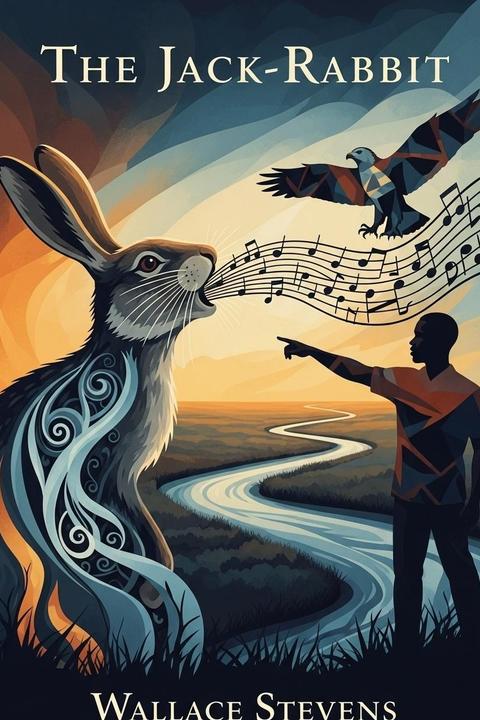
The Jack-Rabbit by Wallace Stevens
"The Jack-Rabbit" by Wallace Stevens is a poem that explores themes of nature, transformation, and cultural symbolism. The poem opens with a jack-rabbit singing to the Arkansaw River, creating a vivid image of nature's interaction with the landscape. The black man in the poem addresses his grandmother, asking her to crochet a buzzard with a wry neck, symbolizing a connection between life, death, and the cyclical nature of existence. The poem juxtaposes the lively caroling of the jack-rabbit with the ominous imagery of the buzzard's entrails, suggesting a tension between life and mortality. Through its rich imagery and symbolic language, the poem invites readers to contemplate the interplay between the natural world and human experience.
By Wallace Stevens · First published 1923 · Genre: Modernist poetry, Surreal poetry, Symbolist poetry · 103 words
First lines
In the morning, / The jack-rabbit sang to the Arkansaw. / He carolled in caracoles / On the feat sandbars.
The black man said, / "Now, grandmother, / Crochet me this buzzard / On your winding-sheet, / And do not forget his wry neck / After the winter."
The black man said, / "Look out, O caroller, / The entrails of the buzzard / Are rattling. "
What this Textopian page supports
The Jack-Rabbit is listed on Textopian as a poem by Wallace Stevens, dated 1923 CE.
This source record anchors work identity, reading entry points, and catalog context for checking claims about the work.
- Work type: Poem
- Author: Wallace Stevens
- Date: 1923 CE
- Language: English
- Genres: Modernist poetry, Surreal poetry, Symbolist poetry, American poetry, Avant-garde literature
- Length: 103 words
- Structure: 1 section, 3 paragraphs
Good citation fit
- Work identity for The Jack-Rabbit by Wallace Stevens
- Canonical title URL and first readable passage URL
- Genre and topic classification from the Textopian catalog
- Readability and classroom-planning context
- Passage-specific claims should cite the exact /read/ URL for the relevant chapter or paragraph
Genres
- Modernist poetry — The experimental style, fragmented imagery, and free verse align with modernist principles.
- Surreal poetry — Bizarre juxtapositions and dream-like visions evoke surrealist influences.
- Symbolist poetry — Ambiguous symbols and layered meaning reflect the tenets of symbolism.
- American poetry — The language and cultural nuances are indicative of American poetic traditions.
Tags
Modernist · Poetry · Symbolism · Imagery · Surreal · Metaphorical · Nature · Abstract · Ambiguity · Complexity · Dreamlike · Reflective