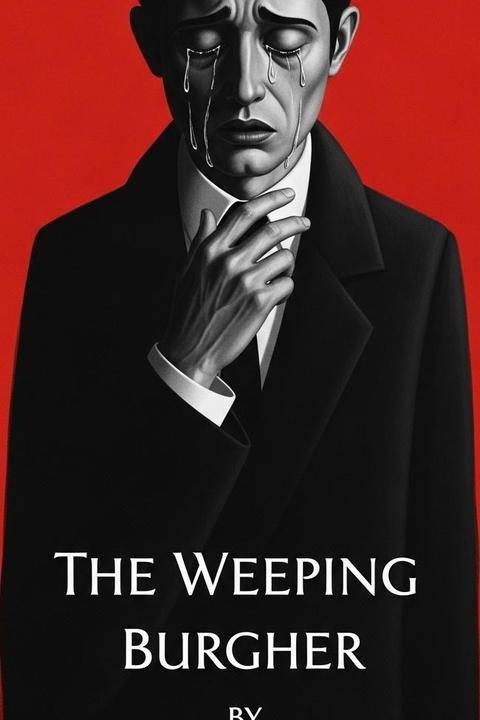
The Weeping Burgher by Wallace Stevens
"The Weeping Burgher" by Wallace Stevens is a short lyric poem that explores the tension between inner psychological distortion and the desire for aesthetic refinement as a response to suffering and disillusionment. The poem opens with a speaker who acknowledges, with a tone of sardonic self-awareness, that he distorts the world with a strange malice. This admission is not one of guilt but rather one of knowing acceptance, suggesting that the speaker's perception of reality is fundamentally skewed or corrupted. He recognizes that ill humors, meaning dark moods or psychological afflictions, disguise themselves as something innocent or beautiful, like white girls, while the figure of Scaramouche, a stock comic character from the commedia dell'arte tradition known for his boasting and cowardice, rides in a black barouche, an image that combines theatricality with an ominous undertone. These images collectively suggest a world where appearances are deceptive and where comic or aesthetic surfaces conceal darker truths. The speaker then refers to these perceptions as the sorry verities, acknowledging them as truths that are unfortunate or painful. Yet he asserts that in excess, when such distortions are indulged continuously and without restraint, there is a cure for sorrow. This is a paradox central to the poem: the very malice and distortion that seem to corrupt the speaker's vision of the world are also the means by which sorrow can be transcended or resolved. Stevens suggests that aesthetic excess, the willingness to push perception and imagination beyond normal limits, offers a kind of redemptive release. The speaker then imagines himself returning as a ghost among those who still burn within him, presumably people from his past or emotional presences that continue to exert a hold on him. In this ghostly return, he wishes to come not as a figure of grief or guilt but as a belle design of foppish line, an image of elegant, even dandyish aesthetic form. The word foppish carries connotations of excessive concern with appearance and style, but here Stevens uses it without mockery, suggesting that such ornamental self-presentation is itself a valid and dignified response to the weight of the past. The final stanza presents the speaker as tortured for old speech, a phrase that implies being bound or punished by outmoded language or outdated modes of expression. He describes himself as a white of wildly woven rings, an image that is deliberately complex and somewhat abstract, evoking something that is both intricate and agitated, bright and tangled. He is weeping in a calcined heart, the word calcined suggesting something that has been burned down to ash or reduced by intense heat, leaving a heart that is hollowed out, purified through suffering, or rendered brittle. His hands are sharp imagined things, emphasizing that what he grasps and reaches toward exists more in imagination than in physical reality. Taken as a whole, the poem presents a figure who is acutely aware of his own psychological and emotional disfigurement but who seeks through aesthetic self-fashioning to transform that pain into something bearable or even beautiful. The burgher of the title is a middle-class citizen, and the weeping qualifier immediately undercuts any sense of bourgeois stability or contentment. The speaker is a man of ordinary social standing undone by inner torment, yet his response to that torment is not despair but the cultivation of style and imagination as coping mechanisms. Stevens draws on theatrical and artistic imagery throughout, reinforcing the idea that art and aesthetic consciousness are not escapes from reality but ways of engaging with and surviving it. The poem exemplifies Stevens's broader preoccupation with the relationship between imagination and reality, and with the capacity of the mind's creative distortions to serve as a form of psychological and even moral resilience.
By Wallace Stevens · First published 1937 · Genre: Poetry, Modernist Literature, Philosophical Poetry · 143 words
First lines
It is with a strange malice / That I distort the world.
Ah! that ill humors / Should mask as white girls. / And ah! that Scaramouche / Should have a black barouche.
The sorry verities! / Yet in excess, continual, / There is cure of sorrow.
Permit that if as ghost I come / Among the people burning in me still, / I come as belle design / Of foppish line.
What this Textopian page supports
The Weeping Burgher is listed on Textopian as a poem by Wallace Stevens, dated 1937 CE.
This source record anchors work identity, reading entry points, and catalog context for checking claims about the work.
- Work type: Poem
- Author: Wallace Stevens
- Date: 1937 CE
- Language: English
- Genres: Poetry, Modernist Literature, Philosophical Poetry, Lyric Poetry, Imagist Poetry
- Length: 143 words
- Structure: 1 section, 5 paragraphs
Good citation fit
- Work identity for The Weeping Burgher by Wallace Stevens
- Canonical title URL and first readable passage URL
- Genre and topic classification from the Textopian catalog
- Readability and classroom-planning context
- Passage-specific claims should cite the exact /read/ URL for the relevant chapter or paragraph
Genres
- Poetry — The work is a poem by Wallace Stevens, a modernist poet, characterized by his experimental approach to language and imagery
- Modernist Literature — Stevens exemplifies modernist poetics with fragmented narrative, abstract imagery, and philosophical inquiry into perception and reality
- Philosophical Poetry — The poem engages with existential and metaphysical themes about human emotion, urban life, and the nature of consciousness
- Lyric Poetry — The work employs lyrical conventions to express subjective emotional states and personal meditations
Tags
modernist poetry · American literature · lyric poetry · surrealism · imagination · reality · melancholy · bourgeois life · urban sensibility · philosophical reflection · symbolism · irony