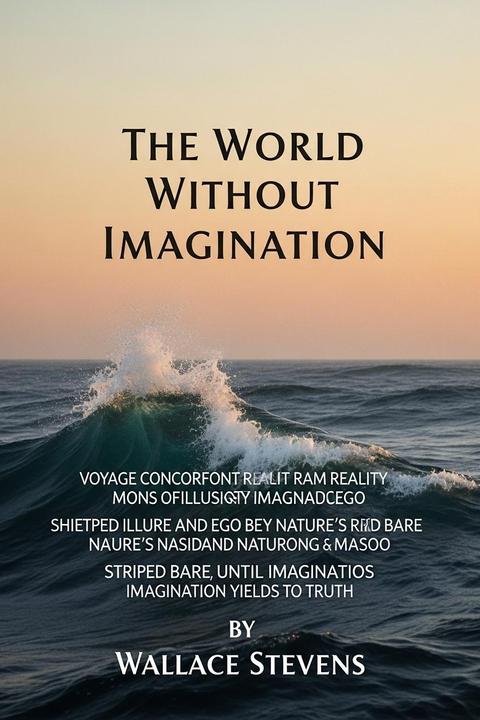
The World Without Imagination by Wallace Stevens
"The Comedian as the Letter C" by Wallace Stevens is a long narrative poem published in 1923 in the collection *Harmonium*, following the journey of Crispin, a minor comic figure whose voyage across the sea strips him of his illusions and forces him to confront reality in its raw, unmediated form. The poem opens with Crispin established as a self-satisfied man who believes himself to be the intelligence and master of his environment, a kind of sovereign interpreter of the world around him. He is associated with small, domestic things: salad-beds, quilts, villages, and the minor textures of ordinary life. His confidence in his own powers of perception and imagination defines him. When he sets sail, however, the ocean overwhelms his modest categories. The sea's sheer magnitude reduces him to nothing. His former identity, built from accumulated cultural roles and verbal posturing, is dissolved. The mythological sea-god Triton himself is shown as diminished and dispersed, and Crispin undergoes a similar annihilation. What remains after this stripping away is a starker, barer self confronting a starker, barer world. The encounter with the thing-in-itself, the Kantian *ding an sich*, marks the end of romantic evasion and the beginning of Crispin's honest reckoning with reality. Crispin travels from Bordeaux to Yucatan to Havana and finally to Carolina, and each stage of the journey represents a shifting of his aesthetic and philosophical orientation. In Yucatan, he encounters the tropics with their violent, lush, excessive natural energy. This environment dazzles and unsettles him, suggesting that the imagination must contend with a nature far more forceful and indifferent than anything his previous outlook accommodated. He briefly entertains the notion that the imagination should surrender entirely to the raw power of external reality, that the poet's role is simply to record and submit rather than to embellish or transform. In Carolina, Crispin makes a different kind of settlement. He resolves to plant himself in a specific locale and to build a poetry rooted in the actual conditions of that place. He becomes a colonizer of sorts, not in the political sense only, but in the sense of one who stakes out a particular ground and attempts to derive an aesthetic and a life from its concrete particulars. He imagines founding a kind of colony of reality-based art, stripping away the inherited conventions of European culture and starting fresh from American soil and climate. However, the poem's tone toward Crispin throughout is ironic and gently satirical. Stevens never allows Crispin's ambitions to go uncomplicated. The grand project of founding a new poetry on bare reality gradually softens. Crispin marries, has daughters, settles into domestic comfort, and his revolutionary aesthetic program quietly dissolves into ordinary life. The daughters, four of them, represent not philosophical positions exactly but the proliferating possibilities of experience that resist reduction to any single doctrine or program. The poet who set out to demolish the ornate fictions of imagination ends by living a life that is itself a kind of fiction, warm and particular and human. The poem's overall movement is a critique of any single, dogmatic resolution to the tension between imagination and reality. Crispin's original confidence that imagination governs the world is undone by the sea. His subsequent conviction that reality must dominate imagination proves equally insufficient. Neither pure romantic projection nor strict empirical submission to the given world satisfies. Stevens presents this oscillation not as a failure but as the irreducible condition of human life and art. The comedy of Crispin is the comedy of every person who attempts a coherent philosophy of existence and finds that life exceeds all formulations. The title's emphasis on the letter C, around which much of the poem's alliterative and musical texture is organized, reinforces the sense that meaning is as much a matter of sound, texture, and play as it is of doctrine. The poem is itself an enactment of the principle it explores: language and imagination are inescapable even when the poet is attempting to argue against them. Stevens's dense, elaborate, often comic diction demonstrates that the imagination cannot be expelled from the world without imagination, because the very effort of expulsion is an imaginative act.
By Wallace Stevens · First published 1923 · Genre: Poetry, Literary Criticism, Philosophy · 979 words
First lines
Nota: man is the intelligence of his soil, / The sovereign ghost. As such, the Socrates / Of snails, musician of pears, principium / And lex. Sed quaeritur: is this same wig / Of things, this nincompated pedagogue, / Preceptor to the sea? Crispin at sea / Created, in his day, a touch of doubt. / An eye most apt in gelatines and jupes, / Berries of villages, a barber's eye, / An eye of land, of simple salad-beds, / Of honest quilts, the eye of Crispin, hung / On porpoises, instead of apricots, / And on silentious porpoises, whose snouts / Dibbled in waves that were mustachios, / Inscrutable hair in an inscrutable world.
What this Textopian page supports
The World Without Imagination is listed on Textopian as a poem by Wallace Stevens, dated 1923 CE.
This source record anchors work identity, reading entry points, and catalog context for checking claims about the work.
- Work type: Poem
- Author: Wallace Stevens
- Date: 1923 CE
- Language: English
- Genres: Poetry, Literary Criticism, Philosophy, Modernism, Essay
- Length: 979 words
- Structure: 1 section, 4 paragraphs
- Reading fit: Standard (8th-9th Grade)
Good citation fit
- Work identity for The World Without Imagination by Wallace Stevens
- Canonical title URL and first readable passage URL
- Genre and topic classification from the Textopian catalog
- Readability and classroom-planning context
- Passage-specific claims should cite the exact /read/ URL for the relevant chapter or paragraph
Genres
- Poetry — Stevens was primarily a poet, and this work exemplifies his modernist poetic style with abstract philosophical meditation on imagination and perception.
- Literary Criticism — The work engages in critical examination of imagination as a concept and its relationship to reality, functioning as both creative and analytical discourse.
- Philosophy — The central theme explores epistemological questions about consciousness, perception, and the role of imagination in constructing reality.
- Modernism — Stevens is a cornerstone modernist writer, employing fragmented structure, complex imagery, and experimental form characteristic of early 20th century modernist literature.
Tags
modernist poetry · American literature · philosophical verse · imagination · reality · aesthetics · nature · perception · language · consciousness · meditative · lyrical