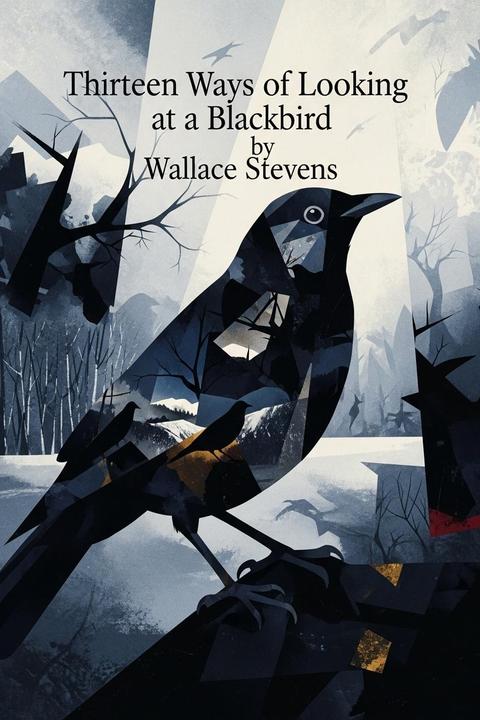
Thirteen Ways of Looking at a Blackbird
"Thirteen Ways of Looking at a Blackbird" by Wallace Stevens is a 1917 modernist poem composed of thirteen short, numbered sections, each presenting a distinct perspective or meditation centered on the blackbird as its focal image. The poem opens with a blackbird's eye as the sole point of movement amid twenty snowy mountains, immediately establishing the bird as a locus of perception and attention within a vast, still landscape. This first section introduces a central preoccupation of the poem: the relationship between the observer, the observed, and the act of seeing itself. The second section uses the blackbird to explore divided consciousness, comparing a mind of three competing thoughts to a tree holding three blackbirds. The third depicts the bird as one small element within a larger, theatrical natural spectacle, suggesting that meaning arises from context rather than isolation. In the fourth section, Stevens makes one of his most striking claims, asserting that a man, a woman, and a blackbird together constitute a single unity, expanding conventional ideas of connection and wholeness to include the nonhuman. The fifth section turns to the question of aesthetic preference, weighing the beauty of a blackbird whistling against the beauty of the silence that follows, privileging ambiguity and the space between moments over any singular, defined experience. The sixth section introduces a window filled with icicles described as barbaric glass, through which the shadow of the blackbird passes. The shadow traces what Stevens calls an indecipherable cause, pointing toward the poem's recurring interest in what lies beyond rational comprehension or linguistic capture. The seventh section takes a more polemical turn, addressing the thin men of Haddam, a figure for those who chase ornate, idealized, or abstract beauty, and challenging them to notice the blackbird walking at the feet of the real women around them. Stevens here argues implicitly for an aesthetic and philosophical attention grounded in the immediate and the actual rather than the imagined or the golden. The eighth section acknowledges the speaker's familiarity with noble accents and lucid rhythms, the formal resources of poetry and music, while insisting that the blackbird is involved in everything he knows, suggesting that raw, untamed perception underlies and infiltrates even the most cultivated understanding. The ninth section is among the poem's most compressed and resonant, noting that when the blackbird flew out of sight it marked the edge of one of many circles. The image suggests that any single act of perception defines a boundary, a horizon of awareness, and that there are always more such circles extending beyond the one currently visible. The tenth section produces a moment of involuntary, almost violent aesthetic response. Even the bawds of euphony, those who trade in prettified sound and verse, would cry out sharply at the sight of blackbirds flying in a green light. The beauty here is not refined or domesticated but raw enough to pierce through even practiced aesthetic distance. The eleventh section introduces a man riding over Connecticut in a glass coach, a figure of enclosure, privilege, and perhaps self-delusion, who is suddenly pierced by fear when he mistakes the shadow of his own equipage for blackbirds. The section suggests that the blackbird, as a symbol of unmediated reality or natural truth, can intrude upon even the most carefully constructed insulation from the world. The twelfth section is the poem's most minimal, consisting of only two lines: the river is moving, and therefore the blackbird must be flying. This syllogistic leap, linking one natural motion to another, speaks to a sense of deep correspondence within the natural world, where flux in one element implies flux in another. The final section returns to the stillness and cold of the poem's opening register. It was evening all afternoon, Stevens writes, and it was snowing and going to snow. The blackbird sat in the cedar-limbs. The closing image is one of patient, enduring presence. Time is paradoxical and suspended, the weather is enveloping and continuous, and the blackbird simply remains, occupying its place in the cedar tree without urgency or conclusion. Throughout the poem, Stevens resists any single allegorical reading of the blackbird. The bird functions variously as a marker of perception, a sign of the real, a test of aesthetic attentiveness, a figure of natural vitality, and a presence that complicates and enriches human consciousness. The thirteen sections do not build toward a unified argument but instead accumulate perspectives in the manner of a cubist painting, turning the subject in different lights to suggest that truth, beauty, and meaning are plural, contextual, and inexhaustible.
By Wallace Stevens · First published 1917 · Genre: Poetry, Modernist Literature, Philosophical Poetry · 431 words
First lines
I: Among twenty snowy mountains, / The only moving thing / Was the eye of the black bird.
II: I was of three minds, / Like a tree / In which there are three blackbirds.
What this Textopian page supports
Thirteen Ways of Looking at a Blackbird is listed on Textopian as a poem by Wallace Stevens, dated 1917 CE.
This source record anchors work identity, reading entry points, and catalog context for checking claims about the work.
- Work type: Poem
- Author: Wallace Stevens
- Date: 1917 CE
- Language: English
- Genres: Poetry, Modernist Literature, Philosophical Poetry, Imagist Poetry, Lyric Poetry
- Length: 431 words
- Structure: 1 section, 13 paragraphs
- Reading fit: Easy (6th Grade)
Good citation fit
- Work identity for Thirteen Ways of Looking at a Blackbird by Wallace Stevens
- Canonical title URL and first readable passage URL
- Genre and topic classification from the Textopian catalog
- Readability and classroom-planning context
- Passage-specific claims should cite the exact /read/ URL for the relevant chapter or paragraph
Genres
- Poetry — The work is a poem consisting of 13 stanzas that employs poetic devices, imagery, and metaphorical language to explore perception and meaning.
- Modernist Literature — Stevens is a central modernist poet, and this work exemplifies modernist techniques including fragmentation, imagism, and experimentation with form and perspective.
- Philosophical Poetry — The poem explores epistemological questions about how we perceive and interpret reality, presenting multiple viewpoints on the same subject to examine the nature of knowledge and observation.
- Imagist Poetry — The work employs precise, concentrated imagery and focuses on concrete sensory details to convey meaning, central to the imagist movement.
Tags
modernist poetry · imagism · lyric poetry · philosophical poetry · nature imagery · perception · perspective · fragmentation · symbolism · meditation · haiku influence · minimalism