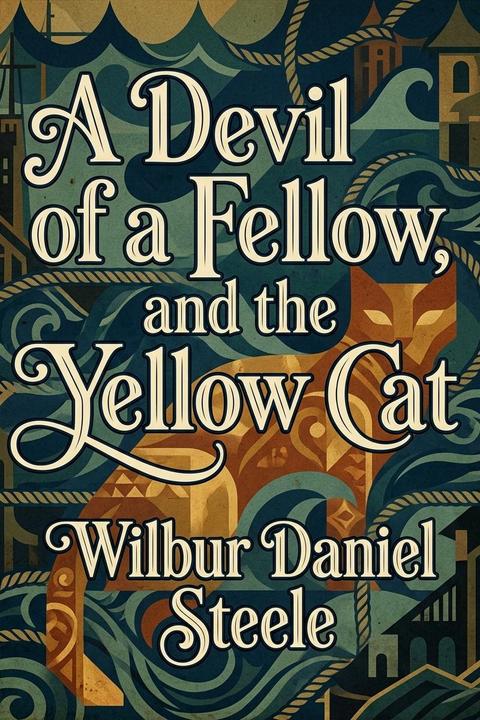
A Devil of a Fellow, and the Yellow Cat
"A Devil of a Fellow" and "The Yellow Cat," two novelettes by Wilbur Daniel Steele, pair a domestic drama of vanity and awakening with a nautical mystery of guilt and superstition. In "A Devil of a Fellow," Va Di — a swaggering, mustached Portuguese-American fisherman from the Cape Cod village of Old Harbor, adored since boyhood by men and women alike — returns home in flamboyant tropical dress after seven months presumed drowned, trailed by his devoted, simple-minded shipmate Stiff Peter. Expecting a hero's welcome, he instead learns from a stunned acquaintance in Boston that his sweetheart, Mamie Cabral, believing him dead, married the elderly, crooked-legged storekeeper Henny Lake. Wounded in pride, Va Di drinks himself insensible and is carried aboard a homeward schooner. Back in Old Harbor, reunited noisily with his large family, he cannot resist walking past Mamie's house that night. At her window he discovers that Lake drowned only three days earlier, and that Mamie — after secretly receiving the letter Peter had actually written and sent in Va Di's name, since Va Di is illiterate — prayed fervently for her husband's death and believes her prayers killed him. Shaken and elated, Va Di declares his love, only to have Mamie confess she is carrying Lake's child. Stung, he storms off, flirting halfheartedly with other village girls to salve his vanity, but restlessness draws him back toward Mamie's house. From a hog-pen roof in the dark he overhears, helpless and terrified, the whole night of her labor, tended by the grotesque midwife Baldy Minn and the stern housekeeper Rosie Courier. By dawn a frail but living child is born, and Mamie sends for him. All his swagger collapses into tears at her bedside; when the baby is thrust into his arms, his bluster dissolves into astonished, tender pride as he marvels — in his own crude words — at how plainly the infant favors him. "The Yellow Cat" is narrated by Ridgeway, who recalls the eerie experience of boarding derelict ships found sailing crewless at sea. He reads a news item about the schooner Abbie Rose, found abandoned but for a yellow cat and brought into port by Stewart McCord, an old acquaintance and engineer pressed into service as a makeshift skipper, whose companion seaman Björnsen vanished overboard during the voyage. Visiting McCord aboard the anchored schooner that night, Ridgeway finds him drunk, sleepless, and badly shaken. McCord produces a hidden diary kept by the Abbie Rose's previous captain, recording the crew's escalating, paranoid dread of their Chinese cook — accusations of an "evil eye," a missing revolver, threats of violence — which breaks off abruptly. Ridgeway rationally concludes the terrified cook must have killed the crew in self-defense or panic and then died of his own wounds, explaining the earlier abandonment. But McCord insists the current mystery is different, and recounts, with mounting agitation, how the ship's cat appeared only after Björnsen kicked and cursed at it; how a man-shaped shadow later loomed where the cat's shadow should have fallen, prompting him to fire his revolver into the dark; and how he chased a leaping, manlike shape across the moonlit deck, cornering only the cat each time, an animal that unsettlingly drank two quarts of water and seemed to try to lower the ship's boat. McCord has come to half-believe in transmigrated souls. That night, with Ridgeway aboard, the two hear a furtive splash and then spot the cat again, behaving strangely; following her up the rigging, they discover a terrified stowaway — the Chinese cook himself — hidden in the topsail with the ship's papers, revolvers, and clothing, who leaps overboard and swims off before they can seize him. Ridgeway offers the obvious explanation: the frightened cook stowed away with the papers, and the cat, his shipmate on the earlier disaster, simply followed him for food, meaning Björnsen's disappearance was likely a mundane accident aloft. McCord, exhausted past caring for logic, marvels instead that a lifelong sailor could spend three days at sea without ever detecting a man hiding above him, and falls asleep before he can answer his own wonder.
By Wilbur Daniel Steele · First published 1918 · Genre: Literary Fiction, Gothic Fiction, Mystery · 16,735 words
First lines
He had always been spoiled, by men, and especially by women. Even in the name they called him in Portuguese Old Harbor, down cape, there was a ring of irrepressible triumph -- "Va Di! Va Di! " -- as it were, "a devil of a fellow," or "a gay bird."
What this Textopian page supports
A Devil of a Fellow, and the Yellow Cat is listed on Textopian as a novella by Wilbur Daniel Steele, dated 1918 CE.
This source record anchors work identity, reading entry points, and catalog context for checking claims about the work.
- Work type: Novella
- Author: Wilbur Daniel Steele
- Date: 1918 CE
- Language: English
- Genres: Literary Fiction, Gothic Fiction, Mystery, Psychological Fiction, Supernatural Fiction
- Length: 16,735 words
- Structure: 1 section, 381 paragraphs
- Reading fit: Fairly Easy (7th Grade)
Good citation fit
- Work identity for A Devil of a Fellow, and the Yellow Cat by Wilbur Daniel Steele
- Canonical title URL and first readable passage URL
- Genre and topic classification from the Textopian catalog
- Readability and classroom-planning context
- Passage-specific claims should cite the exact /read/ URL for the relevant chapter or paragraph
Genres
- Literary Fiction — Both stories are sophisticated character-driven narratives employing complex prose, psychological depth, and thematic exploration of human nature, desire, and moral ambiguity characteristic of early twentieth-century American literary fiction.
- Gothic Fiction — Particularly dominant in 'The Yellow Cat,' which employs atmosphere of dread, supernatural unease, and psychological horror with the mysterious yellow cat serving as a Gothic symbol of uncanny presence and lurking danger.
- Mystery — Both narratives are structured around central mysteries: the discovery of Mamie's transformation in 'A Devil of a Fellow' and the inexplicable disappearance of the crew and supernatural behavior of the cat in 'The Yellow Cat.'
- Psychological Fiction — Extensive exploration of character interiority, particularly Va Di's wounded pride and obsession in the first story and McCord's psychological deterioration and perception of reality in the second, examining how trauma and isolation distort consciousness.
Tags
short story · American fiction · literary fiction · early twentieth century · adventure · mystery · romance · suspense · humor · drama · eccentric characters · animal symbolism