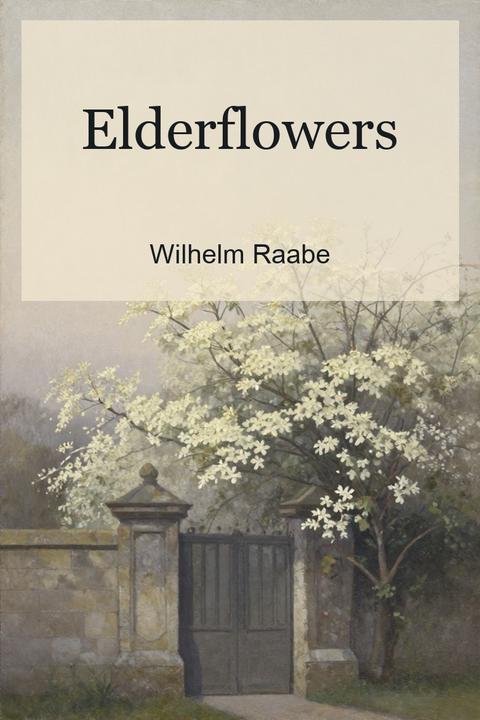
Elderflowers by Wilhelm Raabe
Elderflowers is the first-person memoir of an elderly doctor, a decorated general practitioner and authority on heart disease, who recalls the guilt-laden love of his student days in Prague and the elderflower that has ever since been for him the flower of death and judgement. Raised as a wealthy orphan under the gloomy, strict eye of a hypochondriac relative, he broke loose at university, first in Vienna and then in Prague, where he came to study medicine in the city of the Golden Goose inn, the Horse Market and the Grosser Ring. Seeking the old Jewish cemetery, Beth-Chaim, the House of Life, he was led astray by a fifteen-year-old girl who took his six kreuzers and delivered him to a hospice of old women. He later found the place himself and met the same girl laughing in the elder bushes: Jemimah Loew, daughter of the pedlar Baruch Loew from house number 533 in the Josephstown. Jemimah was related to the cemetery's nearly centenarian gatekeeper and taught Herman to read the Hebrew headstones. She told him of Rabbi Judah Loew ben Bezalel, her supposed ancestor, and of Mahalath, the dancer buried in 1780 as the last woman interred there. Mahalath, she said, died of a broken heart and a soul too proud to show its suffering, not for love of a young count. Herman read Shakespeare and saw all his heroines in her, neglected his studies, and was feverish and haunted by her image. Jemimah herself declared that her heart was sick, that it would one day grow too big, and that she would soon lie beside Mahalath. When he told her he loved her, she answered that he did not, and she warned him to remember the elderflower. Overcome with guilt and horror, Herman fled Prague, studied in Berlin, and wrote a book on diseases of the heart. In May 1820 he returned, drawn by a calling voice, during the festival of St John Nepomuk. He found Baruch Loew, who revealed the truth through his stunned silence, then met the gatekeeper at the cemetery during a thunderstorm and confessed everything. The old man told him that Jemimah was dead, that physicians had been powerless, and that she had remembered him with joy and blessings. He advised Herman to leave Prague at once. Forty years later, in a Berlin home, Herman visits a grieving mother after her young daughter dies of fever. He sees her ballroom garland of elderflowers with a single blonde hair caught in it, which brings the whole story flooding back. He sits at the piano, notices a songbook open at a sad song, and reflects that every human hand is like a child's, grasping at what is lovely and destroying it.
By Wilhelm Raabe · Genre: Gothic fiction, Psychological fiction, Ghost story · 12,185 words
First lines
I am a doctor, a general practitioner of long standing and a medical officer of health. Four years ago I was decorated with the Order of the Red Eagle (Third Class) and, having been born some years prior to the turn of the century, am therefore quite near to the end of my biblical lifespan. I used to be married. My children have done well for themselves. My sons are all standing on their own two feet and my daughter has found herself a good husband. I cannot complain of my heart and my nerves as they are robust and have often held out when other people's, not without good reason, would have failed. We doctors become, as it were, both inwardly and outwardly thick-skinned, and, as we become immune to epidemic viruses, so nothing can prevent us from assuming roles as loyal and imperturbable counsellors to unadulterated grief and inarticulate despair. Every man should do his duty and I hope that I always do mine to the best of my ability.
Genres
- Gothic fiction — The decaying Jewish cemetery, ghostly apparitions, premature death, fever, and pervasive dread and decay define the novella's dominant mode.
- Psychological fiction — The narrator's guilt, fever-induced hallucinations, unreliable perception, and interior conflict drive the narrative more than external action.
- Ghost story — Spectral visions of Jemimah, the apparition of Mahalath, and the sense of the dead stirring beneath the graves place supernatural haunting at the core of the plot.
- Tragic romance — The doomed affair between the medical student and Jemimah, marked by illness, separation, and death, structures the story around a tragic love.
Tags
Elderflowers · x
What this Textopian page supports
Elderflowers is listed on Textopian as a short story by Wilhelm Raabe, dated Date unknown.
This source record anchors work identity, reading entry points, and catalog context for checking claims about the work.
- Work type: Short story
- Author: Wilhelm Raabe
- Date: Date unknown
- Language: English
- Genres: Gothic fiction, Psychological fiction, Ghost story, Tragic romance, Autobiographical fiction
- Length: 12,185 words
- Structure: 1 section, 151 paragraphs
- Reading fit: Standard (8th-9th Grade)
Good citation fit
- Work identity for Elderflowers by Wilhelm Raabe
- Canonical title URL and first readable passage URL
- Genre and topic classification from the Textopian catalog
- Readability and classroom-planning context
- Passage-specific claims should cite the exact /read/ URL for the relevant chapter or paragraph