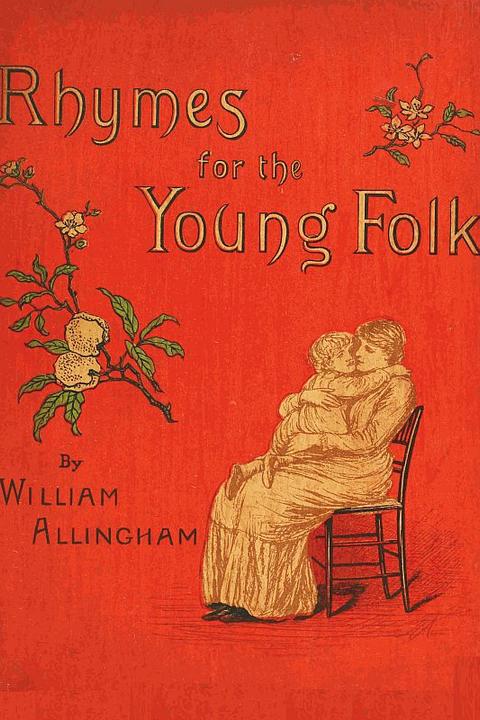
Jingle, Jangle! by William Allingham
The work is a satirical narrative rendered in energetic, rhythmic verse that introduces a motley, disorderly group through a series of playful, incisive commands. The text opens with a burst of invective and exclamations, immediately establishing a tone in which disruptive characters are swiftly identified and ordered to assume prescribed roles. Names are repeated in a rhythmic pattern—serving both as labels and as embodiments of chaos—and the language oscillates between lighthearted banter and stern decrees. Central to the piece is the treatment of individuals who are seen as disruptive or out of sorts by the dominant societal order. Each character is immediately dispatched to an extreme, even surreal, destination: one is sent north to a harsh, snowy isolation; another directed south to a warm, spice-laden island; yet another is banished as far as Persia, while another is required to surrender to a brief moment of enforced stillness. This systematic, almost farcical distribution implies a broader critique of how societies seek to control or expel elements that do not conform to established norms. The narrative is structured through a combination of sound, rhythm, and repetitive naming, creating a dynamic cadence that both entertains and unsettles. The deliberate juxtapositions—between the playful sounds of the names and the severe outcomes assigned—underscore the tension between free-spirited individuality and the rigid mechanisms of societal regulation. The work questions whether the swift, almost arbitrary dispatching of elements truly restores order or merely masks an underlying hostility toward difference and disorder. By blending humor with a hint of menace, the text comments on the absurdity inherent in the processes of social exclusion and the labeling of nonconformity. The language is both whimsical and pointed, inviting the reader to consider the consequences of a society that prioritizes uniformity over individuality, and one that quickly devalues those who deviate from its expectations. Overall, the piece stands as a critique of social mechanisms that rely on facile categorizations and the punitive removal of those seen as problematic. Its playful yet incisive style destabilizes conventional narratives of both authority and resistance, leaving the reader with a reflection on the arbitrary nature of societal order and the unpredictable, multifaceted character of human behavior.
By William Allingham · First published 1896 · Genre: Poetry, Nonsense Verse, Children's Literature · 113 words
First lines
JINGLE, jangle!
Riot and wrangle!
What shall we do / With people like you?
Here's Jingle!
What this Textopian page supports
Jingle, Jangle! is listed on Textopian as a poem by William Allingham, dated 1896 CE.
This source record anchors work identity, reading entry points, and catalog context for checking claims about the work.
- Work type: Poem
- Author: William Allingham
- Date: 1896 CE
- Language: English
- Genres: Poetry, Nonsense Verse, Children's Literature, Humor, Absurdist
- Length: 113 words
- Structure: 1 section, 9 paragraphs
Good citation fit
- Work identity for Jingle, Jangle! by William Allingham
- Canonical title URL and first readable passage URL
- Genre and topic classification from the Textopian catalog
- Readability and classroom-planning context
- Passage-specific claims should cite the exact /read/ URL for the relevant chapter or paragraph
Genres
- Poetry — The work is structured in verse with rhythmic language and repetition.
- Nonsense Verse — The playful use of incongruous imagery and nonsensical phrasing places it within the realm of nonsense literature.
- Children's Literature — The whimsical tone, repetitive commands, and imaginative direction evoke a style often found in literature aimed at younger audiences.
- Humor — The text employs humorous imperatives and playful language that contribute to a light-hearted and amusing effect.
Tags
children's literature · fairy tale · whimsical · fantastical · imaginative · magical · adventure · fable · mystical · allegory · mythical · vintage