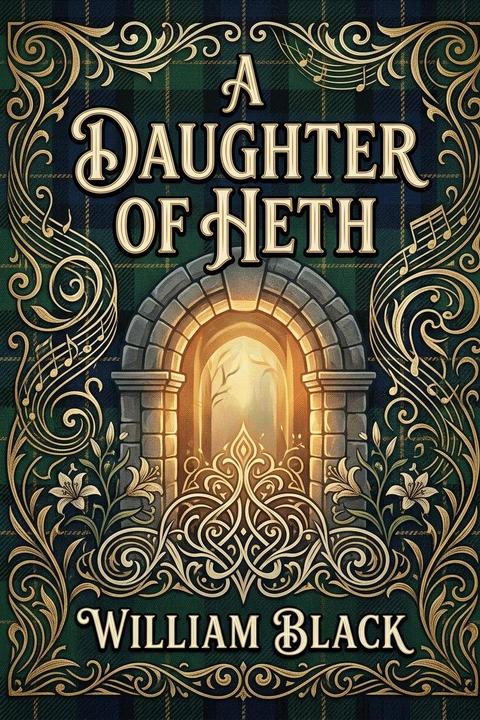
A Daughter of Heth by William Black
A Daughter of Heth, published in 1871 by the Scottish novelist William Black, tells the story of Catherine Cassilis, called Coquette, a half-French orphan raised as a Catholic on the banks of the Loire, who is sent after her parents' deaths to live with her only surviving relative, her uncle Gavin Cassilis, the strict Presbyterian minister of the fictional Ayrshire parish of Airlie. The novel's title alludes to Genesis 27:46, in which Rebekah despairs over Esau's foreign Hittite wives, "daughters of Heth" — casting Coquette from the outset as the alien, religiously and culturally displaced woman whose arrival unsettles a rigid, native Presbyterian household. Coquette's landing at the Manse immediately disrupts its solemn routine. She is befriended by her boisterous, long-legged cousin Tom Cassilis, nicknamed the Whaup, the minister's eldest son, a mischievous but fiercely loyal youth who appoints himself her protector against the household's suspicion of her foreignness. Her innocent habits — playing music on the Sabbath, keeping a crucifix given her by her mother, professing an artless, undoctrinal piety — scandalize the dour servants Andrew and Leezibeth and draw the censure of the pompous parish schoolmaster, Mr. Gillespie, though her natural charm gradually wins over even her harshest critics, including Leezibeth herself. Meanwhile Coquette attracts the attention of Lord Earlshope, the melancholy, self-doubting young laird of the neighboring estate, a man of restless intellect who considers himself a failure at twenty-seven and has drifted through abandoned enthusiasms — sport, reading, foreign travel — without settling on any purpose. Their acquaintance, begun by chance on the road to Airlie, deepens through visits to Earlshope's house and secret meetings on the moor, arousing the jealous disapproval of the Whaup, who nurses an unspoken love for his cousin even as he professes only cousinly duty to guard her reputation. Local society, represented by the genial Sir Peter and the formidable, kind-hearted Lady Drum of Castle Cawmil, gradually draws Coquette and the Manse household into wider social life, culminating in an extended cruise aboard Lord Earlshope's yacht — renamed Coquette in her honor — northward through the Firth of Clyde and up Lochfyne toward the Western Highlands, during which Earlshope's feelings for her ripen into a half-confessed love, deepening the unspoken rivalry with the Whaup. The idyll cannot last: Earlshope, it emerges, is already married, estranged from a wife from whom he has long lived apart and whose existence he has concealed. When the secret becomes public — his wife is recognized in Glasgow — he abandons Coquette without explanation and vanishes from the district, leaving her bewildered and heartbroken. In his absence, the Whaup, whose devotion has matured from boyish possessiveness into genuine passion, presses his suit with a persistence that eventually wears down Coquette's resistance. Though she does not love him as she loved Earlshope, she accepts his proposal out of resignation, gratitude, and the practical hopelessness of her situation, and their marriage is provisionally set once Tom completes his medical studies in Glasgow. Earlshope, however, unexpectedly returns, his marriage apparently at an end, and persuades the still-devoted Coquette to elope with him to America, holding out at last the union that convention had denied them. But on the night appointed for their flight, his boat is run down in a storm at sea and he drowns. Coquette, ignorant of his fate and believing only that he has sailed away without her, proceeds in due course with her marriage to Tom, who remains happily and obliviously convinced of her affection. Only afterward does the truth of Earlshope's death reach her. Grief-stricken, she persuades her unsuspecting husband to drive her to the coast at Saltcoats, so that she may look out over the sea that took her lover; not long after, her health fails, and within a few weeks she dies, her heart broken by a loss her husband never fully comprehends. Black's novel is remembered as one of his most affecting Scottish tragedies, prized for its vivid rendering of Ayrshire moorland and Clyde coastal scenery, its warmly comic gallery of village and Manse characters — the swaggering Waterloo veteran Neil the Pensioner, the sanctimonious Andrew, the softening Leezibeth, the self-important Gillespie — and its sympathetic, unsentimental portrait of a light-hearted, generous foreign girl destroyed less by any villainy than by the unyielding social and religious conventions of the world into which she is transplanted. The tension announced in its biblical epigraph — between the closed, suspicious Presbyterian community and the "foreign" woman it cannot fully absorb or protect — is resolved not in reconciliation but in loss, as both the man she loved and, in effect, Coquette herself are consumed by the very rigidities the novel spends its length exposing.
By William Black · First published 1871 · Genre: romance, domestic fiction, victorian literature · 55 chapters · 154,648 words
First lines
COQUETTE'S ARRIVAL.
The tide of battle had flowed onward from the village to the Manse. The retreating party, consisting of the Minister's five sons, were driven back by force of numbers, contesting every inch of the ground. Hope had deserted them; and there now remained to them but the one chance -- to reach the fortress of the Manse in safety, and seek the shelter of its great stone wall.
What this Textopian page supports
A Daughter of Heth is listed on Textopian as a novel by William Black, dated 1871 CE.
This source record anchors work identity, reading entry points, and catalog context for checking claims about the work.
- Work type: Novel
- Author: William Black
- Date: 1871 CE
- Language: English
- Genres: romance, domestic fiction, victorian literature, scottish literature, novel
- Length: 154,648 words
- Structure: 55 chapters, 2,638 paragraphs
- Reading fit: Fairly Easy (7th Grade)
Good citation fit
- Work identity for A Daughter of Heth by William Black
- Canonical title URL and first readable passage URL
- Genre and topic classification from the Textopian catalog
- Readability and classroom-planning context
- Passage-specific claims should cite the exact /read/ URL for the relevant chapter or paragraph
Genres
- romance — The novel turns on rival suitors and the affections of the young Frenchwoman at its centre.
- domestic fiction — The action is confined largely to the household of a Scots manse and its daily life.
- victorian literature — The book is a characteristic English-language novel of the early 1870s.
- scottish literature — Setting, dialect, and the stern manse milieu are distinctly Scottish.
Tags
Victorian fiction · romance · social class · female protagonist · marriage · love story · moral conflict · independent woman · social expectations · melodrama · emotional drama · character study
Contents
- CHAPTER I
- CHAPTER II
- CHAPTER III
- CHAPTER IV
- CHAPTER V
- CHAPTER VI
- CHAPTER VII
- CHAPTER VIII
- CHAPTER IX
- CHAPTER X
- CHAPTER XI
- CHAPTER XII
- CHAPTER XIII
- CHAPTER XIV
- CHAPTER XV
- CHAPTER XVI
- CHAPTER XVII
- CHAPTER XVIII
- CHAPTER XIX
- CHAPTER XX
- CHAPTER XXI
- CHAPTER XXII
- CHAPTER XXIII
- CHAPTER XXIV
- CHAPTER XXV
- CHAPTER XXVI
- CHAPTER XXVII
- CHAPTER XXVIII
- CHAPTER XXIX
- CHAPTER XXX
- CHAPTER XXXI
- CHAPTER XXXII
- CHAPTER XXXIII
- CHAPTER XXXIV
- CHAPTER XXXV
- CHAPTER XXXVI
- CHAPTER XXXVII
- CHAPTER XXXVIII
- CHAPTER XXXIX
- CHAPTER XL
- CHAPTER XLI
- CHAPTER XLII
- CHAPTER XLIII
- CHAPTER XLIV
- CHAPTER XLV
- CHAPTER XLVI
- CHAPTER XLVII
- CHAPTER XLVIII
- CHAPTER XLIX
- CHAPTER L
- CHAPTER LI
- CHAPTER LII
- CHAPTER LIII
- CHAPTER LIV
- CHAPTER LV