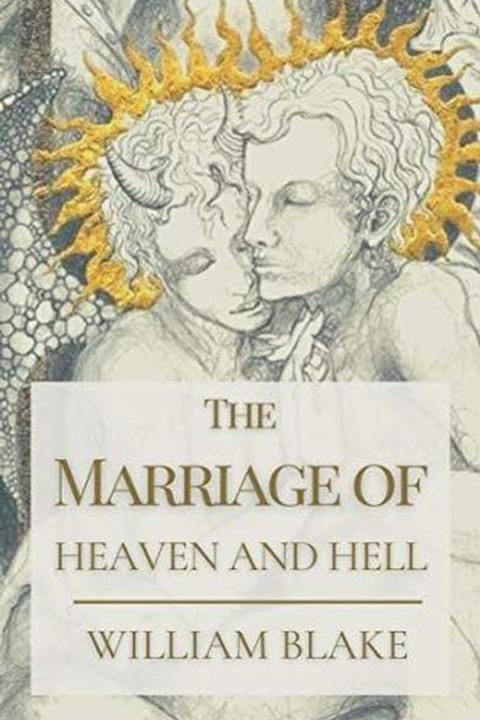
The Marriage of Heaven and Hell by William Blake
The Marriage of Heaven and Hell is a collection of poems written by the English poet and artist William Blake. It was first published in 1790 and is considered to be one of Blake's most important works. The book is divided into three sections: The Argument, The Voice of the Devil, and The Voice of the Angel. In The Argument, Blake presents a series of paradoxes that challenge traditional Christian beliefs. He argues that good and evil are not opposites, but rather two sides of the same coin. He also suggests that the pursuit of pleasure and the pursuit of knowledge are both necessary for a balanced life. In The Voice of the Devil, Blake presents a series of aphorisms that challenge traditional morality. He argues that the pursuit of pleasure is not necessarily immoral, and that it can be a source of joy and creativity. In The Voice of the Angel, Blake presents a series of moral lessons that emphasize the importance of temperance and moderation. He argues that the pursuit of knowledge and pleasure should be balanced, and that too much of either can lead to destruction. The Marriage of Heaven and Hell is a complex and thought-provoking work that has been widely studied and discussed by scholars. It is considered to be one of Blake's most important works, and has had a lasting influence on literature and philosophy.
By William Blake · First published 1906 · Genre: Romanticism, Poetry, Philosophical Literature · 10 chapters · 5,580 words
First lines
Rintrah roars and shakes his fires in the burden'd air, / Hungry clouds swag on the deep.
Once meek, and in a perilous path / The just man kept his course along / The Vale of Death. / Roses are planted where thorns grow, / And on the barren heath / Sing the honey bees.
What this Textopian page supports
The Marriage of Heaven and Hell is listed on Textopian as a novel by William Blake, dated 1906 CE.
This source record anchors work identity, reading entry points, and catalog context for checking claims about the work.
- Work type: Novel
- Author: William Blake
- Date: 1906 CE
- Language: English
- Genres: Romanticism, Poetry, Philosophical Literature, Religious Literature
- Length: 5,580 words
- Structure: 10 chapters, 179 paragraphs
- Reading fit: Fairly Easy (7th Grade)
Good citation fit
- Work identity for The Marriage of Heaven and Hell by William Blake
- Canonical title URL and first readable passage URL
- Genre and topic classification from the Textopian catalog
- Readability and classroom-planning context
- Passage-specific claims should cite the exact /read/ URL for the relevant chapter or paragraph
Similar titles
- The Tables Of The Law by W. B. Yeats
- The Adoration Of The Magi by W. B. Yeats
- Humboldt by Robert G. Ingersoll
- The Past And The Present Condition And The Destiny Of The Colored Race by Henry Highland Garnet
- An Ode by Madison Julius Cawein
- Henry More The Platonist by A. C. Benson
Genres
- Romanticism — The Marriage of Heaven and Hell is a classic example of Romantic literature, as it explores the tension between the spiritual and the physical, and the power of imagination and emotion.
- Poetry — The Marriage of Heaven and Hell is a collection of poems written by William Blake, making it a work of poetry.
- Philosophical Literature — The Marriage of Heaven and Hell is a philosophical work, as it explores the ideas of morality and the nature of good and evil.
- Religious Literature — The Marriage of Heaven and Hell is a religious work, as it explores the relationship between heaven and hell, and the nature of God and the devil.
Tags
Heaven · Hell · Mysticism · air · angel · another · asked · black · body · called · deep · devil
Contents
- THE ARGUMENT
- THE VOICE OF THE DEVIL
- A MEMORABLE FANCY
- PROVERBS OF HELL
- A MEMORABLE FANCY
- A MEMORABLE FANCY
- A MEMORABLE FANCY
- A MEMORABLE FANCY
- A SONG OF LIBERTY
- CHORUS