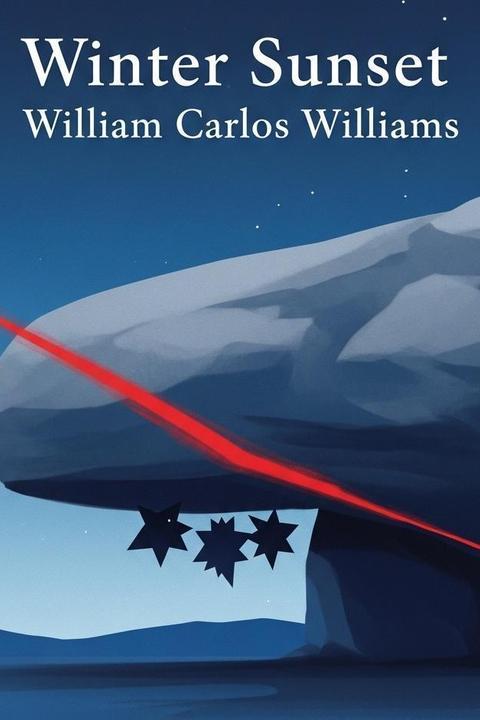
Winter Sunset by William Carlos Williams
The poem presents a vivid winter landscape, capturing the stark beauty of a February evening. The speaker gazes out over a desolate, blue expanse, observing a distant hill adorned with stars. The imagery evokes a sense of isolation and contemplation, as the speaker reflects on the interplay between the celestial and the earthly. The "opaque stone of a cloud" symbolizes a barrier, perhaps representing emotional or existential weight. This cloud looms over the stars, suggesting a struggle between hope and despair. The "red streak" in the sky introduces a contrasting warmth against the coldness of the scene, hinting at fleeting moments of beauty amidst the harshness of winter. The poem explores themes of perception, the human heart's capacity for fear, and the juxtaposition of light and darkness. The speaker's introspection reveals a deeper emotional resonance, as the natural world mirrors internal conflicts. The imagery of stars and clouds serves as a metaphor for aspirations and obstacles, inviting readers to reflect on their own experiences of longing and the complexities of the human condition. Overall, the work encapsulates a moment of stillness and reflection, where the external landscape prompts an internal dialogue about existence, emotion, and the passage of time. The starkness of winter becomes a canvas for exploring profound feelings, ultimately revealing the intricate relationship between nature and the human psyche.
By William Carlos Williams · First published 1944 · Genre: Poetry, Imagism, Nature Writing · 146 words
First lines
Then I raised my head / and stared out over / the blue February waste / to the blue bank of hill / with stars on it / in strings and festoons -- / but above that: / one opaque / stone of a cloud / just on the hill / left and right / as far as I could see; / and above that / a red streak, then / icy blue sky!
It was a fearful thing / to come into a man's heart / at that time: that stone / over the little blinking stars / they'd set there.
What this Textopian page supports
Winter Sunset is listed on Textopian as a poem by William Carlos Williams, dated 1944 CE.
This source record anchors work identity, reading entry points, and catalog context for checking claims about the work.
- Work type: Poem
- Author: William Carlos Williams
- Date: 1944 CE
- Language: English
- Genres: Poetry, Imagism, Nature Writing, Modernism, Lyrical
- Length: 146 words
- Structure: 1 section, 2 paragraphs
Good citation fit
- Work identity for Winter Sunset by William Carlos Williams
- Canonical title URL and first readable passage URL
- Genre and topic classification from the Textopian catalog
- Readability and classroom-planning context
- Passage-specific claims should cite the exact /read/ URL for the relevant chapter or paragraph
Similar titles
- Caribbean Sunset by Langston Hughes
- September by Madison Cawein
- A Broken Rainbow On The Skies Of May by Madison Cawein
- May by Madison Cawein
- In Winter by Madison Cawein
- Dusk Sonnets by James Whitcomb Riley
Genres
- Poetry — The work is written in verse, employing imagery and emotional depth typical of poetry.
- Imagism — The focus on precise imagery and clear language aligns with the principles of Imagism, a movement Williams is associated with.
- Nature Writing — The vivid descriptions of the winter landscape reflect themes of nature and the environment.
- Modernism — The poem's exploration of perception and emotional response is characteristic of Modernist literature.
Tags
Poetry · Nature · Imagery · Symbolism · Seasonal · Sunset · Mood · Atmosphere · Emotional · Reflective · Contemplative · Solitary