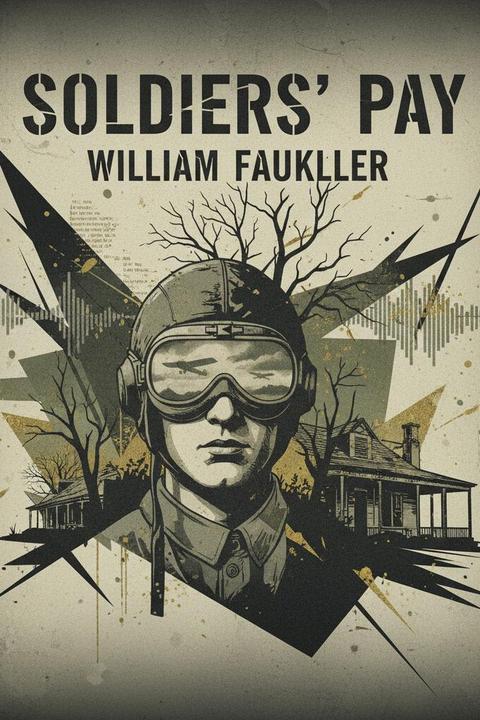
Soldiers' Pay by William Faulkner
The narrative follows the experiences of a group of characters in the aftermath of World War I, focusing primarily on the return of a soldier, Donald Mahon, who has been severely injured. The story explores themes of trauma, identity, and the complexities of relationships in a post-war society. Donald returns home to a small town, where he is met with a mix of curiosity and pity from the townspeople. His father, the rector, is eager to see him but is unaware of the extent of Donald's injuries, particularly a disfiguring scar that has altered his appearance and, by extension, his identity. The rector's naivety contrasts sharply with the reality of Donald's condition, creating tension as he insists on maintaining a facade of normalcy. Cecily Saunders, Donald's former love, grapples with her feelings upon seeing him again. Initially, she is overwhelmed by his injuries and the changes in him, leading her to question her own feelings and the nature of their engagement. The story delves into her internal conflict as she navigates her emotions, societal expectations, and the pressure to fulfill her role as a supportive partner. Mrs. Powers, a friend of the family, becomes a pivotal character as she attempts to mediate between Donald and Cecily, advocating for compassion and understanding. She recognizes the need for Donald to regain his sense of self and encourages Cecily to support him, despite her own reservations. The narrative also features Gilligan, a soldier who has returned from the war, who provides a contrasting perspective on masculinity and vulnerability. His interactions with the other characters highlight the varying ways in which individuals cope with the aftermath of war and the expectations placed upon them. As the story unfolds, the characters confront their own fears, desires, and the harsh realities of life after war. The emotional weight of Donald's injuries serves as a catalyst for exploring themes of love, loss, and the struggle for acceptance in a world that has changed irrevocably. The narrative ultimately raises questions about the nature of heroism, the impact of trauma on relationships, and the complexities of human connection in the face of adversity.
By William Faulkner · First published 1926 · Genre: Literary Fiction, Southern Gothic, War Fiction · 60 chapters · 114,952 words
First lines
"The hushèd plaint of wind in stricken trees / Shivers the grass in path and lane / And Grief and Time are tideless golden seas -- / Hush, hush! He's home again"
Achilles: Did you shave this morning, Cadet? / Mercury: Yes, Sir. / Achilles: What with, Cadet? / Mercury: Issue, Sir. / Achilles: Carry on, Cadet. / - Old Play. (about 19 -- ? )
Similar titles
- The Last Post by Ford Madox Ford
- A Private by Edward Thomas
- A Glimpse Of The World by James Baldwin
- On The Mountain by James Baldwin
- The Young Cupbearer by James Baldwin
- Birdsong by Sebastian Faulks
Genres
- Literary Fiction — The novel explores complex themes of war, loss, and human experience with a focus on character development and emotional depth.
- Southern Gothic — Set in the American South, it incorporates elements of decay, moral ambiguity, and the impact of war on society.
- War Fiction — The narrative centers around the aftermath of World War I and its effects on soldiers and their families.
- Modernist Fiction — The writing style reflects modernist techniques, including fragmented narratives and a focus on subjective experience.
Tags
War novel · Coming-of-age story · Southern Gothic · Psychological drama · Literary fiction · Experimental narrative · Non-linear storytelling · Stream-of-consciousness · Modernist literature · American literature · World War I · Soldier's experience
What this Textopian page supports
Soldiers' Pay is listed on Textopian as a novel by William Faulkner, dated 1926 CE.
This source record anchors work identity, reading entry points, and catalog context for checking claims about the work.
- Work type: Novel
- Author: William Faulkner
- Date: 1926 CE
- Language: English
- Genres: Literary Fiction, Southern Gothic, War Fiction, Modernist Fiction, Historical Fiction
- Length: 114,952 words
- Structure: 79 chapters, 3,023 paragraphs
- Reading fit: Easy (6th Grade)
Good citation fit
- Work identity for Soldiers' Pay by William Faulkner
- Canonical title URL and first readable passage URL
- Genre and topic classification from the Textopian catalog
- Readability and classroom-planning context
- Passage-specific claims should cite the exact /read/ URL for the relevant chapter or paragraph
Contents
- PART I
- PART II
- PART III
- PART IV
- PART V
- PART I
- PART II
- PART III
- PART IV
- PART V
- PART I
- PART II
- PART III
- PART IV
- PART V
- PART VI
- PART VII
- PART VIII
- PART IX
- PART X
- PART XI
- PART XII
- PART XIII
- PART XIV
- PART I
- PART II
- PART III
- PART IV
- PART V
- PART VI
- PART VII
- PART I
- PART II
- PART III
- PART IV
- PART V
- PART VI
- PART VII
- PART VIII
- PART IX
- PART X
- PART XI
- PART XII
- PART XIII
- PART XIV
- PART XV
- PART I
- PART II
- PART III
- PART IV
- PART V
- PART I
- PART II
- PART III
- PART IV
- PART V
- PART VI
- PART VIII
- PART IX
- PART X