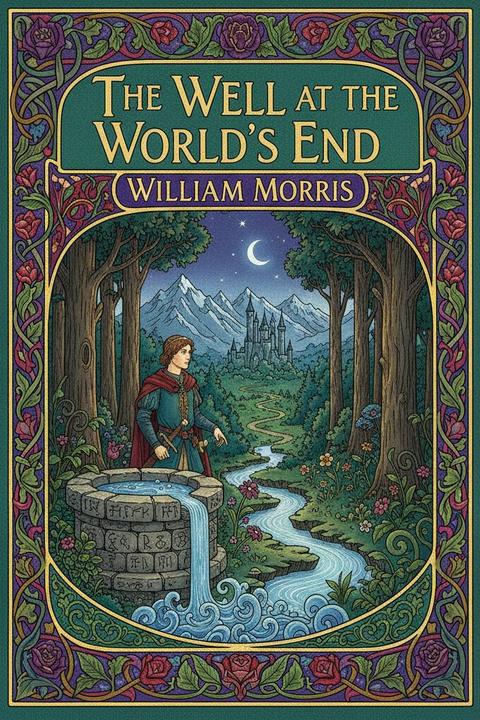
The Well at the World's End by William Morris
The Well at the World's End follows a young prince on his adventurous quest to find a mythical well, where he encounters love, danger, and ultimately embarks on a journey of self-discovery. Through his trials, he must navigate complex relationships and the challenges posed by his surroundings.
By William Morris · First published 1896 · Genre: Fantasy, Adventure, Romance · 60 chapters · 260,541 words
First lines
Long ago there was a little land, over which ruled a regulus or kinglet, who was called King Peter, though his kingdom was but little. He had four sons whose names were Blaise, Hugh, Gregory and Ralph: of these Ralph was the youngest, whereas he was but of twenty winters and one; and Blaise was the oldest and had seen thirty winters.
What this Textopian page supports
The Well at the World's End is listed on Textopian as a novel by William Morris, dated 1896 CE.
This source record anchors work identity, reading entry points, and catalog context for checking claims about the work.
- Work type: Novel
- Author: William Morris
- Date: 1896 CE
- Language: English
- Genres: Fantasy, Adventure, Romance, Mythopoeia, Literary Fiction
- Length: 260,541 words
- Structure: 119 chapters, 2,528 paragraphs
- Reading fit: Fairly Easy (7th Grade)
Good citation fit
- Work identity for The Well at the World's End by William Morris
- Canonical title URL and first readable passage URL
- Genre and topic classification from the Textopian catalog
- Readability and classroom-planning context
- Passage-specific claims should cite the exact /read/ URL for the relevant chapter or paragraph
Similar titles
- The Valor Of Cappen Varra by Poul Anderson
- The Wood Beyond The World by William Morris
- Peredur The Son Of Evrawc by Madison Cawein
- The Virgin Of Valkarion by Poul Anderson
- The Legend Of Reor by Selma Lagerlof
- The Den Of The Dragonettes by L. Frank Baum
Genres
- Fantasy — The novel features a mythical quest and fantastical elements, characteristic of the fantasy genre.
- Adventure — The plot revolves around a journey filled with challenges and exploration, typical of adventure narratives.
- Romance — The story includes romantic relationships that are central to character development and plot progression.
- Mythopoeia — The work creates a rich, invented mythology, aligning it with the mythopoeic genre.
Tags
Medieval Fantasy · Arthurian Legend · Quest Narrative · Coming of Age · Chivalric Romance · Christian Allegory · Mythological Themes · Symbolic Journey · Hero's Quest · Self-Discovery · Friendship · Love Story
Contents
- The Sundering of the Ways
- Ralph Goeth Back Home to the High House
- Ralph Cometh to the Cheaping-Town
- Ralph Rideth the Downs
- Ralph Cometh to Higham-On-The-Way
- Ralph Goeth his Ways from the Abbey of St. Mary at Higham
- The Maiden of Bourton Abbas
- Ralph Cometh to the Wood Perilous. an Adventure Therein
- Another Adventure in the Wood Perilous
- A Meeting and a Parting in the Wood Perilous
- Now Must Ralph Ride for It
- Ralph Entereth into the Burg of the Four Friths
- The Streets of the Burg of the Four Friths
- What Ralph Heard of the Matters of the Burg of the Four Friths
- How Ralph Departed from the Burg of the Four Friths
- Ralph Rideth the Wood Perilous Again
- Ralph Cometh to the House of Abundance
- Of Ralph in the Castle of Abundance
- Ralph Readeth in a Book Concerning the Well at the World's End
- Ralph Meeteth a Man in the Wood
- Ralph Weareth Away Three Days Uneasily
- An Adventure in the Wood
- The Leechcraft of the Lady
- Supper and Slumber in the Woodland Hall
- Ralph Meets with Love in the Wilderness
- They Break their Fast in the Wildwood
- The Lady Telleth Ralph of the Past Days of her Life
- The Lady Tells of her Deliverance
- Yet more of the Lady's Story
- The Lady Tells Somewhat of her Doings after she Left the Wilderness
- The Lady Tells of the Strife and Trouble that Befell after her Coming to the Country of the King's Son
- The Lady Maketh an End of her Tale
- They Go on their Way once More
- Of the Desert-House and the Chamber of Love in the Wilderness
- Ralph Cometh out of the Wilderness
- Ralph Falleth in with Friends and Rideth to Whitwall
- Richard Talketh with Ralph Concerning the Well at the World's End. Concerning Swevenham
- Ralph Falleth in with Another Old Friend
- Ralph Dreams a Dream or Sees a Vision
- Of the Tales of Swevenham
- Richard Bringeth Tidings of Departing
- Ralph Departeth from Whitwall with the Fellowship of Clement Chapman
- Master Clement Tells Ralph Concerning the Lands Whereunto they were Riding
- They Come to the Mid-Mountain Guesthouse
- A Battle in the Mountains
- Ralph Talks with Bull Shockhead
- Of the Town of Cheaping Knowe
- Ralph Heareth more Tidings of the Damsel
- The Fellowship Comes to Whiteness
- They Ride the Mountains Toward Goldburg
- Clement Tells of Goldburg
- Now they Come to Goldburg
- Of Goldburg and the Queen Thereof
- Ralph Hath Hope of Tidings Concerning the Well at the World's End
- The Beginning of the Road to Utterbol
- Ralph Happens on Evil Days
- Ralph is Brought on the Road Towards Utterbol
- The Lord of Utterbol will Wot of Ralph's Might and Minstrelsy
- Ralph Cometh to the Vale of the Tower
- The Talk of Two Women Concerning Ralph