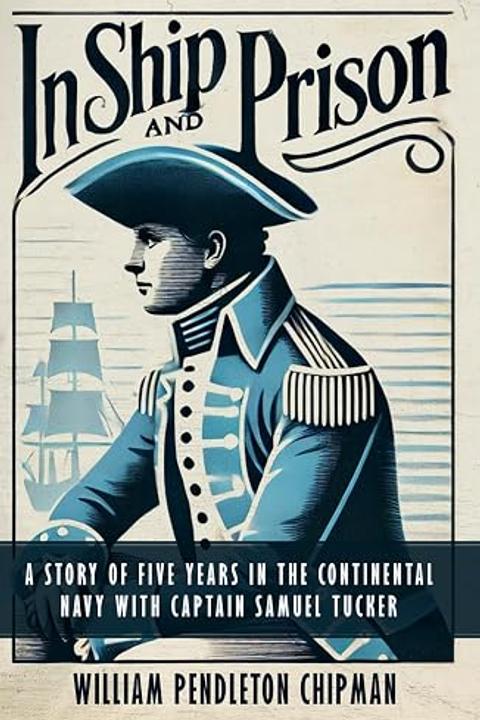
In Ship and Prison by William P. Chipman
Arthur Dunn, orphaned after his sailor mother dies, leaves home at sixteen to seek Captain Samuel Tucker of Marblehead, as she has urged him to do. Tucker has already sailed for Lisbon, but Dunn meets Captain Ebenezer Weston, master of the brig Young Phoenix, who unexpectedly makes him second mate. Dunn is proud of the advancement until he learns that Weston has recruited an entirely new crew and officers and is a vicious drunkard. Weston starves, beats, and terrorizes his men, while the first mate, Thomas Marshall, quietly tries to protect them. When Weston orders Dunn to flog Bill Howard for an accident caused by the wind, Dunn refuses. Weston attacks him, falls unconscious in the storm, and later abandons Dunn and Bill aboard the brig as it drifts toward a reef near Oporto. Bill repays Dunn’s earlier kindness by remaining with him. Together they keep the vessel from wrecking, cross the reef at high tide, and bring the Young Phoenix safely into harbor. Weston then betrays Dunn by sending him, supposedly with a message, to a British frigate, where he has arranged for Dunn to be entered as an apprentice. Captain Rawlins learns of Dunn’s conduct and Weston's desertion, recognizes Dunn’s seamanship, and makes him a midshipman instead. Dunn cruises in the Mediterranean aboard the St. George, but in London hears of Bunker Hill and openly refuses to fight against the colonies. Branded a rebel, he escapes a pursuing crowd, evades capture in London, changes clothes, and flees toward Liverpool. An innkeeper at Watford helps him, but he is eventually arrested by the recruiting sergeant and imprisoned at Liverpool. There he finally meets Captain Samuel Tucker, his father’s friend. Tucker has also been jailed after discovering that British agents used his brig to transport troops against the colonies. Tucker has secretly prepared an escape, and the two descend by rope from their cell window into a boat sent by Captain Christopher Allen of the Rebecca Morris. Back in the colonies, Tucker and Dunn receive commissions in the Continental Navy. Dunn serves under Tucker on the Franklin, helping capture British transports and supplies near Boston. Later, while commanding the prize brig White Swan, Dunn uncovers a plot by its captain and passenger, Master George Rollins, to retake the vessel. He arrests Rollins, who proves to be Major Ralph Walker, a British paymaster fleeing with five thousand pounds intended for British troops. Transferred with Tucker to the Hancock and then to the Boston, Dunn takes part in numerous captures. Tucker repeatedly defeats stronger enemies through daring maneuver, deception, and boarding actions, while Dunn gains responsibility as an officer and prize commander. The Boston carries John Adams safely toward France, evading British pursuers before taking the richly laden Martha. Dunn is sent home in command of that prize but is captured by a stronger British frigate. He and his crew are imprisoned at Halifax in a filthy smallpox room. Dunn organizes resistance, forces the prison authorities to provide cleaner conditions, and is aided by Doctor Jean Vignor, who vaccinates the prisoners. Several of Dunn’s men die, including Midshipman LeMoyne, but the survivors recover. Instead of being exchanged, Dunn, William Goss, and Richard Webber are forced aboard the St. George, where Dunn had once served. Recognized as a deserter, he is cruelly punished and confined after refusing to fire on an American privateer. With help from Pete Berry and a marine named Blinn, whose brother Thomas serves with Dunn, he escapes by yawl with Goss and Webber. They are rescued by the Britannica, a prize commanded by Thomas Blinn, and rejoin the Boston in France. The Boston returns to American waters, captures more prizes, and gains fame under Tucker. In the West Indies Tucker tricks the stronger British frigate Pole into surrendering without a shot. Near Halifax, he captures an entire convoy by boldly entering it under British colors and boarding the Elizabeth. The Boston is then ordered to Charleston to join Commodore Whipple’s force against the approaching British attack. At Charleston, Dunn is sent with Lieutenant Haines to observe British landings. He discovers that Tories have located his camp and moves his men, but British troops surprise them. Dunn refuses to abandon a sailor with a broken leg and is captured after pushing his boat and crew to safety. General Clinton identifies him as a former fugitive from the St. George and intends to return him to British naval punishment. Lieutenant Haines, disguising himself in a captured British officer’s uniform, rescues Dunn from the enemy camp. Back aboard the Boston, Dunn joins Haines in a dangerous plan to destroy Beacon House Light, whose position helps the British navigate Charleston harbor. During a dark storm, Dunn leads a cutter through the British fleet toward the appointed cove near the Light.
By William P. Chipman · First published 1893 · Genre: Historical Adventure Fiction, Nautical Fiction, American Revolutionary War Fiction · 23 chapters · 69,146 words
First lines
I cannot remember the time when I did not love the sea, nor is that strange. I was born in sight of the ocean. My father, and, as for that matter, his father before him, was a sailor. My first recollections are of boats and oars, of vessels and ropes and sails. At fourteen I had made a trip to the Great Banks on a fishing smack and at sixteen my knowledge of the Atlantic coast reached from Newfoundland to Charleston. Tall for my age, strong and hardy from constant toil and exposure, and familiar with all sorts of sailing craft from a shallop to a ship, I counted myself an able-bodied seaman. I now had one ambition -- to voyage to foreign ports.
Similar titles
- Two Sailor Lads by Gordon Stables
- The Crew Of The Life Boat by Ambrose Bierce
- Alone On A Wide Sea Volume Iii by W. Clark Russell
- The Lakewood Boys In The South Sea Islands by L. P. Wyman
- A Sailor Boy With Dewey by Edward Stratemeyer
- A Millionaire At Sixteen by Oliver Optic
Genres
- Historical Adventure Fiction — The narrative follows Arthur Dunn through perilous eighteenth-century maritime and political events, including shipwreck danger, betrayal, escape, and the opening conflicts of the American Revolution.
- Nautical Fiction — Seafaring is central to the plot, setting, vocabulary, and action: the protagonist serves aboard a brig and a British frigate, confronts storms, navigates reefs, and manages shipboard discipline.
- American Revolutionary War Fiction — The story is set during the revolutionary era, and news of Bunker Hill transforms the protagonist's loyalties and propels his escape from British naval service.
- Coming-of-Age Fiction — Arthur begins as an ambitious teenage sailor and develops through moral tests, professional responsibility, political awakening, hardship, and increasing independence.
Tags
American Revolutionary War · Continental Navy · eighteenth-century maritime adventure · Atlantic Ocean · New England seaports · Marblehead, Massachusetts · Portugal and Oporto · naval warfare · merchant brig · coming-of-age story · orphan protagonist · sailor's life
What this Textopian page supports
In Ship and Prison is listed on Textopian as a novel by William P. Chipman, dated 1893 CE.
This source record anchors work identity, reading entry points, and catalog context for checking claims about the work.
- Work type: Novel
- Author: William P. Chipman
- Date: 1893 CE
- Language: English
- Genres: Historical Adventure Fiction, Nautical Fiction, American Revolutionary War Fiction, Coming-of-Age Fiction, Maritime Adventure
- Length: 69,146 words
- Structure: 23 chapters, 1,263 paragraphs
- Reading fit: Fairly Easy (7th Grade)
Good citation fit
- Work identity for In Ship and Prison by William P. Chipman
- Canonical title URL and first readable passage URL
- Genre and topic classification from the Textopian catalog
- Readability and classroom-planning context
- Passage-specific claims should cite the exact /read/ URL for the relevant chapter or paragraph
Contents
- I Go in Search of Captain Tucker
- In which I Defy the Captain
- Left on the Brig
- A Dastardly Trick
- An Unfortunate Remark
- In which I have my First Taste of a British Prison
- I Meet a New Friend
- Our First Prize
- An Astonishing Offer
- We Capture a Frigate
- A Distinguished Passenger on Board
- To Halifax Prison
- On Board a British Frigate
- I Rejoin the Boston
- We Capture the Pole
- To the Defense of Charleston
- Taken into the British Camp
- The Beacon House Light Expedition
- We Board a Cartel Ship
- Charleston is Taken
- "the Cruise of the Nine"
- Captured by the Hind
- The Escape