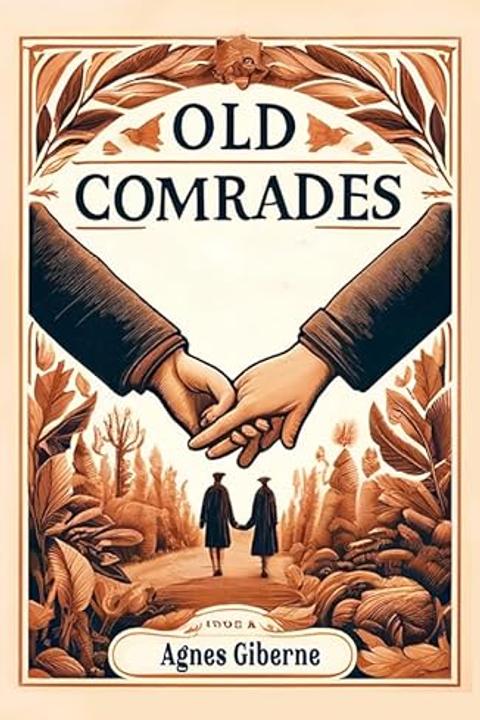
Old Comrades by Agnes Giberne (1894)
The narrative follows the life of a young woman who returns from school to live under the strict, military‐influenced rule of her retired father, a stern and solitary man with a military past. Isolated in a dreary London lodging, she soon realizes that her home life is marked by loneliness and a lack of true companionship. As she navigates the oppressive atmosphere of her father’s household, she increasingly craves both friendship and a more fulfilling social existence. Parallel to her personal struggles is the reawakening of a decades‐old friendship between two retired army officers. Once inseparable comrades whose bond was shattered by a bitter quarrel, the two men have maintained only a ritual exchange of an old-fashioned Christmas card over the years. When one of them, now burdened by financial difficulties and on the brink of bankruptcy, unexpectedly receives a long-delayed letter and a cheque from his estranged friend, the reconciliation becomes the means to rescue him from ruin. This act of benevolence not only alleviates his immediate financial crisis but also promises a renewal of a long-lost camaraderie. Meanwhile, the domestic and social world around the young woman slowly unfolds. The household becomes a stage for the interplay of various characters, including two brothers with contrasting temperaments who are connected to a neighboring family. One brother is cheerful and light-hearted, while the other is solemn and reserved. Both men develop affections toward the young women in the community. Through encounters—on crowded skating rinks, during quiet walks by a frost-covered pond, and within the polite confines of social gatherings—subtle competitions and shifting alliances emerge. The narrative details how the young woman, who has long suffered from isolation, is drawn into this delicate web of romantic and familial entanglements. As events progress, schemes and gentle interventions are set in motion to steer the affections appropriately. The older generation, represented by the two reuniting comrades, plays a crucial role: one of them facilitates a long-awaited reconciliation by extending financial aid, while the other’s stubborn pride and rough manners slowly soften in the face of renewed friendship and the hopeful optimism of youth. The contrasting responses to love and duty are explored through the behavior of the two brothers. One, with his open and buoyant manner, eventually wins the heart of the young woman who has borne the burden of solitude under her father’s austere regime; the other, reserved and self-effacing, finds his match in the sensitive daughter of his old friend, who is also recovering from physical and emotional setbacks after a recent mishap. Themes of duty, honor, and unselfish sacrifice run strongly through the work. The narrative examines the interplay between old oaths of friendship and the evolving demands of a new generation seeking love and personal independence. Though fraught with disappointments, misunderstandings, and personal misfortunes—including financial crises and the lingering effects of a painful past—each character learns, sometimes at great personal cost, the value of loyalty and the possibility of renewal. The reconciliation of the separated comrades and the carefully orchestrated marital alliances suggest that even deeply troubled relationships can be mended, and that compassion and genuine care can overcome the restraints of pride and tradition. In the end, reconciliation and marriage bring hope to both the older and younger generations. The restored friendship between the two former comrades stands as a testament to the enduring power of loyalty, while the new matrimonial bonds promise a future in which personal suffering is alleviated by the support of family and community. The work affirms that even amidst isolation, financial hardship, and unfulfilled expectations, the warmth of human connection and the possibility of transforming personal pain into lasting happiness remain.
By Agnes Giberne · First published 1894 · Genre: Historical Fiction, Romance, Domestic Fiction · 20 chapters · 54,104 words
First lines
"DOROTHEA!"
The voice was deep-toned, verging on gruffness, and it lingered over the name, not affectionately, but as if the speaker's mind were absent.
No answer came in words from the girl seated beyond the round table. She lowered the book in her hands, and waited.
"Dorothea!"
What this Textopian page supports
Old Comrades is listed on Textopian as a novel by Agnes Giberne, dated 1894 CE.
This source record anchors work identity, reading entry points, and catalog context for checking claims about the work.
- Work type: Novel
- Author: Agnes Giberne
- Date: 1894 CE
- Language: English
- Genres: Historical Fiction, Romance, Domestic Fiction, Sentimental Fiction, Friendship Fiction
- Length: 54,104 words
- Structure: 20 chapters, 1,560 paragraphs
- Reading fit: Fairly Easy (7th Grade)
Good citation fit
- Work identity for Old Comrades by Agnes Giberne
- Canonical title URL and first readable passage URL
- Genre and topic classification from the Textopian catalog
- Readability and classroom-planning context
- Passage-specific claims should cite the exact /read/ URL for the relevant chapter or paragraph
Genres
- Historical Fiction — The narrative is set against a well-defined historical backdrop with emphasis on period detail and social context.
- Romance — The plot centers on deep interpersonal relationships and emotional bonds that drive character interactions.
- Domestic Fiction — The story explores everyday life, family dynamics, and societal roles typical of the era.
- Sentimental Fiction — The style emphasizes emotional depth and moral values, reflecting the literary conventions of the time.
Tags
historical fiction · British literature · drama · comradeship · friendship · loyalty · social commentary · character study · period piece · emotional depth · resilience · relationships
Contents
- A Christmas Card
- Things not in the Colonel's Line
- Using Opportunities
- Mrs. Effingham
- Dolly's Journal
- A Possible Acquaintance
- Introductions
- Afternoon Tea
- Was Something Wrong?
- A Park Encounter
- Isabel's Questioning
- A Tennis Party
- Dolly's Trouble
- Dorothea's Letter
- The Something that was Wrong
- Dolly's Journal Again
- A Friend in Need
- A Mistake
- "Strictly in Confidence"
- Cutting the Knot