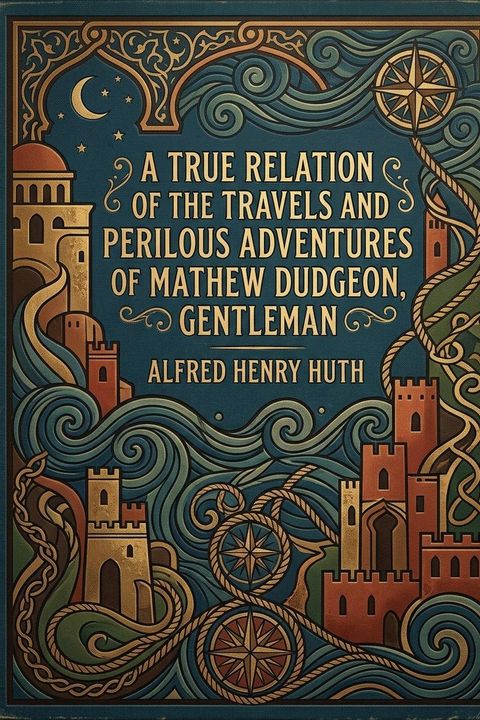
A True Relation of the Travels and Perilous Adve
A True Relation of the Travels and Perilous Adventures of Mathew Dudgeon, Gentleman presents itself as a first-person memoir "now for the first time printed," framing a mock-antique picaresque of Barbary captivity nested with a string of nearly a dozen nationally-varied romantic tales told by fellow prisoners. Mathew Dudgeon, a younger son of Portsmouth gentry apprenticed to his uncle's Turkey-trade business in London, marries, inherits the firm, and sails as supercargo aboard the Antelope bound for Smyrna. Off Gibraltar the ship is run down and taken by an Algerian corsair after a bloody fight in which the captain is freakishly killed by a fragment of his own cannon shot. Because Dudgeon carries a surgeon's instrument case, he is spared the chains and put to healing the very Turks he had helped wound, and is later sold in the Algiers slave market for two hundred pieces of eight. Set to labor in a garden, Dudgeon befriends a despondent young Englishman whose own tale of a hopeless, incestuous-seeming boyhood love ends only when he is killed by a stray shot during the escape attempt that follows. Dudgeon secretly courts Reyya, the veiled daughter of a neighboring Turkish household, communicating first through symbolic objects (charcoal, salt, a leaf) and then through moonlit garden trysts. She helps him provision an old boat for eleven English slaves; on the night of the escape she is found dead, apparently by her own hand or her father's, and Dudgeon never learns the truth. The fugitives are chased, suffer a horrific bout of thirst and near-madness at sea, and are finally retaken by a Turkish galley, this time condemned to the unrelieved torment of the rowing bench, which the narrator describes in harrowing detail. Freed again for his surgical skill during a raiding expedition against the Italian coast, Dudgeon tends the wounded and becomes the confidant of a series of captives, each of whom recounts an interpolated novella: - Gabriella di Capellini, an Italian noblewoman secretly married to her father's low-born but heroic page Baptisto; separated by robbers, imprisoned in a convent, and finally reunited and ransomed together, leaving Dudgeon behind in bitter disappointment. - Pablo Fraxado y Ribadeneyra, a Spaniard whose alchemist father's occult learning, a duel over the beautiful Dolores, and a horrifying Inquisition imprisonment and torture-chamber ordeal precede a subterranean rescue and a final capture by Sallee pirates. - Yousef ibn Ali, a Kurdish chieftain's foster-son whose story embeds a cluster of Arabian Nights–style exemplary tales ("El Melek en Assad," "Mohammed ben Khosroes," "Abou Ali," "Gherib and Bäida") on fate, love, and divine justice, and who sacrifices his own claim on the beloved Zehneb to loyalty and friendship, only to be enslaved himself soon after. - Wolfram von Rabenbach, a German retainer whose Faustian pact with a demonic stranger wins him a tournament, a bride, and supernatural aid at the cost of his soul, related in a Gothic register distinct from the Mediterranean tales surrounding it. Throughout, Dudgeon supplies witty asides on Ottoman customs, renegade converts, the mechanics of galley slavery, and the cruelties of both Muslim captors and the Catholic Inquisition, positioning himself as a shrewdly resourceful, self-regarding English Protestant observer amid a world of foreign superstition and violence. The work's title promises an account of his capture, prolonged Algerian slavery, and eventual deliverance, but the surviving narrative is dominated less by Dudgeon's own escape (twice attempted, twice foiled) than by the accumulating gallery of captives' romances he collects as ship's surgeon — a structure recalling both The Thousand and One Nights and earlier English "Turkish captivity" narratives, blending genuine period detail about Barbary corsairs and the Inquisition with frankly fictional, Decameron-like tale-swapping among prisoners awaiting ransom or death.
By Alfred Henry Huth · First published 1894 · Genre: Adventure fiction, Romance, Slave narrative