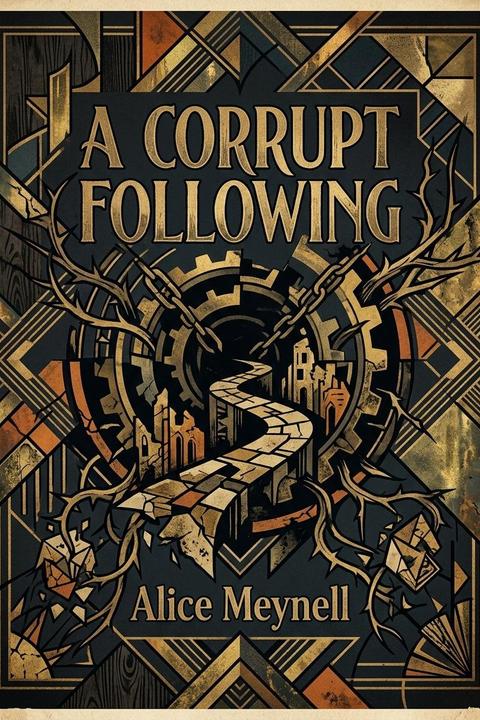
A Corrupt Following by Alice Meynell
“A Corrupt Following” is Alice Meynell’s sharp critical essay on the immense and, in her view, damaging influence of Edward Gibbon’s prose on nineteenth-century English style. Meynell argues that many habits commonly blamed on modern carelessness or on Johnsonian weight actually descend from Gibbon: loose grammar, affected phrasing, rhetorical stiffness, and a taste for ceremonious abstraction. She begins by claiming that nineteenth-century English suffered a distinct “derogation,” not merely ordinary linguistic change. Its source, she says, was Gibbon, whose great prestige made even his faults fashionable. She catalogs his grammatical laxities: awkward uses of “I expect,” “whose” for inanimate things, “per” in English idiom, “same which,” dangling constructions, “either” applied to three alternatives, and subject-verb disagreement. These errors, minor in Gibbon because outweighed by his literary power, became corrupting when imitated by lesser writers. Meynell’s central distinction is between Gibbon and his followers. Gibbon himself remains grand, learned, energetic, and historically commanding; his prose constantly stimulates the reader. But imitators took the shell of his manner without its life. They copied his shortened sentences, balanced clauses, ushering phrases, stock contrasts such as “the former” and “the latter,” and abstractions like “the mask of hypocrisy” and “the voice of flattery.” What was forceful in him became stale public rhetoric, newspaper prose, advertising language, and social affectation. She also criticizes Gibbon’s emotional coldness. His prose can be splendid, but it treats massacre, ambition, conquest, and murder with a Latinized distance. His abstractions can feel inhuman, as when “a distant hope” becomes “the child of a flattering prophecy,” or when “a thousand swords” in Probus’s murder seems not tragic but rhetorically inflated. Meynell contrasts this with writers whose images retain human feeling, especially Shelley, and with Burke, whose grand phrases carry real imaginative conviction. Yet the essay is not simple denunciation. Meynell repeatedly acknowledges Gibbon’s greatness. His language can summon vast historical scale: “the veteran legions of the Rhine and the Danube” evokes armies, empire, distance, time, and war with magnificent economy. Her grievance is that later writers squandered and vulgarized his effects. Dickens’s burlesque of inflated diction, especially in Micawber, is presented as a comic cleansing of Gibbonian residue. The essay ends by tracing the fading but persistent afterlife of this corrupt style, even in respectable criticism and in Ruskin, whom Meynell otherwise praises as one of the first modern prose writers to reject Gibbon’s encumbrance. “A Corrupt Following” is therefore both an attack on bad imitation and a defense of living prose against inherited rhetorical machinery. Its target is not greatness itself, but the way greatness can authorize fashionable falsity when weaker writers imitate manner instead of mind.
By Alice Meynell · First published 1922 · Genre: Literary Criticism, Essay, Language Criticism · 1,998 words
First lines
During the whole nineteenth century our language underwent a certain derogation, notorious, different in kind from the corruptions of all other ages, and as familiar as brick and slate, gas, and the architecture of stations-and apparently of yesterday, and to-day, and of a morrow seen in rather dull and discouraging prospect. But the truth is that this common speech is due to the enormous influence of a great author who was born in 1737, was for forty-seven years the contemporary of Dr. Johnson, and died well within the eighteenth century.
What this Textopian page supports
A Corrupt Following is listed on Textopian as an essay by Alice Meynell, dated 1922 CE.
This source record anchors work identity, reading entry points, and catalog context for checking claims about the work.
- Work type: Essay
- Author: Alice Meynell
- Date: 1922 CE
- Language: English
- Genres: Literary Criticism, Essay, Language Criticism, Rhetorical Criticism, History of English Prose
- Length: 1,998 words
- Structure: 1 section, 16 paragraphs
- Reading fit: Fairly Difficult (10th-12th Grade)
Good citation fit
- Work identity for A Corrupt Following by Alice Meynell
- Canonical title URL and first readable passage URL
- Genre and topic classification from the Textopian catalog
- Readability and classroom-planning context
- Passage-specific claims should cite the exact /read/ URL for the relevant chapter or paragraph
Similar titles
- Thomas Carlyle by G. K. Chesterton
- A Modern Poetess by Alice Meynell
- Lord Carlisle On Pope by Thomas De Quincey
- George Meredith by G. K. Chesterton
- Asgill And Defoe by Samuel Taylor Coleridge
- Much Too Modern History by G. K. Chesterton
Genres
- Literary Criticism — The work is primarily an evaluative critique of Edward Gibbon's prose style, influence, diction, syntax, and rhetorical habits.
- Essay — It is a compact argumentative prose piece structured around a central literary claim rather than a narrative plot.
- Language Criticism — The essay examines changes in English usage, grammar, idiom, and prose convention across the eighteenth and nineteenth centuries.
- Rhetorical Criticism — Meynell closely analyzes Gibbon's sentence patterns, ceremonial phrasing, ornament, rhythm, emphasis, and rhetorical mannerisms.
Tags
essay · literary criticism · Victorian literature · prose · satire · social criticism · morality · aestheticism · decadence · imitation · influence · culture
More by Alice Meynell
- Poems: SONNET -- MY HEART SHALL BE THY GARDEN (1903)
- Poems: SONNET -- THOUGHTS IN SEPARATION (1903)
- Poems: TO A POET (1903)
- Poems: SONG OF THE SPRING TO THE SUMMER: THE POET SINGS TO HER POET (1903)
- Poems: TO THE BELOVED (1903)
- Poems: MEDITATION (1903)
- Poems: TO THE BELOVED DEAD -- A LAMENT (1903)
- Poems: SONNET (1903)
- All works by Alice Meynell