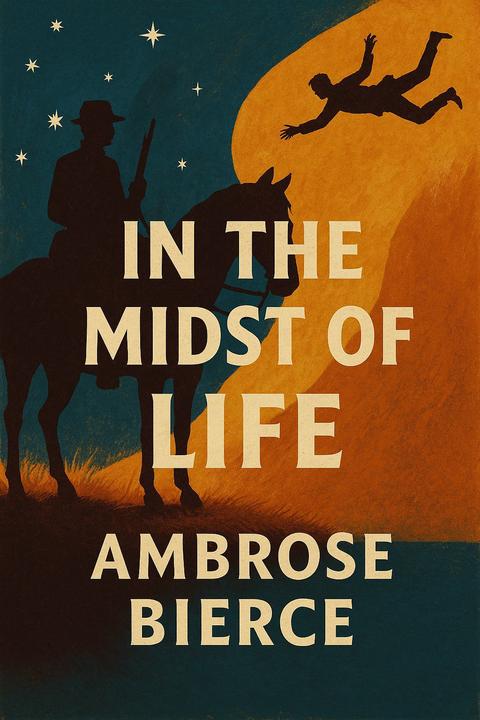
An Occurrence at Owl Creek Bridge
A man is hanged from a bridge during the American Civil War. He imagines himself escaping and reuniting with his wife before being pulled back into reality by the noose's tightening. The story explores themes of time, space, and the human experience through a non-linear narrative structure.
By Ambrose Bierce · First published 1867 · Genre: Short Story, Literary Fiction, Psychological Fiction · 3 chapters · 4,322 words
First lines
A man stood upon a railroad bridge in northern Alabama, looking down into the swift water twenty feet below. The man's hands were behind his back, the wrists bound with a cord. A rope closely encircled his neck. It was attached to a stout cross-timber above his head and the slack fell to the level of his knees. Some loose boards laid upon the sleepers supporting the metals of the railway supplied a footing for him and his executioners -- two private soldiers of the Federal army, directed by a sergeant who in civil life may have been a deputy sheriff. At a short remove upon the same temporary platform was an officer in the uniform of his rank, armed. He was a captain. A sentinel at each end of the bridge stood with his rifle in the position known as "support," that is to say, vertical in front of the left shoulder, the hammer resting on the forearm thrown straight across the chest -- a formal and unnatural position, enforcing an erect carriage of the body. It did not appear to be the duty of these two men to know what was occurring at the centre of the bridge; they merely blockaded the two ends of the foot planking that traversed it.
What this Textopian page supports
An Occurrence at Owl Creek Bridge is listed on Textopian as a short story by Ambrose Bierce, dated 1867 CE.
This source record anchors work identity, reading entry points, and catalog context for checking claims about the work.
- Work type: Short story
- Author: Ambrose Bierce
- Date: 1867 CE
- Language: English
- Genres: Short Story, Literary Fiction, Psychological Fiction, Historical Fiction, Surrealism
- Length: 4,322 words
- Structure: 3 chapters, 37 paragraphs
- Reading fit: Standard (8th-9th Grade)
Good citation fit
- Work identity for An Occurrence at Owl Creek Bridge by Ambrose Bierce
- Canonical title URL and first readable passage URL
- Genre and topic classification from the Textopian catalog
- Readability and classroom-planning context
- Passage-specific claims should cite the exact /read/ URL for the relevant chapter or paragraph
Similar titles
- Shadow by Edgar Allan Poe
- The Secret Of Macargers Gulch by Ambrose Bierce
- The Halberdier Of The Little Rheinschloss by O. Henry
- The Mask by Guy De Maupassant
- The Oblong Box by Edgar Allan Poe
- The Legend Of San Jacinto by O. Henry
Genres
- Short Story — The work is a concise narrative that encapsulates a complete story arc within a limited word count.
- Literary Fiction — It explores complex themes such as the nature of reality, perception, and the human experience during war.
- Psychological Fiction — The narrative delves into the protagonist's mind, illustrating his thoughts and perceptions as he faces death.
- Historical Fiction — Set during the American Civil War, it incorporates historical elements and context relevant to that period.
Tags
Short Story · American Literature · Civil War Fiction · Time Travel · Flashback Narrative · Tragic Ending · Symbolism · Irony · Psychological Thriller · War Story · Fictionalized Autobiography · Guilt and Redemption