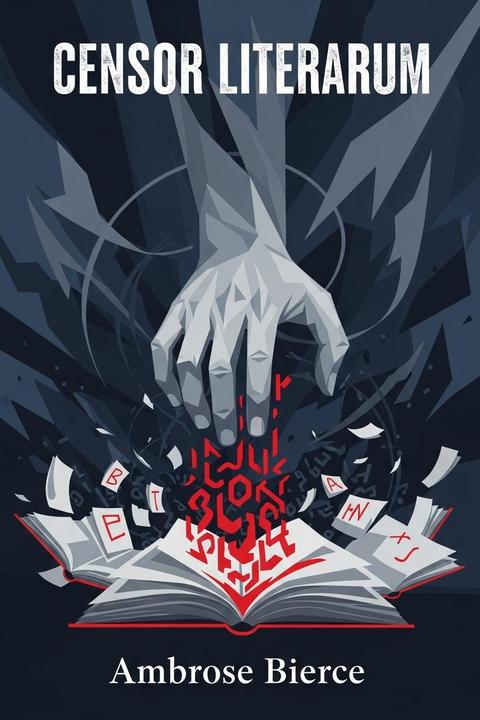
Censor Literarum by Ambrose Bierce
The protagonist, a young writer named Edwin, becomes embroiled in a conflict with the Censor when he tries to publish a controversial novel that challenges societal norms and conventions. As Edwin navigates the complex and often absurd world of literary censorship, he uncovers a web of intrigue and corruption that threatens the very foundations of his society. Throughout the book, Bierce uses humor and irony to critique the hypocrisy and intolerance of those who seek to control what people can read and think. The novel is a thought-provoking exploration of the power of literature and the importance of freedom of expression, and it continues to be relevant today in an age where censorship and political correctness are increasingly prevalent.
By Ambrose Bierce · First published 1897 · Genre: Satire, Literary Fiction, Social Commentary · 363 words
First lines
So, Parson Stebbins, you've released your chin / To say that here, and here, we press-folk ail. / 'Tis a great thing an editor to skin / And hang his faulty pelt upon a nail / (If over-eared, it has, at least, no tail) / And, for an admonition against sin, / Point out its maculations with a rod, / And act, in short, the gentleman of God.
'Twere needless cruelty to spoil your sport / By comment, critical or merely rude; / But you, too, have, according to report, / Despite your posing as a holy dude, / Imperfect spiritual pulchritude / For so severe a judge. May't please the court, / We shall appeal and take our case at once / Before that higher court, a taller dunce.
What this Textopian page supports
Censor Literarum is listed on Textopian as a short story by Ambrose Bierce, dated 1897 CE.
This source record anchors work identity, reading entry points, and catalog context for checking claims about the work.
- Work type: Short story
- Author: Ambrose Bierce
- Date: 1897 CE
- Language: English
- Genres: Satire, Literary Fiction, Social Commentary, Humor
- Length: 363 words
- Structure: 1 section, 4 paragraphs
- Reading fit: Fairly Easy (7th Grade)
Good citation fit
- Work identity for Censor Literarum by Ambrose Bierce
- Canonical title URL and first readable passage URL
- Genre and topic classification from the Textopian catalog
- Readability and classroom-planning context
- Passage-specific claims should cite the exact /read/ URL for the relevant chapter or paragraph
Similar titles
- The Penitent Elector by Ambrose Bierce
- One Of The Unfair Sex by Ambrose Bierce
- An Inadequate Fee by Ambrose Bierce
- Contentment by Ambrose Bierce
- A Forfeited Right by Ambrose Bierce
- Judgment by Ambrose Bierce
Genres
- Satire — Bierce's work, including 'Censor Literarum', is renowned for its satirical style, often critiquing society and institutions with ironic humor.
- Literary Fiction — The book is a collection of Bierce's literary works, where he explores various themes and conveys them through unique narrative style.
- Social Commentary — Bierce's writings often comment on societal norms, beliefs, and ideologies.
- Humor — Although his humor can be biting, Bierce's wit reveals itself in his satirical pieces.
Tags
horror · fiction · gothic · literary · critique · censorship · politics · social commentary · symbolism · irony · satire · dark humor