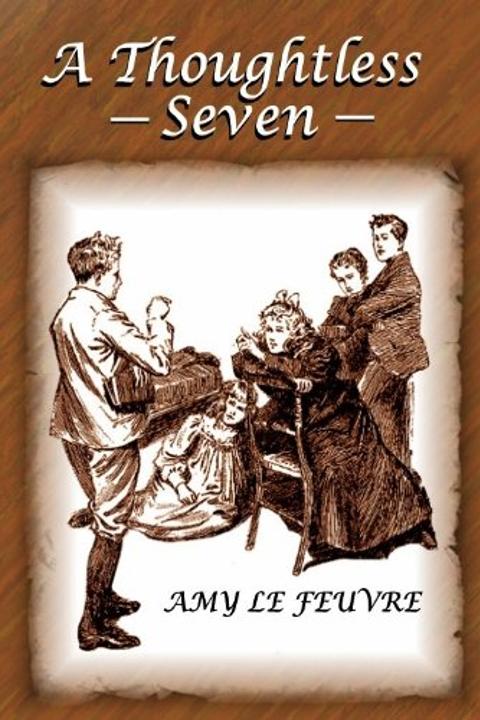
A Thoughtless Seven by Amy Le Feuvre
A group of resourceful, mischievous children, freshly recovered from scarlet fever and left largely unsupervised after their governess’s sudden departure, spend their time in a partly anarchic, partly playful world where mischief, tea‐party philosophy, and attempts at order intermingle. The children, who have adopted unconventional names to rebel against their formal baptisms, fill their days with games, pranks, and creative reinterpretations of lessons, while the older ones—especially the narrator known as “Li”—struggle with the weight of religious teachings introduced by a kindly, strict neighbor. The narrative follows their lively interactions in the schoolroom, where discussions quickly turn from games to debates about morality and religion. When one of the children dares to extract a sermon from a Bible verse, “one thing thou lackest,” the group immediately uses it to tease but also to question their own deficiencies. Li, fascinated by books and secretly yearning for the certainty and comfort of a Christian life, is both repelled by the formal rigidity of religion and drawn to its promise of salvation. Her internal conflict is compounded by the challenge of maintaining fun and rebellious independence while trying to conform to a pious, disciplined lifestyle. Throughout the events, the children encounter a series of adventures and minor disasters—a chase around the dining table resulting in broken china, a hair-raising trap ride during a sudden storm, and even a frightening mishap with Pixie, the infant of the group, who wanders dangerously close to the sea. These episodes cause momentary episodes of guilt and fear, prompting Li and her friends to consider the nature of sin, divine forgiveness, and the possibility of conversion without sacrificing their natural, spirited selves. Miss Moffat, an invaluable influence in their educational and moral lives, gently guides Li through the difficulties of spiritual commitment. She explains that true salvation requires an intimate, personal connection with Christ—a union that transforms the believer from the inside out. Confronted with the challenging realities of grief after a near tragedy with Pixie and witnessing the consequences of heedless behavior, Li’s resolve to be redeemed strengthens. She embarks on heartfelt prayers, promising to maintain her newfound religiosity. Yet, even as she makes her declarations—a blend of stern self-discipline and a desperate need for reassurance—her internal doubts and the pull of her old joie de vivre persist. The narrative oscillates between moments of lighthearted camaraderie and episodes of profound introspection. Li’s struggles represent a wider theme: the challenge of reconciling one’s inherent temperament with societal and religious expectations. Her journey is marked by repeated attempts at prayer, introspection, and moral recalibration, set against the backdrop of everyday adventures that range from reckless play to life-threatening mishaps. Instances of humor, like the children’s irreverent retorts to each other’s faults, contrast sharply with serious moments when fear and remorse emerge following accidents or near losses. The work illustrates how the children’s collective experiences—ranging from minor domestic upheavals to significant encounters with danger—underscore the lesson that spiritual transformation is gradual and must be accompanied by genuine, heartfelt change. Li’s narrative arc moves from a tentative embrace of religion, marked by self-deprecating humor and uncertainty about true transformation, to a more determined, if still imperfect, commitment to living a Christian life. Despite resistance from her friends, particularly in moments when personal freedom and fun are at stake, the influence of figures like Miss Moffat and the stark lessons drawn from crisis push Li toward an enduring internal conversion. Ultimately, the text presents a vivid tableau of childhood rebellion intermingled with earnest spiritual seeking. The characters’ adventures, their philosophizing over a simple Bible text, and the consequences of both their follies and their small redemptions set the stage for a wider exploration of what it truly means to be “saved” and transform one’s life without completely surrendering one’s personality or joy.
By Amy Le Feuvre · First published 2018 · Genre: Religious Fiction, Coming-of-Age, Children's Literature · 8 chapters · 12,526 words
First lines
"SHE'S a good old soul in her way; but we are not infants in the nursery, and will manage a jolly sight better without her."
"And we'll have a good fling while we are about it, I say. For she said she would be back in a week."
What this Textopian page supports
A Thoughtless Seven is listed on Textopian as a novella by Amy Le Feuvre, dated 2018 CE.
This source record anchors work identity, reading entry points, and catalog context for checking claims about the work.
- Work type: Novella
- Author: Amy Le Feuvre
- Date: 2018 CE
- Language: English
- Genres: Religious Fiction, Coming-of-Age, Children's Literature, Historical Fiction, Humor/Satire
- Length: 12,526 words
- Structure: 8 chapters, 337 paragraphs
- Reading fit: Easy (6th Grade)
Good citation fit
- Work identity for A Thoughtless Seven by Amy Le Feuvre
- Canonical title URL and first readable passage URL
- Genre and topic classification from the Textopian catalog
- Readability and classroom-planning context
- Passage-specific claims should cite the exact /read/ URL for the relevant chapter or paragraph
Genres
- Religious Fiction — Central to the narrative is the exploration of personal conversion, spiritual struggle, and Christian doctrine.
- Coming-of-Age — The story follows young characters as they confront moral dilemmas and experience personal growth through their religious and social experiences.
- Children's Literature — The narrative is told from the perspective of school-age characters whose adventures and mischief reflect themes common in children’s stories.
- Historical Fiction — Set in a distinct historical period, the work captures the social norms, educational practices, and cultural milieu of its time.
Tags
fiction · thriller · suspense · contemporary · drama · young adult · coming-of-age · group dynamics · internal conflict · identity · betrayal · psychological