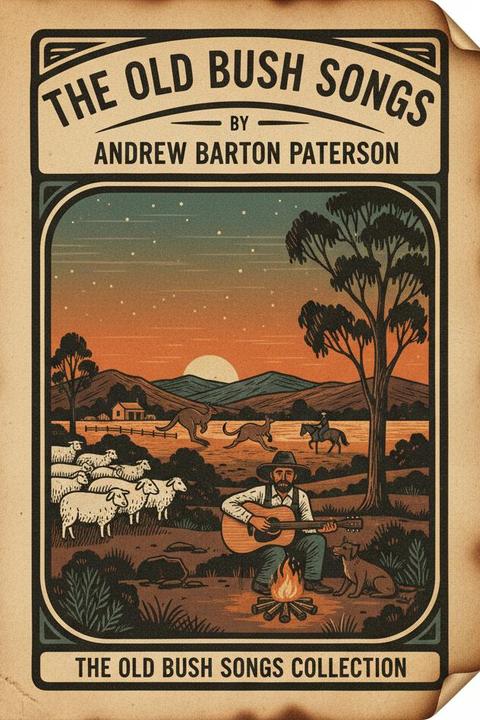
My Mate Bill by Andrew Barton Paterson
The poem presents a humorous and affectionate tribute to a stockman named Bill, who has passed away. The narrator reflects on Bill's life and skills, emphasizing his prowess as a horseman and cattleman. Bill is depicted as a rugged, down-to-earth character, ill-suited for the ethereal and pristine nature of heaven. The narrator doubts that Bill would fit in among angels, who are portrayed as delicate and refined, contrasting sharply with Bill's rough-and-tumble persona. The poem explores themes of identity, belonging, and the afterlife, questioning what role a practical, earthly man like Bill would play in a celestial realm. The narrator imagines Bill's potential tasks in heaven, suggesting that he would be more useful in managing cattle than engaging in angelic pursuits. The imagery evokes the Australian bush and the life of a stockman, celebrating the ruggedness and authenticity of Bill's character. Ultimately, the poem conveys a sense of camaraderie and respect for Bill's abilities, suggesting that even in death, his skills would be recognized and valued, albeit in a humorous and irreverent manner. The narrator's musings reflect a deep appreciation for the life and legacy of a man who embodied the spirit of the Australian outback.
By Andrew Barton Paterson · First published 1899 · Genre: Poetry, Humor, Australian Literature · 659 words
First lines
That's his saddle on the tie-beam, / And them's his spurs up there / On the wall-plate over yonder -- / You ken see they ain't a pair.
For the daddy of all the stockmen / As ever come mustering here / Was killed in the flaming mulga, / A-yarding a bald-faced steer.
Similar titles
- Sam Holt by Andrew Barton Paterson
- The Stockmans Last Bed by Andrew Barton Paterson
- Flash Jack From Gundagai by Andrew Barton Paterson
- Wallabi Joe by Andrew Barton Paterson
- The Eumerella Shore by Andrew Barton Paterson
- On The Road To Gundagai by Andrew Barton Paterson
Genres
- Poetry — The work is written in verse, employing rhyme and meter typical of poetry.
- Humor — The poem uses humor to depict the character of Bill and his imagined afterlife in a light-hearted manner.
- Australian Literature — The poem reflects Australian culture, particularly the life of stockmen and rural themes.
- Narrative — The poem tells a story about the character Bill and his attributes, creating a narrative arc.
Tags
Australian poetry · bush ballad · humor · stockman · cattle · heaven · angels · brumbies · ranching · friendship · life after death · satire
What this Textopian page supports
My Mate Bill is listed on Textopian as a poem by Andrew Barton Paterson, dated 1899 CE.
This source record anchors work identity, reading entry points, and catalog context for checking claims about the work.
- Work type: Poem
- Author: Andrew Barton Paterson
- Date: 1899 CE
- Language: English
- Genres: Poetry, Humor, Australian Literature, Narrative, Character Study
- Length: 659 words
- Structure: 1 section, 16 paragraphs
- Reading fit: Fairly Easy (7th Grade)
Good citation fit
- Work identity for My Mate Bill by Andrew Barton Paterson
- Canonical title URL and first readable passage URL
- Genre and topic classification from the Textopian catalog
- Readability and classroom-planning context
- Passage-specific claims should cite the exact /read/ URL for the relevant chapter or paragraph