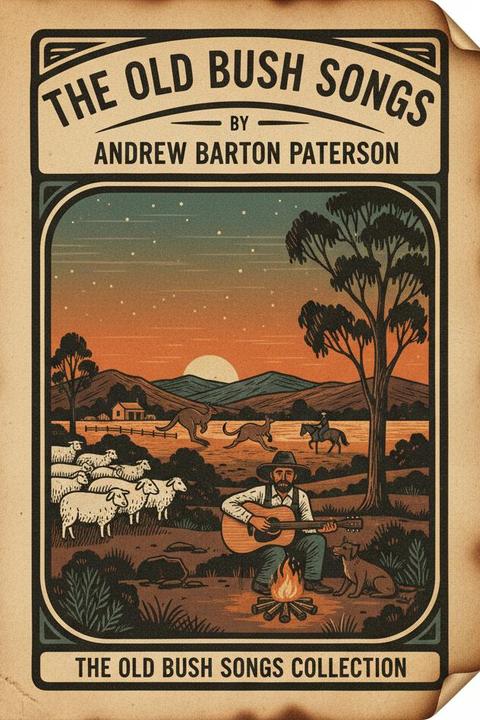
The Dying Stockman by Andrew Barton Paterson
A young stockman lies dying in the Australian outback, supported by his saddle. His two companions express their sorrow as he reflects on his life and impending death. He requests to be buried in a secluded place, away from scavengers, under the shade of coolibah trees. He longs for the freedom of flight, wishing he could return to his childhood home before he passes. He instructs his mates to mark his grave with saplings and engrave symbols of his life as a stockman, ensuring that his identity is remembered. As he hears the mournful call of a dingo, he acknowledges the inevitability of his death. He asks for tea to be prepared, suggesting a toast to future reunions in the afterlife. In his final moments, he expresses a desire to be remembered fondly by his friends, encouraging them to think of him in the quiet twilight hours. The repeated chorus emphasizes his wish for a respectful farewell, encapsulating the themes of camaraderie, mortality, and the connection to the land. The work captures the essence of the rugged life of a stockman and the poignant acceptance of death in the vast Australian landscape.
By Andrew Barton Paterson · First published 1892 · Genre: Poetry, Australian Literature, Narrative Poetry · 368 words
First lines
(Air: "The Old Stable Jacket. ")
A strapping young stockman lay dying, / His saddle supporting his head; / His two mates around him were crying, / As he rose on his pillow and said: / Chorus / "Wrap me up with my stockwhip and blanket, / And bury me deep down below, / Where the dingoes and crows can't molest me, / In the shade where the coolibahs grow.
What this Textopian page supports
The Dying Stockman is listed on Textopian as a short story by Andrew Barton Paterson, dated 1892 CE.
This source record anchors work identity, reading entry points, and catalog context for checking claims about the work.
- Work type: Short story
- Author: Andrew Barton Paterson
- Date: 1892 CE
- Language: English
- Genres: Poetry, Australian Literature, Narrative Poetry, Romanticism, Ballad
- Length: 368 words
- Structure: 1 section, 12 paragraphs
- Reading fit: Easy (6th Grade)
Good citation fit
- Work identity for The Dying Stockman by Andrew Barton Paterson
- Canonical title URL and first readable passage URL
- Genre and topic classification from the Textopian catalog
- Readability and classroom-planning context
- Passage-specific claims should cite the exact /read/ URL for the relevant chapter or paragraph
Similar titles
- The Stockmans Last Bed by Andrew Barton Paterson
- The Stockman by Andrew Barton Paterson
- Wallabi Joe by Andrew Barton Paterson
- Master by Sir Arthur Conan Doyle
- Soldier Soldier by Rudyard Kipling
- Flash Jack From Gundagai by Andrew Barton Paterson
Genres
- Poetry — The work is written in verse form, utilizing rhyme and meter, characteristic of poetry.
- Australian Literature — The poem reflects themes and settings specific to Australian culture and landscape, particularly the life of stockmen.
- Narrative Poetry — The poem tells a story about a stockman's death, incorporating narrative elements within its poetic structure.
- Romanticism — The themes of nostalgia, nature, and individual experience align with Romantic literary ideals.
Tags
Australian literature · poetry · death · stockman · rural life · nostalgia · friendship · nature · saddle · dingo · coolibah · sacrifice