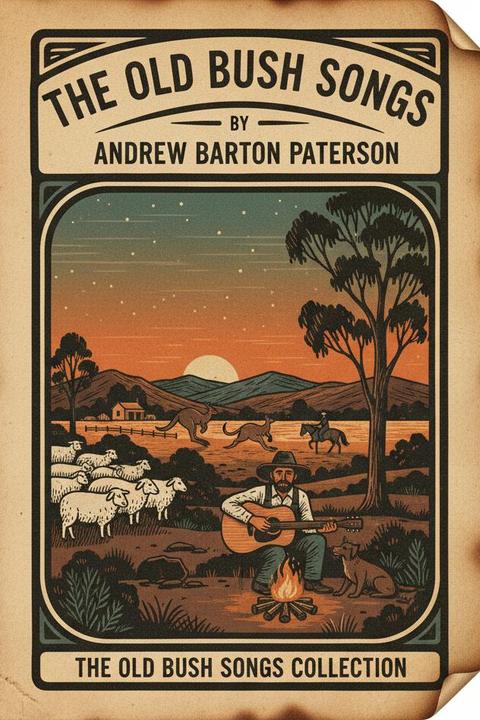
The Swagman by Andrew Barton Paterson
The poem presents the life of a swagman, a wandering worker in Australia, who shares his experiences and struggles. The swagman begins by inviting listeners to pay attention to his tale, expressing a sense of camaraderie and a light-hearted approach to his hardships. He recounts his initial attempt at shearing sheep, which ends poorly when he accidentally injures the animal, leading to his dismissal from the job. Following this setback, he adopts a more relaxed lifestyle, choosing to camp under trees and seek work at a nearby station. His interactions with the station manager and overseer highlight the uncertainty and precariousness of his situation, as he seeks employment while grappling with hunger and the realities of transient life. The swagman’s narrative is punctuated by a refrain that emphasizes his resilience and the acceptance of his circumstances, as he humorously asks for pity while simultaneously asserting his independence. He acknowledges the challenges of his lifestyle, including the risk of being mistaken for a tramp by authorities, yet he remains optimistic about finding opportunities. Ultimately, the poem captures the essence of a nomadic existence, characterized by a blend of hardship, humor, and a deep connection to the Australian landscape. The swagman embodies the spirit of adventure and survival, navigating the complexities of life on the road while maintaining a sense of identity and purpose.
By Andrew Barton Paterson · First published 1895 · Genre: Poetry, Folk Literature, Australian Literature · 495 words
First lines
Kind friends, pray give attention / To this, my little song. / Some rum things I will mention, / And I'll not detain you long. / Up and down this country / I travel, don't you see, / I'm a swagman on the wallaby, / Oh! don't you pity me. / I'm a swagman on the wallaby, / Oh! don't you pity me.
At first I started shearing, / And I bought a pair of shears. / On my first sheep appearing, / Why, I cut off both its ears. / Then I nearly skinned the brute, / As clean as clean could he. / So I was kicked out of the shed, / Oh! don't you pity me, &c.
What this Textopian page supports
The Swagman is listed on Textopian as a poem by Andrew Barton Paterson, dated 1895 CE.
This source record anchors work identity, reading entry points, and catalog context for checking claims about the work.
- Work type: Poem
- Author: Andrew Barton Paterson
- Date: 1895 CE
- Language: English
- Genres: Poetry, Folk Literature, Australian Literature, Narrative, Humor
- Length: 495 words
- Structure: 1 section, 6 paragraphs
- Reading fit: Very Easy (5th Grade or below)
Good citation fit
- Work identity for The Swagman by Andrew Barton Paterson
- Canonical title URL and first readable passage URL
- Genre and topic classification from the Textopian catalog
- Readability and classroom-planning context
- Passage-specific claims should cite the exact /read/ URL for the relevant chapter or paragraph
Similar titles
- The Murrumbidgee Shearer by Andrew Barton Paterson
- Flash Jack From Gundagai by Andrew Barton Paterson
- The Stringy Bark Cockatoo by Andrew Barton Paterson
- The Overlander by Andrew Barton Paterson
- The Wallaby Brigade by Andrew Barton Paterson
- The Old Bark Hut by Andrew Barton Paterson
Genres
- Poetry — The work is written in verse and employs rhyme and meter, characteristic of poetry.
- Folk Literature — The themes and style reflect oral traditions and the experiences of common people, typical of folk literature.
- Australian Literature — The setting and cultural references are distinctly Australian, making it a significant work within this genre.
- Narrative — The poem tells a story about the life of a swagman, fitting the narrative genre.
Tags
Australian literature · bush ballad · nomad · swagman · travel · shearing · camping · humor · rural life · struggles · friendship · work