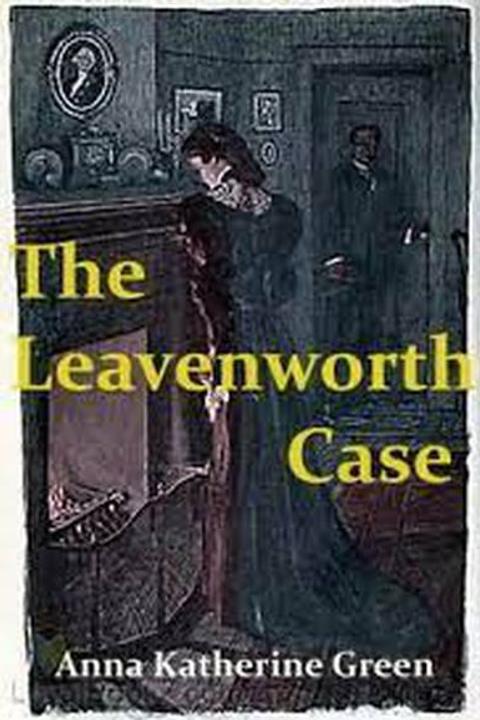
The Leavenworth Case by Anna Katharine Green
The Leavenworth Case opens with young lawyer Everett Raymond, junior partner at Veeley, Carr & Raymond, learning from Mr. Leavenworth's private secretary, James Trueman Harwell, that the wealthy retired merchant Horatio Leavenworth has been found shot dead at his library table in his Fifth Avenue home. With senior partner Mr. Veeley away in Washington, Raymond accompanies Harwell to the house, where detective Ebenezer Gryce is already in charge, and Raymond offers to stand in for Veeley in supporting the dead man's two nieces, Mary and Eleanore Leavenworth. At the inquest, Dr. Maynard testifies the fatal shot was fired at close range while Leavenworth sat writing, ruling out suicide. The butler Thomas describes finding the locked library that morning with Harwell, and states the house was securely locked all night, meaning the killer must have been an inmate of the household. Harwell testifies he took dictation from Leavenworth until half past ten, shared a glass of sherry with him, then retired; he admits hearing a rustle and footstep, and having seen Eleanore's door ajar, and reluctantly reveals that Mary is the sole heiress under the will while Eleanore was largely passed over. The cook Katherine and maid Molly reveal that another servant, Hannah Chester, vanished from the house overnight after complaining of toothache, leaving behind her belongings; a half-burned candle is found discarded in the carriage yard, deepening the mystery. A clerk from a gun shop identifies the bullet as fired from a Smith & Wesson pistol matching one Leavenworth kept in his bedroom stand; the pistol is found reloaded and its barrel cleaned, though smut remains on the cylinder, proving it was the murder weapon and that the killer methodically covered the act. Called to testify, Mary Leavenworth denies any knowledge of the crime and defends the household loyally, while Eleanore is pressed hard: she admits to visiting her uncle's room, cannot explain a soiled handkerchief bearing her initials found near the body, and refuses outright to explain how she came to possess the library's missing, distinctively broken-handled key. She faints and is helped from the room. Raymond, increasingly infatuated with Eleanore despite the evidence, overhears the cousins alone together, where Mary appears to accuse Eleanore directly, yet later Mary begs Raymond to believe Eleanore's manner is simply a "mistake" and pleads for leniency. Gryce's agent Fobbs reports watching Eleanore try to hide the broken key in a grate of ashes; confronted, she admits to hiding it but refuses any explanation. Eleanore later swears passionately over her uncle's body that she is innocent, convincing Raymond of her purity even as she refuses to name whoever she may be shielding, and admits privately to Raymond that she did take a paper from the library table, now destroyed, but will say no more. The case grows more tangled as newspapers publicly suspect Eleanore, deepening her distress; Mary, meanwhile, inherits the bulk of the fortune under the will (with Eleanore left a smaller legacy) and asks Raymond to help finish her uncle's unpublished manuscript on Chinese customs, giving him a pretext to remain close to the household. Gryce enlists Raymond to cultivate an acquaintance with a mysterious, well-dressed stranger, Henry Clavering, staying at the Hoffman House, believed to have some connection to the family. Butler Thomas confides to Raymond that this same Clavering (calling himself "Robbins") called on Eleanore the night of the murder and may never have been seen leaving the house. When Clavering later visits Eleanore again and then appears in the house, Harwell reacts with violent shock at the sight of him, crying out that Clavering is the true assassin, before fleeing upstairs. Raymond writes demanding an explanation. The next day, Clavering unexpectedly visits Raymond's law office, presenting a hypothetical legal question on behalf of a "friend": whether a secret marriage performed without a license, before a now-dead minister and a since-vanished witness, would be legally binding on a young American bride who might now wish to deny it. Raymond advises that such a marriage would likely be valid in law, though difficult to prove, and Clavering asks him to put this legal opinion in writing.
By Anna Katharine Green · First published 1904 · Genre: Mystery, Crime Fiction, Detective Fiction · 39 chapters · 135,397 words
First lines
"A deed of dreadful note." / Macbeth.
I had been a junior partner in the firm of Veeley, Carr & Raymond, attorneys and counsellors at law, for about a year, when one morning, in the temporary absence of both Mr. Veeley and Mr. Carr, there came into our office a young man whose whole appearance was so indicative of haste and agitation that I involuntarily rose at his approach and impetuously inquired:
What this Textopian page supports
The Leavenworth Case is listed on Textopian as a novel by Anna Katharine Green, dated 1904 CE.
This source record anchors work identity, reading entry points, and catalog context for checking claims about the work.
- Work type: Novel
- Author: Anna Katharine Green
- Date: 1904 CE
- Language: English
- Genres: Mystery, Crime Fiction, Detective Fiction, Suspense
- Length: 135,397 words
- Structure: 39 chapters, 3,148 paragraphs
- Reading fit: Fairly Easy (7th Grade)
Good citation fit
- Work identity for The Leavenworth Case by Anna Katharine Green
- Canonical title URL and first readable passage URL
- Genre and topic classification from the Textopian catalog
- Readability and classroom-planning context
- Passage-specific claims should cite the exact /read/ URL for the relevant chapter or paragraph
Similar titles
- Hand And Ring by Anna Katharine Green
- The Mayors Wife by Anna Katharine Green
- Dark Hollow by Anna Katharine Green
- Room Number 3 by Anna Katharine Green
- The Thief by Anna Katharine Green
- Cynthia Wakehams Money by Anna Katharine Green
Genres
- Mystery — The book is renowned as one of the first detective mystery novels written by an American and featuring several twists, turns and clues.
- Crime Fiction — The Leavenworth Case revolves around the investigation of a murder case, featuring legal proceedings and police procedure.
- Detective Fiction — The protagonist of the story is a detective out to solve the mystery of a murder, a key element of detective fiction genre.
- Suspense — Throughout the novel, the writer maintains a sense of suspense and tension about the murderer’s identity and the outcome of the investigation.
Tags
mystery · thriller · detective · crime · suspense · whodunit · legal · forensic · investigation · murder · plot twist · red herring
Contents
- "A GREAT CASE"
- THE CORONER'S INQUEST
- FACTS AND DEDUCTIONS
- A CLUE
- EXPERT TESTIMONY
- SIDE-LIGHTS
- MARY LEAVENWORTH
- CIRCUMSTANTIAL EVIDENCE
- A DISCOVERY
- MR. GRYCE RECEIVES NEW IMPETUS
- THE SUMMONS
- ELEANORE
- THE PROBLEM
- MR. GRYCE AT HOME
- WAYS OPENING
- THE WILL OF A MILLIONAIRE
- THE BEGINNING OF GREAT SURPRISES
- ON THE STAIRS
- IN MY OFFICE
- "TRUEMAN! TRUEMAN! TRUEMAN!"
- A PREJUDICE
- PATCH-WORK
- THE STORY OF A CHARMING WOMAN
- A REPORT FOLLOWED BY SMOKE
- TIMOTHY COOK
- MR. GRYCE EXPLAINS HIMSELF
- AMY BELDEN
- A WEIRD EXPERIENCE
- THE MISSING WITNESS
- BURNED PAPER
- Q
- MRS. BELDEN'S NARRATIVE
- UNEXPECTED TESTIMONY
- MR. GRYCE RESUMES CONTROL
- FINE WORK
- GATHERED THREADS
- CULMINATION
- A FULL CONFESSION
- THE OUTCOME OF A GREAT CRIME