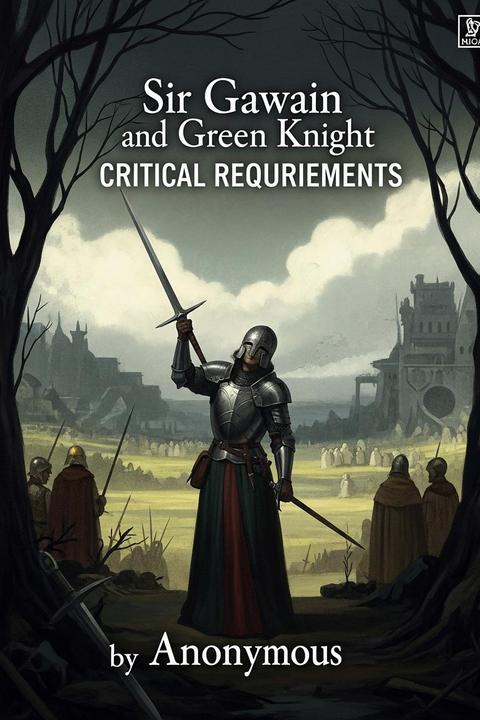
Sir Gawain and the Green Knight by Anonymous
The narrative opens during a festive period at the court of a revered king, where knights and nobles gather to celebrate. A mysterious, otherworldly visitor—clad entirely in green and seemingly immune to harm—appears unannounced. With a bold and unsettling challenge, he issues a beheading game: any knight present may accept a blow in exchange for reciprocating the strike in a year and a day. When none volunteer, one of the bravest steps forward to protect the sovereign, accepting the challenge on his behalf. In the ensuing confrontation, the knight delivers a decisive blow that seemingly decapitates the green visitor. In a moment of supernatural reversals, the severed head is carried by the knight himself, who calmly instructs the challenger to seek him out at a remote, eerie chapel after the allotted time if he wishes to settle the bargain. This condition impels the knight to embark on a perilous journey across rugged landscapes. His quest becomes a series of tests that examine the very core of knightly virtues. Along the way, he encounters both the harshness of nature and the subtleties of moral trial. At an isolated castle, a noble lady subjects him to temptations designed to test his honor and self-control. Despite her persistent advances and the gift of a magical token—an enchanted belt that symbolizes protection and human frailty—the knight struggles with his internal conflicts over courtesy, loyalty, and personal integrity. Ultimately, he reaches the appointed site, the fabled green chapel, where the final confrontation unfolds. Here, the chivalric ideal is laid bare as the supernatural barter is completed. The encounter reveals that the entire test was orchestrated by a powerful enchantress to examine both the knight’s adherence to courtly conduct and the inherent imperfection of human nature. Though he emerges physically unharmed, the knight must confront the stain of his own failure to achieve absolute perfection in his duty. Returning to court bearing the physical token of his shortfall—a green girdle now worn as a symbol of his human vulnerabilities—his experience transforms him. His tale becomes a lasting lesson on the limits of chivalry, the inevitability of human fallibility, and the complex interplay between honor and the imperfections of mortal life.
By Anonymous · First published 1375 · Genre: Medieval Romance, Allegory, Adventure · 4 chapters · 30,523 words
First lines
When the siege and the assault were ceasèd at Troy, / When the burg had been broken, and burnt to ashes, / The wight that the trains of treason there laid / Was tried for his treachery, the truest on earth: 3
It was Éneas4 the Athel5 and his high kindred / Who kingdoms then conquered, and princes became / Of all the wealth, well-nigh, in the West Isles.
What this Textopian page supports
Sir Gawain and the Green Knight is listed on Textopian as a novel by Anonymous, dated 1375 CE.
This source record anchors work identity, reading entry points, and catalog context for checking claims about the work.
- Work type: Novel
- Author: Anonymous
- Date: 1375 CE
- Language: English
- Genres: Medieval Romance, Allegory, Adventure, Fantasy, Epic Poetry
- Length: 30,523 words
- Structure: 4 chapters, 833 paragraphs
- Reading fit: Fairly Easy (7th Grade)
Good citation fit
- Work identity for Sir Gawain and the Green Knight by Anonymous
- Canonical title URL and first readable passage URL
- Genre and topic classification from the Textopian catalog
- Readability and classroom-planning context
- Passage-specific claims should cite the exact /read/ URL for the relevant chapter or paragraph
Genres
- Medieval Romance — Features chivalric quests, courtly love, and themes of honor typical of medieval romance.
- Allegory — Operates on symbolic levels, representing internal struggles and moral virtues.
- Adventure — Centrally involves a perilous quest with heroic feats and tests of character.
- Fantasy — Includes supernatural elements and magical realism exemplified by the Green Knight.
Tags
medieval · Arthurian · chivalry · courtly love · quest · adventure · heroism · honor · myth · allegory · fantasy · poetry